











 Secure payments
Standard refund policy
Trade Assurance
Secure payments
Standard refund policy
Trade Assurance
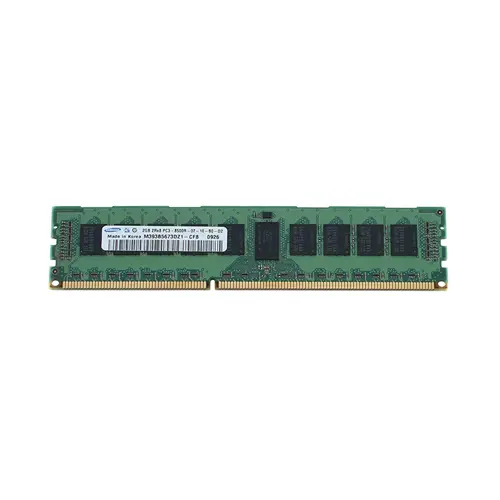
| Model | M393B5673DZ1-CF8 |
|---|---|
| Product Type | Memory Module |
| Compliance Standards | EU RoHS,FCC |
| Memory Capacity | 2 GB |
| Memory Technology | DDR3 |
| Product Voltage | 1.5V |
| RAM Speed | 1066MHz |
| RAM Standard | DDR3-1066/PC3-8500 |
| Error Identifying | ECC |
| Signal Type | Registered |
| Column Access Strobe (CAS) | CL7 |
| Rank | Dual Rank x8 |
| Quantity of Pins | 240-pin |
| RAM Genre | RDIMM |
This legacy DDR3-1066 ECC Registered RDIMM is purpose-built for aging server platforms hosting virtualization clusters or memory-resident databases, where continuous data integrity is non-negotiable. The registered command/address buffer stabilizes signal loading under fully populated DIMM slots, while the dual-rank x8 configuration enables rank interleaving for improved throughput and ECC ensures single-bit error correction in 24/7 enterprise workloads.
1. ECC protection silently corrects single-bit memory errors, preventing silent data corruption and unplanned downtime in mission-critical server workloads.
2. Registered buffering strengthens signal integrity across high-density memory channels, enabling stable operation with larger DIMM counts essential for maximizing virtualization host capacity.
3. Dual Rank x8 organization interleaves memory bank accesses, boosting effective bandwidth to sustain smooth virtual machine responsiveness under heavy consolidation.
4. A modest 2 GB capacity targets cost-efficient, single-purpose appliances or lightweight legacy servers where rock-solid reliability outweighs raw density.
5. The conservative 1066 MHz clock speed balances throughput with low thermal stress, reinforcing long-term stability in always-on enterprise platforms.
In your data center, the M393B5673DZ1-CF8 is far more than a simple DDR3-1066 RDIMM. Built as a registered, ECC-protected module with dual-rank x8 organization, it directly addresses the unseen threats that erode server reliability. When you are running a dense virtualization cluster, a single bit flip caused by background radiation can silently corrupt a guest operating system or hypervisor state—a failure that ECC corrects in real time before it cascades into unexpected downtime. The registered interface buffers command and address signals, stabilizing the heavy electrical loads generated when multiple DIMMs populate a single channel; this ensures your hypervisor host remains stable even at maximum memory capacity. In memory-hungry databases like Redis or SAP HANA, the dual-rank architecture maximizes bank-level parallelism, sustaining higher IOPS under concurrent access patterns rather than stalling the pipeline. With a CAS latency of just seven cycles at 1066 MHz, data retrieval stays responsive even while the module guards against silent corruption. RoHS and FCC compliance guarantees it drops safely into your managed environment without regulatory friction. This combination means you gain a memory foundation where transactional integrity and continuous uptime are not optional extras but built-in certainties.
Capacity Planning for Samsung M393B5673DZ1-CF8 (DDR3-1066 ECC RDIMM)
This module is a legacy DDR3 Registered ECC DIMM designed for server-class platforms. Its 2GB capacity per stick and low 1066MHz speed suit older-generation systems where stability and data integrity are paramount. Plan deployments around triple-channel or balanced memory architectures for optimal throughput.
General Virtualization
For lightweight hypervisors hosting multiple VMs, populate all memory channels equally with identical 2GB sticks. Aim for 24--32GB total (12--16 modules) to provide adequate density for guest OS overhead while ECC safeguards VM state. Avoid mixing ranks within a channel to prevent latency penalties.
In-Memory Database
In-memory datasets demand capacity and fault resilience. Deploy maximum supported modules—typically 18 or 24 DIMMs for dual-socket servers—to reach 36--48GB. Dual-rank x8 organization improves bank interleaving, which partially offsets the 1066MHz speed. Use sparingly: modern in-memory DBs quickly outgrow this density; consider this only for small cache layers.
High-Performance Computing
Registered ECC is mandatory for HPC result integrity, but 1066MHz is a bottleneck. Configure all memory channels symmetrically to maximize memory bandwidth aggregation. 12--24 identical modules (24--48GB) suit legacy clusters running throughput-bound workloads where correct results outweigh raw speed. For compute-bound tasks, plan to migrate to higher-frequency DDR3 or DDR4 platforms.
Rigorously tested server DDR3 RDIMM, compatible with Dell R710, R610, HP DL380 G7, IBM x3650 M3, Supermicro X8 systems.
Q: Can I mix this M393B5673DZ1-CF8 with other memory modules of different brands or speeds?
A: Mixing brands or speeds is not recommended. Registered ECC modules must operate in uniform groups to maintain signal integrity and stability. For best results, use identical M393B5673DZ1-CF8 modules.
Q: Is this memory compatible with my system? (Server: Intel/AMD platform)
A: It is compatible with servers supporting DDR3 Registered ECC DIMMs, such as Intel Xeon 5500/5600 series or AMD Opteron 6100 series platforms. Verify your motherboard requires 240-pin RDIMMs.
Q: What is the recommended DIMM population order for optimal performance?
A: Populate identical modules per channel, starting with the slot farthest from the CPU. Follow your server's manual for balanced configurations across memory channels to maximize bandwidth and interleaving.
Q: Does this module support overclocking or XMP profiles?
A: No. This is a server-grade Registered ECC module designed for JEDEC-standard operation at DDR3-1066. Overclocking or XMP is not supported; stability and data integrity are the priority.
Q: What warranty and typical failure rate can I expect?
A: This module carries a one-year warranty. In typical enterprise environments, DDR3 RDIMMs exhibit very low annualized failure rates, often below 0.5%, ensuring dependable long-term operation.