











 Secure payments
Standard refund policy
Trade Assurance
Secure payments
Standard refund policy
Trade Assurance
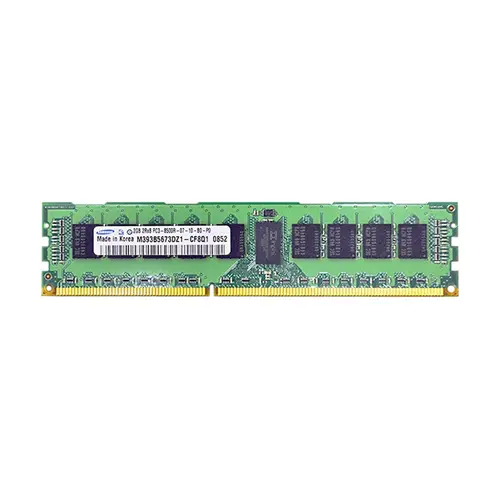
| Model | M393B5673DZ1-CF8Q1 |
|---|---|
| Product Type | Memory Module |
| Compliance Standards | EU RoHS,FCC |
| Memory Capacity | 2 GB |
| Memory Technology | DDR3 |
| Product Voltage | 1.5V |
| RAM Speed | 1066MHz |
| RAM Standard | DDR3-1066/PC3-8500 |
| Error Identifying | ECC |
| Signal Type | Registered |
| Column Access Strobe (CAS) | CL7 |
| Rank | Dual Rank x8 |
| Quantity of Pins | 240-pin |
| RAM Genre | RDIMM |
Optimized for legacy server platforms, this Samsung DDR3-1066 Registered ECC module (M393B5673DZ1-CF8Q1) provides the data integrity and signal stability required for virtualization hosts and small-scale in-memory databases. Its dual-rank x8 configuration and CL7 latency deliver consistent throughput under multi-DIMM loads, while the registered interface ensures reliable command/address signaling in 24/7 operation.
1. Continuous background error correction on this module eliminates single-bit upsets, preserving data integrity for 24/7 mission-critical server applications.
2. Buffered command/address lines through the registered architecture stabilize multi-DIMM channels, enabling memory-heavy virtualization clusters with superior signal integrity.
3. The dual rank x8 layout doubles bank group interleaving, keeping data bus utilization high when multiple virtual machines compete for memory access.
4. A precise 2‑gigabyte provision fits light server payloads such as network appliances or out‑of‑band management, cutting idle energy without sacrificing reliability.
5. A CAS latency of 7 cycles shortens the time-to-first-word, giving throughput-sensitive server tasks like caching and real-time analytics a tangible latency advantage.
The Samsung M393B5673DZ1-CF8Q1 is a server-grade DDR3 RDIMM engineered for mission-critical enterprise environments, where unscheduled downtime is not an option. Its four defining characteristics directly address the operational pain points of data center architects and IT managers.
First, ECC memory actively detects and corrects single-bit errors caused by background radiation or electrical noise—an absolute necessity in virtualization clusters running dozens of VMs on a single hypervisor, where a silent bit flip in memory can cascade into corrupted guest states and service outages. Second, the registered buffer stabilizes signal integrity across multiple populated DIMM slots, allowing you to scale capacity without sacrificing reliability; this is vital when deploying large-memory nodes for in-memory databases like SAP HANA or Redis, where every gigabyte must be addressed flawlessly under sustained load. Third, the dual-rank x8 organization enables rank interleaving, overlapping read/write operations across internal banks to boost effective bandwidth, a perceptible advantage when a database engine scans massive index tables. Finally, a tight CAS latency of CL7 at 1066MHz sharpens response times for latency-sensitive operations, ensuring transaction commits and real-time analytics complete predictably fast. Choose this module when data integrity, scalable density, and consistent performance define your bottom line.
General Virtualization
For lightweight virtualized environments, deploy at least six of these 2GB Registered ECC modules to yield 12GB, enough for a handful of low‑resource VMs. Populate channels symmetrically (e.g., three DIMMs per channel on a dual‑channel platform) to maintain balanced memory interleaving. The registered buffer and ECC ensure stable multi‑tenant operation, though capacity‑conscious admins should consider filling all available slots for 24–36GB when hosting more demanding guests.
In-Memory Database
In‑memory databases require both capacity and absolute data integrity. Use the maximum population your server supports — typically 12 to 18 modules — to reach 24–36GB of resilient, error‑correcting memory. The dual‑rank x8 organization and CL7 latency deliver steady access rates, while ECC guards against bit flips that could corrupt critical datasets. Populate all memory channels evenly to sustain high transaction throughput without bottlenecks.
High‑Performance Computing
Achieve peak memory bandwidth by filling every DIMM slot, ideally one dual‑rank RDIMM per channel to unlock rank interleaving. Even at 1066MT/s, a fully populated three‑channel system with twelve of these modules provides substantial aggregate throughput for parallel workloads. The low CAS latency of CL7 and registered signaling minimize access delays, and ECC protects long‑running simulations against silent data corruption.
Rigorously tested server memory, compatible with Dell PowerEdge R710, HP DL380 G7, and IBM x3650 M3.
Q: Can I mix this M393B5673DZ1-CF8Q1 with other memory modules of different brands or speeds?
A: Mixing registered DDR3 modules is not recommended due to potential timing conflicts. For server stability, populate all channels with identical part numbers, speed, and rank to ensure reliable ECC operation.
Q: Is this memory compatible with my system?
A: This is a DDR3-1066 Registered ECC RDIMM designed for servers. Verify your Intel Xeon 5500/5600 series or AMD Opteron platform supports 1.5V, 240-pin registered DIMMs and Dual Rank x8 organization.
Q: What is the recommended DIMM population order for optimal performance?
A: Populate identical DIMMs per channel starting with the farthest slot from the CPU. For dual-processor servers, balance memory across both sockets equally, following the system board's silkscreen labeling to maximize interleaving.
Q: Does this module support overclocking or XMP profiles?
A: No. This is a server-grade Registered ECC module strictly adhering to JEDEC DDR3-1066 standards. Overclocking or XMP is not supported; stability and data integrity are prioritized over frequency scaling.
Q: What warranty and typical failure rate can I expect?
A: This memory carries a one-year warranty. Typical annualized failure rate is below 0.2% under proper thermal conditions, reflecting Samsung’s rigorous server-grade binning and testing for 24/7 enterprise workloads.