











 Secure payments
Standard refund policy
Trade Assurance
Secure payments
Standard refund policy
Trade Assurance
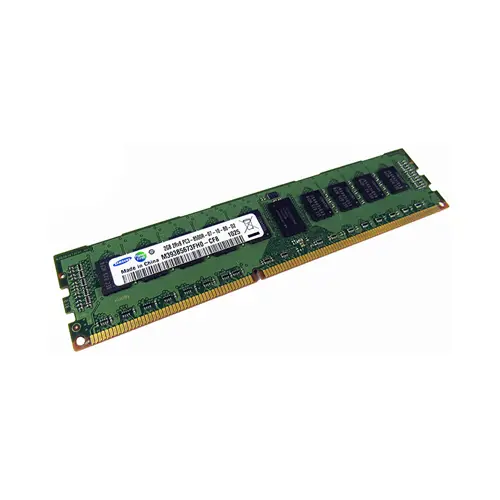
| Model | M393B5673FH0-CF8 |
|---|---|
| Product Type | Memory Module |
| Compliance Standards | EU RoHS,FCC |
| Memory Capacity | 2 GB |
| Memory Technology | DDR3 |
| Product Voltage | 1.5V |
| RAM Speed | 1066MHz |
| RAM Standard | DDR3-1066/PC3-8500 |
| Error Identifying | ECC |
| Signal Type | Registered |
| Column Access Strobe (CAS) | CL7 |
| Rank | Dual Rank x8 |
| Quantity of Pins | 240-pin |
| RAM Genre | RDIMM |
This DDR3-1066 Registered ECC module (M393B5673FH0-CF8) is purpose-built for legacy server platforms requiring maximum data integrity, making it ideal for memory-intensive virtualization and in-memory database workloads where silent data corruption cannot be tolerated. Its dual-rank x8 organization with CL7 latency enhances command/address bus stability via register buffering, while ECC ensures single-bit error correction in high-uptime environments.
1. ECC protection catches and corrects single-bit memory errors in real time, preserving data integrity for always-on enterprise applications like virtualization hosts and financial transaction databases.
2. Registered signaling stabilizes high-density server configurations by buffering address and command lines, allowing fully populated memory channels without compromising system reliability under continuous load.
3. Dual Rank x8 organization interleaves internal bank accesses to keep data streaming efficiently, improving memory-level parallelism for latency-sensitive workloads such as in-memory caches and database indexing.
4. The 2 GB module capacity suits light-weight hypervisor deployments and microservice nodes, delivering just enough memory footprint to isolate container workloads without overspending on idle resources.
5. A 1066 MT/s transfer rate delivers consistent, predictable throughput for entry-level server tasks like file serving and basic web hosting, matching the steady bandwidth needs of cost-conscious data-center environments.
The M393B5673FH0-CF8 is a DDR3 Registered ECC memory module purpose‑built for servers, where stability is non‑negotiable. Four characteristics directly prevent the failures that keep IT administrators up at night. First, ECC error correction silently detects and fixes single‑bit memory errors caused by background radiation. In a virtualization cluster hosting dozens of virtual machines, a single uncorrected bit flip can corrupt a mission‑critical instance; ECC means your services stay alive and data stays accurate. Second, the Registered buffer acts as a signal repeater, stabilizing the electrical load so you can fully populate every channel without degradation — essential when scaling memory capacity for dense, multi‑socket server configurations. Third, the Dual Rank x8 architecture employs internal rank interleaving, effectively doubling the bandwidth compared to a single‑rank design. This sharply reduces latency for memory‑hungry workloads like an in‑memory database or real‑time analytics platform, delivering snappier query responses. Finally, the CL7 CAS latency ensures minimal wait states on every access. Together, these features translate directly into non‑stop uptime, hardened data integrity, and consistent performance under heavy transactional loads, making this RDIMM a bedrock for business‑critical infrastructure.
General Virtualization
This M393B5673FH0-CF8 RDIMM is ideal for virtualization hosts running hypervisors like VMware ESXi or Hyper-V. With ECC and registered buffering, it ensures data integrity and stable operation under heavy multi-VM workloads. We recommend populating at least six identical modules for balanced memory channels, targeting 64–128 GB total to support moderate consolidation ratios.
In-Memory Database
For in-memory databases such as SAP HANA or Redis, low latency and error correction are critical. Install these 2 GB sticks in a symmetrical multi-channel configuration across all CPU sockets, aiming for a minimum of 128 GB across 16+ DIMM slots. The registered ECC design safeguards transactional data while maximizing throughput for real-time analytics.
High-Performance Computing
HPC clusters demand reliable, dense memory per node for simulation and modeling tasks. Populate all available DIMM sockets with this dual-rank module, maintaining uniform rank distribution to avoid performance penalties. A typical dual-socket node should start at 64 GB (32 sticks), scaling to 256 GB for large dataset computations, relying on the 1.5V registered architecture for consistent node-wide performance.
Strictly tested for server compatibility with Dell PowerEdge R710, HP ProLiant DL380 G7, and similar.
Q: Can I mix this M393B5673FH0-CF8 with other memory modules of different brands or speeds?
A: Mixing is not recommended for server environments. All modules should match in speed, rank, and ECC Registered type to ensure memory stability and prevent performance degradation or system faults.
Q: Is this memory compatible with my Intel or AMD server platform?
A: This DDR3-1066 Registered ECC RDIMM is compatible with server boards supporting DDR3 Registered DIMMs, typically Intel 5500/5600 series and AMD G34/C32 platforms. Verify your motherboard's Qualified Vendor List.
Q: What is the recommended DIMM population order for optimal performance?
A: Populate DIMMs in identical sets per memory channel, following the server board manual. Typically fill blue slots first across all CPU memory channels to maintain balanced interleaving and maximize bandwidth.
Q: Does this module support overclocking or XMP profiles?
A: No, this is a JEDEC-compliant server memory module without XMP support. It operates strictly at DDR3-1066 with CL7 timings for mission-critical stability, not overclocking.
Q: What warranty and typical failure rate can I expect?
A: This module includes a one-year warranty. Registered ECC memory typically exhibits very low annualized failure rates in controlled server environments, ensuring high reliability.