











 Secure payments
Standard refund policy
Trade Assurance
Secure payments
Standard refund policy
Trade Assurance
| Product Type | Memory Module |
|---|---|
| Memory Capacity | 2 GB |
| Memory Technology | DDR3 |
| Product Voltage | 1.5V |
| RAM Standard | DDR3-1333/PC3-10600 |
| Error Identifying | ECC |
| Signal Type | Registered |
| Column Access Strobe (CAS) | CL9 |
| Rank | Dual Rank x8 |
| Quantity of Pins | 240-pin |
| RAM Genre | RDIMM |
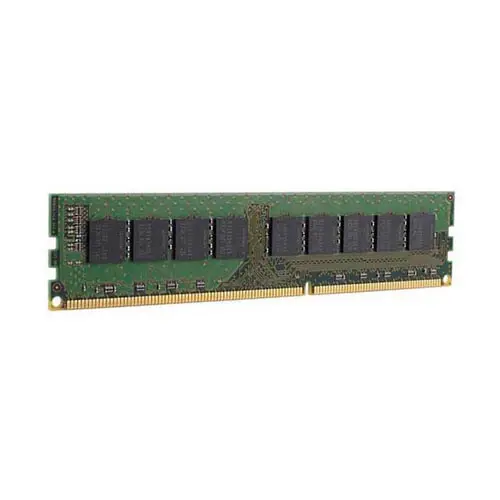
This DDR3-1333 Registered ECC RDIMM, with its dual-rank x8 organization and CAS latency of 9, is a server-grade module purpose-built for legacy enterprise platforms where data integrity and signal stability are critical. It excels in virtualized environments and memory-intensive workloads like in-memory databases, leveraging ECC and the registered buffer to maintain reliable operation across multi-DIMM configurations.
1. ECC protection silently corrects single-bit errors, safeguarding transactional databases and financial computations from silent data corruption that could cause costly outages.
2. Registered signal buffering allows dense memory populations without sacrificing electrical stability, essential for large-scale virtualization hosts running hundreds of VMs.
3. Dual Rank x8 organization interleaves memory banks to hide row-access latency, boosting effective throughput during concurrent OLAP queries and heavy consolidation workloads.
4. DDR3-1333 sustained bandwidth provides predictable baseline performance, matching legacy enterprise application demands while ensuring stable, validated operation in 24/7 deployments.
5. 1.5V operational voltage aligns with proven server thermal budgets, enabling reliable multi-module installations without exceeding enclosure cooling limits in rack-dense environments.
Based on the RDIMM form factor and Registered plus ECC signaling, the Samsung M393B5673FH0-CH9 is unequivocally an enterprise server memory module. In data centers where every bit of uptime and accuracy counts, its four architectural strengths translate directly into business continuity.
First, ECC error correction actively detects and corrects single-bit flips caused by background radiation, virtually eliminating silent data corruption that could poison mission-critical database transactions or financial records. Second, the Registered buffer offloads the memory controller by fanning out clock and command signals, enabling you to populate dense, multi-DIMM channels without signal degradation—this is the foundation for scaling virtualization clusters to support hundreds of VMs without instability. Third, the dual-rank x8 organization leverages interleaving to serve concurrent memory requests faster, meaning a memory-intensive in-memory analytics platform like SAP HANA experiences lower latency and higher throughput during massive concurrent queries. Finally, the 1.5V operating voltage and CL9 latency deliver a sweet spot of energy efficiency for round-the-clock operation, lowering power consumption and cooling costs in large-scale deployments. Together, these features ensure that your virtual infrastructure and real-time databases run with deterministic reliability and uncompromised data integrity.
General Virtualization
For a DDR3 registered ECC server platform, populate all memory channels symmetrically with identical 2 GB RDIMMs to enable interleaving and maximize throughput. A typical dual-socket system with 12 DIMM slots can be filled with these modules to deliver 24 GB of reliable, error-correcting capacity—sufficient for light to moderate virtual machine density. Leave no channel empty to avoid performance penalties under hypervisor memory overcommit.
In-Memory Database
Maximize total capacity by completely filling every available DIMM slot. Even with 2 GB modules, an 18-slot server can yield 36 GB of resilient ECC memory, essential for data integrity in in-memory workloads. Install the same number of dual-rank x8 modules per channel to maintain balanced loading and low latency, enabling consistent query performance on datasets that must reside entirely in RAM.
High Performance Computing
Achieve peak memory bandwidth by populating each memory channel equally. A common configuration uses two 2 GB registered modules per channel (one DIMM per channel is also valid) across all six channels of a dual-socket system, totaling 12 modules for 24 GB while keeping ranks fully symmetrical. This balanced setup leverages DDR3-1333 memory parallelism for HPC codes, and the ECC ensures silent data corruption is prevented during long simulation runs. Avoid mixing ranks or leaving channels unpopulated, as that would degrade sustained bandwidth.
Rigorously validated for server use. Compatible with Dell PowerEdge R720, HP DL380p Gen8, Cisco UCS C220 M3, and more.
Q: Can I mix this M393B5673FH0-CH9 with other memory modules of different brands or speeds?
A: Mixing is not recommended. Registered ECC RDIMMs must be identical in rank, speed, and timings to ensure signal integrity. Mismatched modules may cause system instability or fail to POST on server platforms.
Q: Is this memory compatible with my Intel Xeon or AMD Opteron server platform?
A: This DDR3-1333 Registered ECC RDIMM is compatible with servers supporting 1.5V 240-pin RDIMMs. Verify your motherboard's qualified vendor list for dual-rank x8 modules and 2GB capacity support on the target memory channel.
Q: What is the recommended DIMM population order for optimal performance?
A: Populate identical dual-rank RDIMMs per channel, starting with the farthest slot from the CPU. For dual-socket servers, balance memory across both processors and respect white-slot-first population rules in your server manual.
Q: Does this module support overclocking or XMP profiles?
A: No. Server Registered ECC memory adheres to JEDEC DDR3-1333 CL9 standards. Overclocking or XMP is unsupported, as it compromises error correction and signal stability required for 24/7 enterprise operation.
Q: What warranty and typical failure rate can I expect?
A: This Samsung module carries a 1-year warranty. Enterprise RDIMMs demonstrate an annualized failure rate well below 0.5% under specified thermal and voltage conditions when operated within validated server environments.