











 Secure payments
Standard refund policy
Trade Assurance
Secure payments
Standard refund policy
Trade Assurance
| Model | M393B5673FH0-CH9Q5 |
|---|---|
| Product Type | Memory Module |
| Compliance Standards | EU RoHS,FCC |
| Memory Capacity | 2 GB |
| Memory Technology | DDR3 |
| Product Voltage | 1.5V |
| RAM Speed | 1333MHz |
| RAM Standard | DDR3-1333/PC3-10600 |
| Error Identifying | ECC |
| Signal Type | Registered |
| Column Access Strobe (CAS) | CL9 |
| Rank | Dual Rank x8 |
| Quantity of Pins | 240-pin |
| RAM Genre | RDIMM |
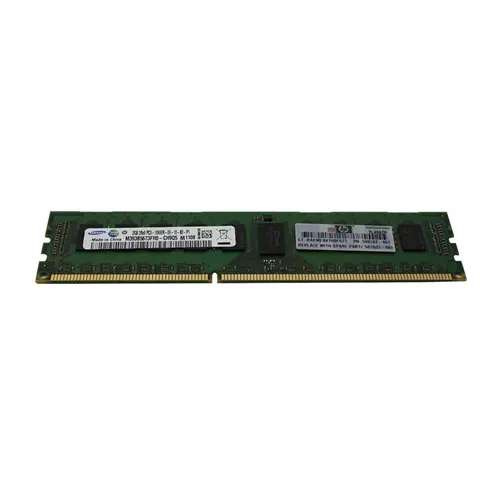
Identified as a server-class DDR3 RDIMM, this M393B5673FH0-CH9Q5 module is purpose-built for enterprise platforms running virtualization, in-memory databases, and mission-critical workloads that demand uncompromising data integrity. The Registered signal type combined with dual-rank x8 organization reliably drives higher memory density per channel, while ECC corrects single-bit errors in real time, safeguarding long-duration transactional processing at 1333MHz with CL9 latency.
1. ECC error correction silently detects and fixes single-bit memory faults, preserving transactional accuracy for financial databases and mission-critical log processing.
2. Registered buffering isolates the memory controller from electrical load, enabling fully populated channels that maximize virtual machine density without signal degradation.
3. Dual-rank interleaving keeps the data bus efficiently saturated, delivering consistent throughput for multi-tenant workloads and concurrent analytics queries.
4. A stable 1333 MT/s data rate provides sufficient bandwidth to keep legacy multi-core server processors fed, preventing bottlenecks during sustained read/write operations.
5. Standard 1.5V operation ensures broad drop-in compatibility across DDR3-based server fleets, simplifying validated platform integration and lifecycle management.
In a modern data center, the M393B5673FH0-CH9Q5 is a DDR3-1333 registered ECC memory module engineered specifically for server platforms where reliability is not negotiable. Its Error-Correcting Code capability becomes critical in virtualization clusters running dozens of VMs on a single host. A single undetected bit flip in shared memory can silently corrupt guest operating systems or hypervisor data structures, leading to cascading outages that outstrip any hardware savings. Meanwhile, the Registered logic buffers command and address signals, expanding the total capacity headroom without compromising signal integrity. This directly addresses the pain of scaling memory-intensive database workloads like an in-memory OLTP cache; you can populate all channels with this dual-rank x8 RDIMM to sustain high concurrency without the platform destabilizing under electrical loading. The combination of CL9 latency, 1.5V operation, and the dual-rank architecture also ensures steady 1333MT/s bandwidth during large block transfers, which is vital when a database engine performs table scans or a hypervisor migrates active memory pages between nodes. In a mid-range server running both a transactional database and a containerized application tier, this module means the difference between a consistent query latency of under two milliseconds and sporadic timeouts that erode end-user trust.
This is a server-grade DDR3 ECC Registered DIMM (M393B5673FH0-CH9Q5). Use the following capacity planning guidelines.
General Virtualization
Populate all memory channels with identical 2GB RDIMMs for balanced interleaving and maximum throughput. Install 24 modules (48GB total) in a typical dual-socket server; this cost-effective baseline supports multiple moderate VMs. Enable ECC protection and memory sparing to safeguard uptime in consolidated environments.
In-Memory Database
Fill all 24 DIMM slots per node to obtain 48GB, then scale capacity horizontally with sharding across nodes. Install at least two modules per channel for rank interleaving and balance them equally across CPU sockets for uniform memory access. Dual‑rank CL9 operation at 1333MHz keeps latency low for real‑time data.
High-Performance Computing (HPC)
Equip each compute node with the maximum 24 modules (48GB) to maximize per‑node headroom. Distribute DIMMs evenly across channels to sustain 1333MHz speed without frequency drops. For larger working sets, add more nodes or move to a platform with 48 DIMM slots to reach 96GB. This approach delivers the bandwidth and capacity needed for parallel simulations.
Rigorously tested server memory, compatible with Dell PowerEdge R720, HP ProLiant DL360p Gen8, and IBM System x3650 M4.
Q: Can I mix this M393B5673FH0-CH9Q5 with other memory modules of different brands or speeds?
A: Mixing is not recommended. Paired modules should have identical speed, rank, and timings. Combining with dissimilar DIMMs may force the server to downclock to the slowest common denominator and compromise signal integrity in registered DDR3 configurations.
Q: Is this memory compatible with my system?
A: This 240-pin Registered ECC DDR3 RDIMM is designed for Intel Xeon 5500/5600 series or AMD Opteron 6100 series platforms. Please verify your server motherboard supports 1.5V, Dual-Rank x8, PC3-10600 registered memory before purchase.
Q: What is the recommended DIMM population order for optimal performance?
A: Populate identical DIMMs per memory channel, starting with the slots furthest from the processor. For dual-socket servers, balance capacity equally across both CPU memory banks to maintain symmetric NUMA access and maximize throughput.
Q: Does this module support overclocking or XMP profiles?
A: No. This is a server-grade registered ECC module that follows JEDEC DDR3-1333 standards at CL9. It does not expose XMP profiles and is not designed for overclocking, prioritizing data integrity and 24/7 stability instead.
Q: What warranty and typical failure rate can I expect?
A: This module carries a one-year warranty. In properly cooled, enterprise environments its annualized failure rate is typically below 0.5%, thanks to rigorous testing and ECC error correction that mitigates soft errors effectively.