











 Secure payments
Standard refund policy
Trade Assurance
Secure payments
Standard refund policy
Trade Assurance
| Model | M393B5673GB0-CH9Q8 |
|---|---|
| Product Type | Memory Module |
| Compliance Standards | CE,WEEE,RoHS |
| Memory Capacity | 2 GB |
| Memory Technology | DDR3 |
| Product Voltage | 1.5V |
| RAM Speed | 1333MHz |
| RAM Standard | DDR3-1333/PC3-10600 |
| Error Identifying | ECC |
| Signal Type | Registered |
| Column Access Strobe (CAS) | CL9 |
| Rank | Dual Rank x8 |
| Quantity of Pins | 240-pin |
| RAM Genre | RDIMM |
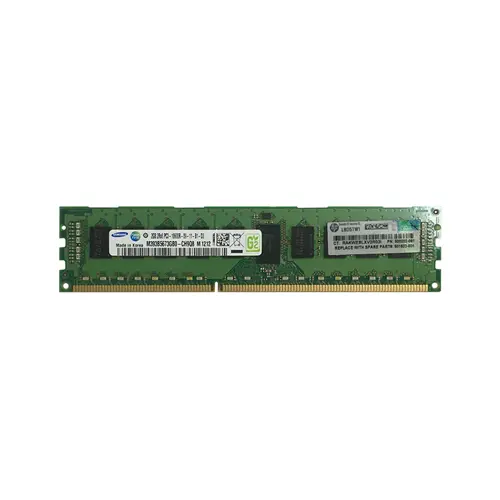
Designed specifically for server platforms, this Samsung M393B5673GB0-CH9Q8 2GB DDR3-1333 RDIMM leverages registered signal buffering and ECC to ensure rock-solid data integrity in virtualized environments and memory-intensive database applications. Its dual-rank x8 organization with CL9 latency optimizes memory interleaving for reliable throughput, making it an ideal choice for legacy enterprise servers that demand steady, error-free operation under 24/7 workloads.
1. Registered signal type buffers command and address lines, enabling massive memory populations essential for enterprise virtualization farms without compromising signal integrity.
2. ECC error identification continuously detects and corrects single-bit memory faults, preventing silent data corruption in transactional databases and critical financial workloads.
3. Dual Rank x8 organization interleaves access across internal banks, boosting sustained bandwidth for in-memory analytics and content delivery services under concurrent user loads.
4. 1333MHz clock speed delivers a stable, industry-standard frequency that ensures predictable latency for legacy ERP systems and scale-out storage nodes running 24/7.
5. 1.5V standard operating voltage drives reliable power delivery across dense rack configurations, keeping thermal stress low inside constrained server chassis during years of continuous uptime.
The M393B5673GB0-CH9Q8 is a server-class Registered DIMM with ECC, purpose-built for data centers where uptime and accuracy are non-negotiable. Its four critical characteristics directly address the real pain points of IT infrastructure. First, ECC actively corrects single-bit memory errors caused by background radiation—a must in a virtualization cluster where a silent bit flip in a hypervisor can crash dozens of virtual machines, causing costly service outages. Second, the Registered signal buffer re-drives address and command lines, drastically reducing electrical load on the memory controller; this lets you populate all 24 DIMM slots on a typical 2U server without stability loss, giving you the massive memory footprint required to consolidate hundreds of VMs. Third, the Dual Rank x8 organization interleaves internal banks to hide precharge latency, boosting effective bandwidth. For an in-memory database like Redis or SAP HANA, this translates directly into higher transactions per second and lower query latency under bursty workloads. Finally, the proven DDR3-1333 speed at CL9 provides a predictable thermal and power envelope in dense rack environments, ensuring your memory doesn’t throttle during years of non-stop operation. This combination means you deploy applications with confidence, knowing your memory won’t silently corrupt transactional data or buckle under the load of a heavy virtualized environment.
Server Memory Capacity Planning
The M393B5673GB0-CH9Q8 is a 2GB DDR3-1333 Registered ECC RDIMM, designed for legacy server platforms requiring data integrity and stability. For capacity planning, consider the following workload scenarios.
General Virtualization
Virtual machines benefit from reliable, moderate-density memory pools. Dual-socket servers with 12 to 18 DIMM slots per CPU can be populated with these 2GB modules to reach 48GB–72GB total, balancing cost and VM density. Use balanced interleaving across memory channels to maximize bandwidth under mixed guest loads.
In-Memory Database
These workloads demand maximum capacity and fault tolerance, often requiring hundreds of gigabytes. Populate all available slots with the highest-count supported configuration, but planning with 2GB RDIMMs will hit density limits quickly—consider transitioning to 8GB or 16GB RDIMMs for larger databases. If retaining 2GB modules, deploy a full 8‑DIMMs-per‑channel layout per CPU to achieve up to 128GB per host, ensuring data protection through ECC and sparing.
High-Performance Computing
HPC clusters rely on bandwidth-sensitive memory configurations. With 1333MHz Registered DIMMs, populate at least one DIMM per channel to enable full memory interleaving and reduce latency in MPI workloads. For tightly coupled nodes, a uniform configuration of six or eight modules per compute node yields 12GB–16GB per node, aligning with typical per-core memory requirements in scientific simulations.
Strictly tested server memory compatible with Dell PowerEdge R720, HP DL380p Gen8, Lenovo x3650 M4, and similar systems.
Q: Can I mix this M393B5673GB0-CH9Q8 with other memory modules of different brands or speeds?
A: Mixing brands or speeds on a registered server platform is not advisable. Mismatched modules can cause boot failures or silent data corruption. Always use identical part numbers per channel for validated stability and performance.
Q: Is this memory compatible with my system?
A: This DDR3-1333 Registered ECC RDIMM targets servers with Intel Xeon 5500/5600 series or AMD Opteron 6000 series chipsets. Confirm your board supports 2GB, 1.5V registered DIMMs. Consult the system’s qualified vendor list for full compatibility.
Q: What is the recommended DIMM population order for optimal performance?
A: Populate identical DIMMs starting with the slots farthest from the CPU per channel, balancing across memory channels. For dual-processor boards, install matching pairs symmetrically. Follow your server’s technical manual for the exact slot numbering and sequence.
Q: Does this module support overclocking or XMP profiles?
A: No. Samsung server RDIMMs are built for data integrity and 24/7 reliability. They run at standard JEDEC timings (1333MHz, CL9, 1.5V) and do not support overclocking, XMP, or user-adjusted frequency profiles.
Q: What warranty and typical failure rate can I expect?
A: This module carries a one-year warranty. Genuine Samsung server DRAM exhibits an extremely low annualized failure rate, typically well under 0.1%, ensuring dependable long-term operation in mission-critical environments.