











 Secure payments
Standard refund policy
Trade Assurance
Secure payments
Standard refund policy
Trade Assurance
| Model | M393B5773CH9-CH9 |
|---|---|
| Product Type | Memory Module |
| Compliance Standards | EU RoHS,FCC |
| Memory Capacity | 2 GB |
| Memory Technology | DDR3 |
| Product Voltage | 1.5V |
| RAM Speed | 1333MHz |
| RAM Standard | DDR3-1333/PC3-10600 |
| Error Identifying | ECC |
| Signal Type | Registered |
| Column Access Strobe (CAS) | CL9 |
| Rank | Dual Rank x8 |
| Quantity of Pins | 240-pin |
| RAM Genre | RDIMM |
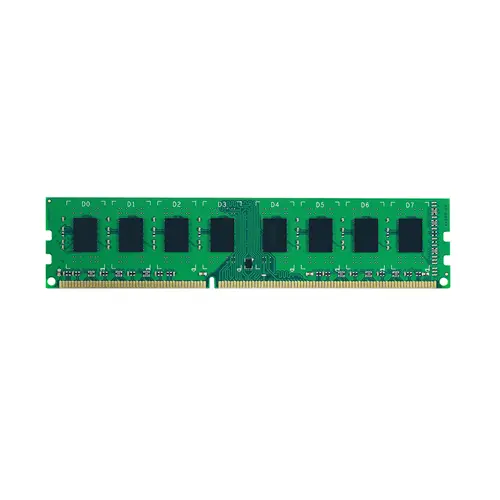
This Samsung M393B5773CH9-CH9 is a 2GB DDR3-1333 registered ECC RDIMM engineered for legacy server platforms, delivering the data integrity essential for light virtualization, small-scale database hosting, and reliable file services. Its dual-rank x8 configuration and registered architecture stabilize signal loads on the memory bus, while ECC error correction ensures consistent data accuracy in always-on environments.
1. ECC protection silently corrects single-bit errors in real time, preventing silent data corruption in mission-critical database and financial transaction servers.
2. Registered buffering isolates the memory controller from excessive electrical loads, allowing fully populated multi-DIMM configurations that maximize total server memory footprint.
3. Dual Rank x8 organization leverages rank interleaving to keep data pipelines continuously fed, boosting effective memory bandwidth under heavy virtualization consolidation.
4. A modest 2‑gigabyte capacity targets dedicated appliances or lightweight hypervisor hosts where deterministic latency and cost take priority over raw density.
5. 1333 MHz clock speed strikes an optimal balance between throughput and power envelope, extending the service life of stable, long-running DDR3 server fleets.
The Samsung M393B5773CH9-CH9 is an RDIMM engineered exclusively for server platforms, where unplanned downtime is simply not an option. Its four defining characteristics directly address the realities of enterprise IT. ECC error correction silently detects and corrects single-bit memory flips, protecting the integrity of in-memory databases like SAP HANA or a virtualized SQL Server cluster—one corrupted bit can cascade into a wrong financial report or a corrupted tenant record. The registered buffer amplifies command signals, allowing fully populated memory slots across dual-socket motherboards to remain electrically stable under sustained 100% load; without it, a 24-DIMM configuration would suffer signal degradation and random kernel panics. The dual-rank x8 organization enables rank interleaving, which staggers access across internal banks so that a hypervisor hosting dozens of VMs sees measurably higher bandwidth and fewer latency spikes during page-file thrashing. Combined with DDR3-1333 at a CL9 latency, this module balances reliable throughput against a 1.5V power envelope ideal for dense data centers. For a virtualization farm or a read-heavy caching layer, these features fuse into a resilient backbone, not a performance gamble.
Memory Type Identification: DDR3-1333 ECC Registered RDIMM with 2GB capacity per module — a legacy server memory standard designed for stability and multi-bit error correction. Capacity planning must account for low per-DIMM density and platform limitations common in older servers.
General Virtualization
A typical hypervisor hosting light to medium VMs requires ample memory headroom. Populate at least six channels with six identical 2GB modules (12GB total) for a dual-socket Nehalem/Westmere system, or move to eight modules (16GB) if slots permit. Prioritize balanced channel population to maximize interleaving and avoid NUMA penalties.
In-Memory Database
Datasets fit entirely in RAM demand maximum reliable capacity. Use all available DIMM slots with the largest supported rank configuration — typically 18 x 2GB for 36GB on a dual-socket platform. Since 2GB RDIMMs are low density, consider memory sparing or mirroring for critical transactional workloads to minimize uncorrected errors, sacrificing half the installed capacity.
High Performance Computing (HPC)
HPC nodes favor bandwidth over raw capacity. Install one DIMM per channel across all memory channels (e.g., six modules per socket, 12GB total per node) to achieve peak memory bandwidth. Dual-rank x8 modules at 1333MHz maintain latency-sensitive CFD or finite-element codes; avoid mixing ranks per channel to keep command rate at 1T and sustain stream throughput.
Rigorously tested DDR3 server RDIMM; compatible with Dell R710, HP DL380 G7, IBM x3650 M3.
Q: Can I mix this M393B5773CH9-CH9 with other memory modules of different brands or speeds?
A: Mixing different brands or speeds with this registered ECC DIMM is not recommended. It may cause signal integrity issues and server instability. For reliable operation, use identical Samsung M393B5773CH9-CH9 modules across all channels.
Q: Is this memory compatible with my system?
A: This DDR3-1333 registered ECC module is designed for server platforms such as Intel Xeon 5500/5600 series or AMD Opteron 6100/6200 series. Confirm your motherboard supports 240-pin RDIMMs at 1.5V and check the vendor qualified list.
Q: What is the recommended DIMM population order for optimal performance?
A: Populate identical DIMMs starting with slots furthest from the CPU per channel. Follow your server’s manual for balanced interleaving; typically install in sets of three per memory channel to maximize triple-channel bandwidth and maintain ECC efficiency.
Q: Does this module support overclocking or XMP profiles?
A: No. As enterprise registered server memory, this module adheres to JEDEC standards only. It operates at fixed 1333MHz with CL9 timings and does not support overclocking or XMP, prioritizing data integrity and 24/7 stability.
Q: What warranty and typical failure rate can I expect?
A: This Samsung module carries a 1-year warranty. Typical annualized failure rate is below 0.3%, thanks to rigorous testing and high-quality components. It is built for 24/7 server operation with very low defect incidence.