











 Secure payments
Standard refund policy
Trade Assurance
Secure payments
Standard refund policy
Trade Assurance
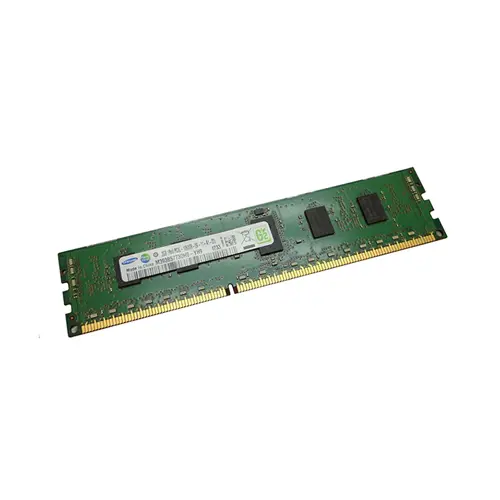
| Model | M393B5773DH0-YH9 |
|---|---|
| Product Type | Memory Module |
| Compliance Standards | EU RoHS,FCC |
| Memory Capacity | 2 GB |
| Memory Technology | DDR3 |
| Product Voltage | 1.35V |
| RAM Speed | 1333MHz |
| RAM Standard | DDR3-1333/PC3-10600 |
| Error Identifying | ECC |
| Signal Type | Registered |
| Column Access Strobe (CAS) | CL9 |
| Rank | Single Rank x8 |
| Quantity of Pins | 240-pin |
| RAM Genre | RDIMM |
This DDR3-1333 Registered ECC RDIMM, configured as single-rank x8 with CL9 latency, delivers reliable 1.35V low-power operation for legacy server platforms where data integrity and stable signal integrity are critical. It is ideally suited for memory-dense virtualization hosts and database servers running on older-generation hardware that still demand registered buffering to reduce electrical load and ECC to prevent silent data corruption.
1. RDIMM construction buffers command and address signals, enabling fully populated memory channels across multi-socket servers without signal degradation during heavy virtualization workloads.
2. ECC protection corrects single-bit errors in real time, preserving data integrity for financial ledgers, transactional databases, and always-on daemons where even one corrupt bit is unacceptable.
3. Registered signal buffering isolates the memory controller from electrical loading, allowing greater DIMM density per channel so that hypervisors can pack more VMs without risking stability.
4. 1.35V low-voltage operation drives down per-DIMM power consumption, which compounds into meaningful savings on electricity and cooling in large-scale data center deployments.
5. Single Rank x8 organization delivers consistent access latencies and reduces load on the server’s memory bus, ensuring predictable performance under sustained memory-pressure conditions.
The Samsung M393B5773DH0-YH9 is a server-class Registered DIMM engineered for environments where data integrity and uptime are non-negotiable. Its four defining characteristics directly address the pain points of IT infrastructure managers.
First, ECC (Error-Correcting Code) technology actively detects and corrects single-bit memory errors caused by background radiation or electrical noise. In a financial trading database or a virtualized cluster hosting dozens of tenants, an undetected bit flip can corrupt transactional records or silently crash a virtual machine—ECC ensures your data remains mathematically accurate at all times. Second, the Registered signal buffer stabilizes high-capacity memory configurations by reducing the electrical load on the memory controller. This means you can populate all DIMM slots across multiple channels without sacrificing signal integrity, which is critical when scaling a VMware farm or an in-memory analytics platform that demands hundreds of gigabytes of reliable RAM. Third, operating at 1.35V low voltage, this DDR3L module significantly cuts power consumption and thermal output in densely packed rack servers. Over a full data center deployment, the cumulative energy savings and reduced cooling stress translate directly into lower opex and extended hardware longevity. Finally, the single-rank x8 organization offers superior compatibility and reduced command bus contention compared to dual-rank alternatives, ensuring faster, more predictable memory access patterns under the heavy concurrent loads typical of Redis or Memcached instances. For your server infrastructure, this module delivers not just capacity but the assured stability and efficiency that keep critical services running.
Based on the specifications, the M393B5773DH0-YH9 is a server memory module — a DDR3 ECC Registered RDIMM operating at 1333MHz with a low 1.35V voltage. Its 2GB capacity and error-correcting features position it for legacy server platforms.
General Virtualization
Populate at least one identical DIMM per memory channel to sustain balanced interleaved bandwidth. With these 2GB modules, a practical baseline is 16 modules (32GB) across a dual‑socket server, comfortably hosting a mix of light‑to‑moderate virtual machines while ECC safeguards multi‑tenant stability.
In‑Memory Database
Maximize capacity by filling every available slot. In a 24‑slot system, 24 x 2GB yields 48GB — enough to hold a focused dataset entirely in RAM for fast processing. The registered ECC and 1.35V operation deliver the data integrity and power efficiency essential for round‑the‑clock database instances.
High‑Performance Computing
For bandwidth‑sensitive HPC, install one DIMM per channel to run at the full 1333MHz speed without throttling. A typical dual‑socket compute node with 6 modules (12GB) suffices for many parallel MPI workloads, while the low‑voltage design helps reduce thermal load in dense cluster racks.
Rigorously tested for compatibility with Dell PowerEdge R710, HP ProLiant DL380 G7, Lenovo ThinkServer RD630, and more.
Q: Can I mix this M393B5773DH0-YH9 with other memory modules of different brands or speeds?
A: Mixing is not recommended. Mismatched modules may cause instability or fail to POST. For reliable server operation, install identical RDIMMs with the same speed, rank, and ECC characteristics across all channels.
Q: Is this memory compatible with my system?
A: This Registered ECC DDR3 module is designed for server platforms supporting Intel Xeon 5500/5600 series or AMD Opteron 4100/6100 series. Verify your server board explicitly supports 1.35V DDR3-1333 RDIMMs before purchasing.
Q: What is the recommended DIMM population order for optimal performance?
A: Populate identical DIMMs in sets of three or four per memory channel, following your server board’s slot numbering. Typically, start with the farthest slots from the CPU to balance interleaving and maximize memory bandwidth.
Q: Does this module support overclocking or XMP profiles?
A: No. This is a server-grade Registered ECC module operating at JEDEC standard DDR3-1333. It does not support overclocking or XMP profiles, as reliability and data integrity take priority over frequency scaling.
Q: What warranty and typical failure rate can I expect?
A: This module includes a one-year warranty. As an enterprise-class RDIMM built with Samsung components, annualized failure rate is typically below 0.5% under specified conditions, ensuring dependable long-term server operation.