











 Secure payments
Standard refund policy
Trade Assurance
Secure payments
Standard refund policy
Trade Assurance
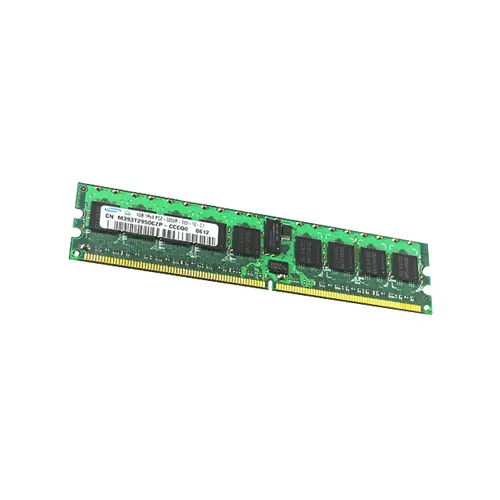
| Model | M393T2950CZP-CCCQ0 |
|---|---|
| Product Type | Memory Module |
| Compliance Standards | EU RoHS,FCC |
| Memory Capacity | 1 GB |
| Memory Technology | DDR2 |
| Product Voltage | 1.8V |
| RAM Speed | 400MHz |
| RAM Standard | DDR2-400/PC2-3200 |
| Error Identifying | ECC |
| Signal Type | Registered |
| Column Access Strobe (CAS) | CL3 |
| Rank | Single Rank x4 |
| Quantity of Pins | 240-pin |
| RAM Genre | RDIMM |
This registered ECC DDR2-400 module is designed for legacy server platforms, delivering the reliability required for virtualization hosts and in-memory databases where data integrity is non-negotiable. The combination of registered signal buffering, ECC error correction, and a low CL3 latency in a single-rank x4 organization ensures stable, validated operation across fully populated memory channels while guarding against silent data corruption.
1. ECC protection corrects single-bit memory errors autonomously, preserving data integrity for mission‑critical enterprise applications that cannot tolerate silent corruption.
2. Registered signal buffering stabilizes command and address lines under heavy DIMM populations, enabling dependable memory expansion in dense server racks.
3. Single Rank x4 organization balances electrical loading on the server memory channel, ensuring clean signal integrity and consistent boot‑level compatibility with older platforms.
4. The 1 GB capacity fits dedicated lightweight roles such as embedded hypervisors or legacy network appliances, where minimal overhead keeps total cost and power strictly controlled.
5. CL3 low‑latency access response reduces initial word fetch delay, benefiting latency‑sensitive transactional workloads that depend on rapid small‑block retrieval.
In server environments, the M393T2950CZP‑CCCQ0 RDIMM is engineered to eliminate the kind of silent errors and instability that directly threaten business continuity. Its ECC technology actively detects and corrects single-bit memory faults, a critical defense in virtualized clusters where a flipped bit in one guest can corrupt an entire application stack or trigger costly failover events. The registered signal buffer addresses a common pain point: as you populate multiple DIMMs to scale capacity, electrical loading increases, causing signal degradation and boot failures. Registered logic isolates the command and address bus, allowing dense, stable configurations that keep your hypervisor fully loaded with VMs. For latency-sensitive workloads like an in‑memory Redis database, the module’s CL3 column access strobe and Single Rank x4 organization deliver swift, predictable data access. The x4‑bit wide DRAM chips improve burst‑error resilience and facilitate effective bank interleaving, raising throughput for transactional queries. Together, these features mean fewer data integrity incidents, reduced unplanned downtime, and a responsive platform that sustains heavy consolidation without compromising service‑level agreements.
General Virtualization
A single 1GB RDIMM is wholly inadequate for modern hypervisors; even a minimal ESXi or Proxmox host demands at least 4–8GB. For lightweight lab virtualization, populate all available channels with eight identical M393T2950CZP modules to reach 8GB, enabling perhaps two to three tiny VMs. However, expect severe memory pressure, and never overcommit RAM on this DDR2-400 platform.
In-Memory Database
In-memory databases like Redis or Memcached require the entire working set to reside in RAM, making this 1GB module impractical for production. You would need at least 16 modules (16GB) across a dual-socket system just to cache a small dataset, but the slow 400MHz clock and high latency will cripple throughput. This hardware is obsolete for in-memory workloads; consider it only for educational tinkering with tiny datasets.
High-Performance Computing
HPC nodes typically demand 64GB to multiple terabytes of bandwidth-sensitive memory. Deploying these 1GB RDIMMs means filling every slot—often 16 or 24 DIMMs per node—merely to achieve 16–24GB, severely limiting problem sizes. The DDR2-400 interface provides just 3.2GB/s per channel, creating a massive bottleneck for memory-bound MPI or OpenMP applications, confining this configuration to legacy scientific code testing only.
Rigorously tested for reliable performance in servers like Dell PowerEdge 2950, HP ProLiant DL380 G5, and IBM System x3650.
Q: Can I mix this M393T2950CZP-CCCQ0 with other memory modules of different brands or speeds?
A: Mixing is not recommended. This registered DDR2-400 ECC module requires identical timings and rank. Mismatched unbuffered or non-ECC DIMMs can cause boot failures or data corruption in server environments.
Q: Is this memory compatible with my system?
A: This is a 240-pin DDR2 Registered ECC RDIMM. It suits legacy server platforms such as Intel Xeon 5000/5100 or AMD Opteron systems requiring DDR2-400 registered memory. Always verify your server's qualified vendor list.
Q: What is the recommended DIMM population order for optimal performance?
A: Populate identical DIMMs starting with the first slot of each memory channel, balancing across channels for interleaving. For single-rank modules, follow the server board layout guide to maximize bandwidth in a registered configuration.
Q: Does this module support overclocking or XMP profiles?
A: No. As a server-grade registered ECC module, it operates exclusively at JEDEC-specified DDR2-400 with no XMP or overclocking support. This ensures the data integrity and reliability required for 24/7 workloads.
Q: What warranty and typical failure rate can I expect?
A: This module includes a one-year warranty. When correctly handled and kept within thermal limits, typical annualized failure rate is below 0.5%. Meticulous manufacturing makes early-life failures rare.