











 Secure payments
Standard refund policy
Trade Assurance
Secure payments
Standard refund policy
Trade Assurance
| Model | M393T2950EZ3-CCC |
|---|---|
| Product Type | Memory Module |
| Compliance Standards | EU RoHS,FCC |
| Memory Capacity | 1 GB |
| Memory Technology | DDR2 |
| Product Voltage | 1.8V |
| RAM Speed | 400MHz |
| RAM Standard | DDR2-400/PC2-3200 |
| Error Identifying | ECC |
| Signal Type | Registered |
| Column Access Strobe (CAS) | CL3 |
| Rank | Single Rank x4 |
| Quantity of Pins | 240-pin |
| RAM Genre | RDIMM |
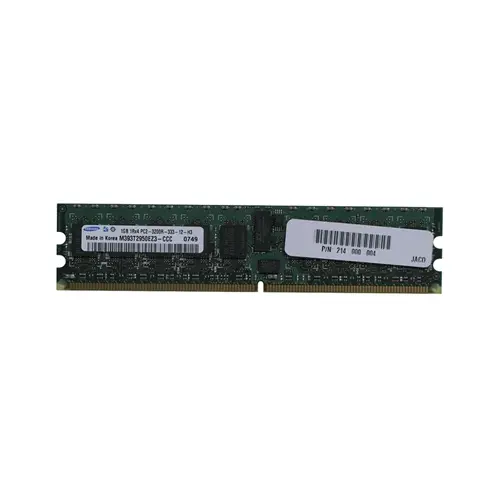
This Samsung M393T2950EZ3-CCC is a legacy DDR2-400 Registered ECC RDIMM designed for stability-centric server platforms, making it suitable for aging virtualization hosts or memory-resident database appliances where data integrity and signal reliability are critical. Its single-rank x4 organization and CL3 latency deliver deterministic access patterns, while the registered signal path ensures robust operation in multi-DIMM configurations.
1. ECC protection corrects single-bit errors in real time, safeguarding data integrity for mission-critical workloads like financial transactions and long-running database operations.
2. Registered signal buffering stabilizes command and address lines across densely populated memory channels, essential for virtualization hosts that demand high DIMM counts without signal degradation.
3. The single-rank design with narrow DRAM devices reduces bus loading, enabling more modules per channel to maximize memory density in virtualized server environments.
4. Adherence to the JEDEC DDR2-400/PC2-3200 standard guarantees predictable, validated platform compatibility, removing integration risk in legacy enterprise infrastructure.
5. A compact one-gigabyte capacity fits single-purpose server appliances or embedded controllers where a lean, power-efficient memory footprint is more critical than raw scale.
The M393T2950EZ3-CCC is a server-grade DDR2 RDIMM engineered specifically for always-on enterprise workloads where data integrity and stability are non-negotiable. Its ECC capability continuously detects and corrects single-bit memory errors, eradicating silent data corruption that could otherwise crash an entire virtualized cluster or introduce subtle inaccuracies in a high-frequency trading ledger. The registered buffer chips protect signal integrity across fully loaded memory channels, allowing you to confidently populate all slots for the density needed to host dozens of virtual machines without random, stubborn outages—your hypervisor uptime becomes predictable. With a minimal CAS latency of 3 cycles and a single-rank x4 architecture, the module slashes access delays and reduces electrical loading; for an in-memory database like Redis that relies on microsecond responsiveness, this directly translates into lower query latency and a higher throughput ceiling under peak load. Operating at just 1.8 volts, it further curbs power draw per DIMM, lowering cooling demands inside densely packed data center racks. In practice, you gain fewer costly service interruptions, deterministic database performance, and a more energy-efficient server infrastructure.
The M393T2950EZ3-CCC is a server-class 1 GB DDR2-400 Registered ECC RDIMM. Below are capacity planning recommendations for key server scenarios.
General Virtualization
For consolidating several lightweight VMs, aim for a minimum of 8 GB total. Fill all available channels with identical 1 GB RDIMMs—for instance, eight modules in an 8-slot server—to achieve 8 GB and enable channel interleaving. ECC protection is essential for virtualization stability.
In-Memory Database
In-memory database workloads prefer large capacity. Given the 1 GB module size, this memory suits only small-scale caching or development environments. Maximize total capacity by installing modules in every DIMM slot (e.g., 16 slots for 16 GB) and rely on ECC to maintain data correctness for Redis or Memcached.
High-Performance Computing
HPC benefits from balanced memory bandwidth and ample capacity. With DDR2-400 RDIMMs, populate memory channels evenly—install modules in matched pairs to activate dual-channel mode. Fully loading all memory banks with these 1 GB modules provides maximum aggregate bandwidth for legacy MPI or scientific simulations, though performance is capped by the low clock speed.
Rigorously tested server memory. Compatible with Dell PowerEdge 2950, HP ProLiant DL380 G5, IBM System x3650.
Q: Can I mix this M393T2950EZ3-CCC with other memory modules of different brands or speeds?
A: Mixing is not recommended for server platforms. Mismatched modules may cause instability or ECC errors. For guaranteed compatibility, use identical Samsung M393T2950EZ3-CCC modules with the same rank, speed, and organization.
Q: Is this memory compatible with my system? (Intel/AMD platform)
A: This DDR2-400 Registered ECC RDIMM is compatible with servers using Intel 5000/5100/5400 series chipsets or older AMD Opteron platforms. Verify your motherboard QVL supports 240-pin DDR2 ECC RDIMMs at 1.8V.
Q: What is the recommended DIMM population order for optimal performance?
A: Follow your server board's manual. Typically, populate the farthest slot from the CPU per channel first. Install identical modules in pairs to enable dual-channel interleaving and maximize memory bandwidth for this registered ECC memory.
Q: Does this module support overclocking or XMP profiles?
A: No. As a server-grade Registered ECC module, it operates strictly at JEDEC standard DDR2-400 (PC2-3200) with CL3 timings. Overclocking and XMP are not supported and would compromise data integrity in mission-critical environments.
Q: What warranty and typical failure rate can I expect?
A: This Samsung module includes a 1-year warranty. Enterprise DDR2 ECC memory is built for reliability with an annualized failure rate (AFR) typically well below 0.1% under normal operating conditions, ensuring long-term stability.