











 Secure payments
Standard refund policy
Trade Assurance
Secure payments
Standard refund policy
Trade Assurance
| Model | M393T2953GZA-CE6 |
|---|---|
| Product Type | Memory Module |
| Compliance Standards | EU RoHS,FCC |
| Memory Capacity | 1 GB |
| Memory Technology | DDR2 |
| Product Voltage | 1.8V |
| RAM Speed | 667MHz |
| RAM Standard | DDR2-667/PC2-5300 |
| Error Identifying | ECC |
| Signal Type | Registered |
| Column Access Strobe (CAS) | CL5 |
| Rank | Dual Rank x8 |
| Quantity of Pins | 240-pin |
| RAM Genre | RDIMM |
This Registered ECC DDR2-667 module with Dual Rank x8 organization ensures robust data integrity and signal stability for legacy servers, making it a reliable choice for memory-intensive enterprise workloads like virtualization and database hosting. Its low CL5 latency and registered architecture further enhance performance consistency under sustained, multi-rank access patterns commonly seen in aging but mission-critical infrastructure.
1. Registered DIMM architecture enables server boards to populate more modules per channel without signal integrity loss, directly supporting massive virtualization density in enterprise data centers.
2. ECC protection continuously detects and corrects single-bit memory errors, preventing silent data corruption that could crash critical financial or database workloads running 24/7.
3. Registered signaling buffers the command and address lines, lowering the electrical load on the memory controller so you can scale up to high-capacity RAM configurations essential for large in-memory analytics.
4. Dual Rank x8 organization leverages rank interleaving to keep data pipes saturated, delivering steadier bandwidth for concurrent virtual machines under heavy consolidation.
5. CL5 column access latency reduces read delays to just five cycles, sharpening response times for latency-sensitive transactional applications in a busy server.
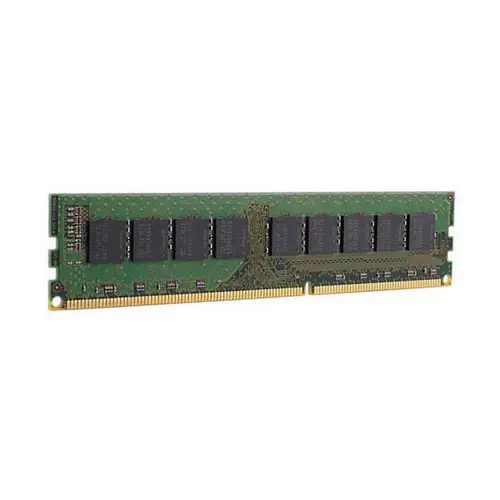
The Samsung M393T2953GZA-CE6 is a DDR2-667 server RDIMM built around four mission-critical attributes: ECC, registered buffering, dual-rank x8 organization, and stable 1.8V power. In a virtualized cluster, ECC corrects single-bit errors on the fly, shielding guest VMs from random crashes that could corrupt databases or halt services. Registered buffering allows all 8 or 16 DIMM slots to be populated without bus loading issues, so you can scale memory to 64 GB or more and run many VMs simultaneously. Dual-rank interleaving accelerates data transfers when multiple VMs or a database engine access memory in parallel, reducing latency during heavy consolidation. For an in-memory database like Redis, ECC ensures that no bit-flip silently changes a key’s value, registered buffering delivers consistent latency even under peak reads/writes, and dual-rank interleaving speeds up thousands of requests per second.
General Virtualization
For lightweight hypervisors on legacy DDR2-era servers, install six or eight identical M393T2953GZA-CE6 modules (6–8 GB total) in balanced channels to maximize memory interleaving. Registered ECC ensures stability for multiple small VMs, but 1 GB DIMMs limit density—consolidate only undemanding workloads and avoid memory overcommitment.
In-Memory Database
Due to the 1 GB module capacity, this RDIMM is unsuitable for modern in-memory datasets. If repurposing older hardware for small caching layers, populate all available slots (e.g., 8x 1 GB) and configure the database to use a RAM disk limited by the 8 GB ceiling. Seriously consider a platform refresh; DDR2 capacity severely throttles performance.
High-Performance Computing
For legacy cluster nodes, deploy fully populated memory banks (8 or 16 identical sticks) to ensure dual-rank x8 DIMMs deliver peak bandwidth. Rely on ECC to protect long-running MPI jobs, but note that 667 MHz and 1 GB per module create a severe bottleneck—reserve such nodes for educational or lightweight parallel tasks only.
Rigorously tested server RDIMM, validated for Dell PowerEdge 2950, HP ProLiant DL380 G5, IBM System x3650.
Q: Can I mix this M393T2953GZA-CE6 with other memory modules of different brands or speeds?
A: Mixing different brands or speeds with this registered ECC DDR2 module is highly discouraged. Mismatched timing and loading can cause system instability and memory errors in server environments.
Q: Is this memory compatible with my Intel or AMD server platform?
A: It is compatible with server boards supporting DDR2-667 registered ECC memory, such as those based on Intel 5000/5400 series chipsets or equivalent AMD Opteron platforms. Please verify your motherboard's qualified vendor list.
Q: What is the recommended DIMM population order for optimal performance on a server board?
A: Populate identical DIMMs in pairs per channel as directed by the server board manual. Typically, fill matching-color slots first to enable dual-channel or memory interleaving for maximum throughput.
Q: Does this module support overclocking or XMP profiles?
A: No. As a server-grade registered ECC DIMM, it adheres strictly to JEDEC DDR2-667 standards and does not support overclocking or XMP profiles. Reliability and data integrity take priority.
Q: What warranty and typical failure rate can I expect with this memory?
A: This module includes a 1-year warranty. Enterprise-class registered ECC memory undergoes rigorous testing, resulting in an extremely low annualized failure rate under normal operating conditions.