











 Secure payments
Standard refund policy
Trade Assurance
Secure payments
Standard refund policy
Trade Assurance
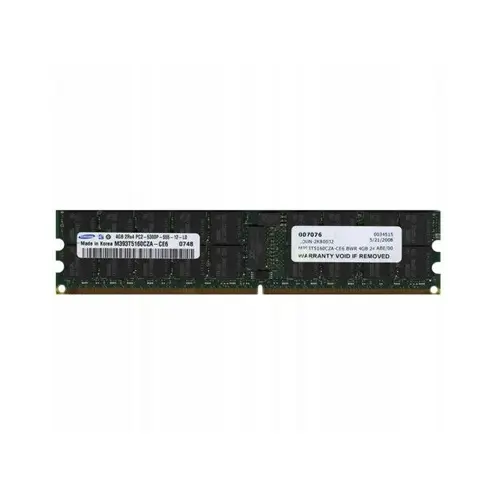
| Model | M393T5160CZA-CE6 |
|---|---|
| Product Type | Memory Module |
| Compliance Standards | EU RoHS,FCC |
| Memory Capacity | 4 GB |
| Memory Technology | DDR2 |
| Product Voltage | 1.8V |
| RAM Speed | 667MHz |
| RAM Standard | DDR2-667/PC2-5300 |
| Error Identifying | ECC |
| Signal Type | Registered |
| Column Access Strobe (CAS) | CL5 |
| Rank | Dual Rank x4 |
| Quantity of Pins | 240-pin |
| RAM Genre | RDIMM |
Identified as a legacy server DDR2 RDIMM, this module is best suited for aging enterprise servers and storage appliances where ECC-registered memory ensures data integrity for virtualization hosts and lightweight in-memory databases. Its Registered signal type and dual-rank x4 organization enhance signal stability and allow the memory controller to interleave access across ranks, effectively mitigating latency for sustained workloads at the rated CL5 timings.
1. ECC protection detects and corrects single-bit errors in real time, safeguarding transactional data integrity for mission-critical enterprise applications.
2. Registered signal buffering stabilizes high-capacity memory configurations, essential for maintaining system reliability under fully populated server boards.
3. Dual Rank x4 organization maximizes bank-level parallelism, boosting memory bandwidth utilization for virtualized workloads running multiple concurrent instances.
4. 667 MHz clock speed delivers consistent memory throughput, reducing latency spikes during peak database query loads in small business servers.
5. 4 GB density per module offers a cost-effective capacity point for entry-level virtualization hosts or lightweight containerized microservices.
In today’s always-on enterprise infrastructure, every bit of data matters. The Samsung M393T5160CZA-CE6 Registered ECC DDR2 module may be a legacy component, but its four core design traits are engineered precisely to eliminate the most common failure points in mission-critical server environments. When you deploy a virtualization cluster running multiple VMs on a single host, memory integrity becomes non-negotiable. The built-in ECC corrects single-bit errors caused by background radiation or electrical noise, preventing silent data corruption that could crash a hypervisor or poison a live database. Meanwhile, the registered buffer isolates the memory controller from excessive electrical loads, letting you populate all 240-pin slots without sacrificing signal quality—vital for dense virtualization setups that demand maximum RAM capacity. The module’s dual-rank x4 organization enables rank interleaving, so while one rank completes a refresh or access cycle, the other prepares the next request. In practice, this parallelism boosts throughput in memory-intensive applications like an in-memory database, shaving precious microseconds off each query. Together with tight CAS 5 latency and a steady 667 MHz clock, this DIMM transforms raw specifications into real-world reliability: fewer application errors, longer platform uptime, and predictable performance when every transaction counts.
This is a server-class DDR2-667 Registered ECC DIMM (4 GB, dual-rank x4). Capacity planning with this legacy module must respect older platform ceilings and channel population rules.
General Virtualization
For even lightweight hypervisors, avoid a single module; install at least two identical RDIMMs (8 GB total) to enable error correction and dual-channel operation. A realistic virtualization host on this generation benefits from 16 GB (4 x 4 GB) to hold a few virtual machines, populating all available memory channels evenly for stable registered signaling.
In-Memory Database
This 4 GB ECC RDIMM severely constrains modern datasets. Maximize capacity by filling every DIMM slot the server supports—typically 16 GB or 32 GB total—using identical dual-rank modules to maintain single-bit correction and predictable latency. Only the smallest read-heavy caches or historical archival indexes will fit; plan to distribute tables across nodes if scale-out is an option.
High-Performance Computing (HPC)
Memory bandwidth is critical, so pair the modules across both channels per processor. Configure compute nodes with 8 GB (2 x 4 GB) or 16 GB (4 x 4 GB) per socket to enable channel interleaving and reduce access bottlenecks. For capacity-driven HPC workloads, fully populate all slots to hit the board’s maximum, but expect a wall at 667 MT/s when feeding multi-core CPUs.
Rigorously tested, compatible with Dell PowerEdge 6950, HP ProLiant DL385 G2, IBM System x3655.
Q: Can I mix this M393T5160CZA-CE6 with other memory modules of different brands or speeds?
A: Mixing is strongly discouraged. This is a registered DDR2-667 ECC module. Disparate brands, speeds, or ranks often cause signal integrity issues and system instability in server environments.
Q: Is this memory compatible with my Intel or AMD server platform?
A: It is designed for servers supporting dual-rank, 240-pin Registered ECC DDR2-667 DIMMs, such as those with Intel 5000/5400 chipsets or corresponding AMD Opteron platforms. Verify motherboard QVL lists.
Q: What is the recommended DIMM population order for optimal performance?
A: Populate identical kits per channel, starting with the furthest slot from the processor. Always follow your server board’s specific memory configuration guide to maintain balanced interleaving and correct ECC operation.
Q: Does this module support overclocking or XMP profiles?
A: No. As a server-grade RDIMM with ECC, it strictly adheres to JEDEC DDR2-667 standard timings. Overclocking or XMP is not supported; reliable, error-free operation takes precedence over speed.
Q: Can this DDR2 registered ECC module be used in a standard desktop PC?
A: No. This memory requires a server motherboard specifically supporting registered ECC DDR2. Standard desktop motherboards only accept unbuffered, non-ECC DIMMs and are physically and electrically incompatible.