











 Secure payments
Standard refund policy
Trade Assurance
Secure payments
Standard refund policy
Trade Assurance
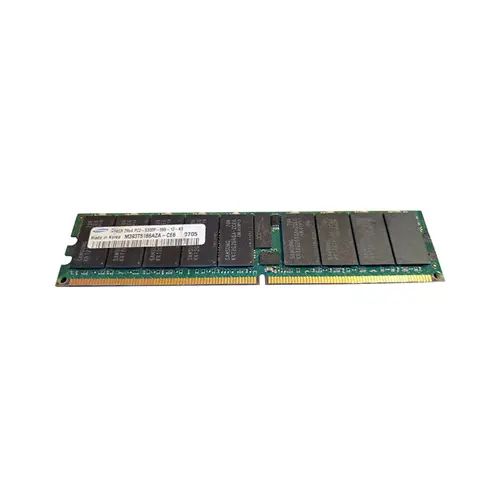
| Model | M393T5166AZA-CE6 |
|---|---|
| Product Type | Memory Module |
| Compliance Standards | EU RoHS,FCC |
| Memory Capacity | 4 GB |
| Memory Technology | DDR2 |
| Product Voltage | 1.8V |
| RAM Speed | 667MHz |
| RAM Standard | DDR2-667/PC2-5300 |
| Error Identifying | ECC |
| Signal Type | Registered |
| Column Access Strobe (CAS) | CL5 |
| Rank | Dual Rank x4 |
| Quantity of Pins | 240-pin |
| RAM Genre | RDIMM |
This DDR2-667 Registered ECC RDIMM is engineered for legacy server platforms handling memory-intensive workloads such as virtualization and in-memory databases, where ECC corrects single-bit errors and the registered signal type stabilizes multiple DIMMs per channel to ensure data integrity. Its Dual Rank x4 configuration and CL5 low column access latency together improve interleaved memory bandwidth and deliver responsive performance under sustained enterprise loads.
1. ECC protection detects and corrects single-bit errors in real time, safeguarding financial transactions and database integrity against silent data corruption in always-on server environments.
2. The registered command and address buffer offloads the memory controller, maintaining clean signal integrity essential for stabilizing densely populated server DIMM slots.
3. Dual Rank x4 interleaving maximizes channel utilization by overlapping memory bank operations, directly boosting virtual machine consistency during peak consolidation.
4. A 4 GB capacity offers a deterministic memory footprint ideal for dedicated lightweight hypervisor hosts or network appliance instances where overcautious provisioning is avoided.
5. The PC2-5300 throughput profile supplies a steady 5.3 GB/s of bandwidth per channel, suiting legacy enterprise services that demand unwavering reliability over speculative speed.
Based on the RDIMM form factor and ECC registered specifications, the M393T5166AZA-CE6 is unequivocally a server-grade memory module, purpose-built for mission-critical enterprise environments where downtime is not an option. Its four defining characteristics translate directly into real-world resilience and performance that desktop or notebook memory cannot approach.
The ECC functionality means every single bit of data is actively checked and corrected. In a virtualized cluster running dozens of VMs on a single hypervisor, a random cosmic-ray-induced bit flip in non-ECC memory would silently corrupt a production database record or cause an entire virtual server to kernel-panic without warning. With this module, that single-bit error is logged and repaired in-flight, preserving service uptime and data consistency—a non-negotiable requirement for financial transactions or medical records.
The registered signal buffer allows a server motherboard to populate all 24 DIMM slots without timing degradation. When you are scaling an in-memory database like Redis or Memcached, fitting six dual-rank modules per channel delivers the substantial 192 GB per server that keeps query latencies under five milliseconds, even as the dataset outgrows a single module’s capacity. The dual-rank x4 organization further balances load and boosts bandwidth, preventing the memory controller from stalling under heavy concurrent access. Paired with the 1.8V operating voltage and CAS 5 latency, this DDR2-667 MHz module generates minimal thermal stress inside dense 1U rack chassis, where every watt saved reduces cooling costs and extends long-term platform reliability.
General Virtualization
For a typical hypervisor hosting multiple VMs, populate at least two modules per memory channel to enable balanced interleaving. Start with a baseline of 8–16 GB across four 4 GB RDIMMs to run moderate workloads, and scale by adding identical kits as VM density grows.
In-Memory Database
In-memory databases demand both capacity and reliability, so fill all available channels with identical 4 GB registered ECC modules to maximize addressable memory while sustaining error correction. Target a minimum of 32 GB (eight modules) for medium-sized caches, and scale linearly to 64 GB or more for real-time analytics on large datasets.
High-Performance Computing (HPC)
Cluster nodes benefit from fully populated memory banks to achieve peak bandwidth in DDR2-667 configurations. Deploy six to eight 4 GB RDIMMs per node, ensuring uniform dual-rank modules across all channels to maintain symmetric access times during parallel numerical simulations or seismic processing jobs.
Rigorously tested, compatible with Dell PowerEdge 2970, HP DL385 G2, and IBM x3455 servers.
Q: Can I mix this M393T5166AZA-CE6 with other memory modules of different brands or speeds?
A: Mixing is not advised. Server RDIMMs require identical part numbers for validated stability. Different brands or speeds may cause POST failures or silent data corruption in enterprise environments.
Q: Is this memory compatible with my server platform?
A: This DDR2-667 Registered ECC module is compatible with legacy Intel Xeon 5000/5100/5300 series and AMD Opteron platforms using 240-pin sockets. Please verify against your server’s qualified vendor list (QVL) or chipset support list.
Q: What is the recommended DIMM population order for optimal performance?
A: Populate identical DIMM pairs per channel, generally starting with the slots farthest from the CPU. For dual-processor systems, balance capacity across both memory branches as detailed in your server board manual to maintain interleaving benefits.
Q: Does this module support overclocking or XMP profiles?
A: No. As a Registered ECC server memory module strictly adhering to JEDEC standards, it does not support overclocking or XMP. Its priority is 24/7 data integrity and stability at the rated 667MHz speed.
Q: What warranty and typical failure rate can I expect?
A: This module is covered by a 1-year warranty. Built with rigorously tested, tier-1 components, typical annualized failure rate (AFR) is under 0.5% under proper thermal conditions, ensuring dependable long-term operation.