











 Secure payments
Standard refund policy
Trade Assurance
Secure payments
Standard refund policy
Trade Assurance
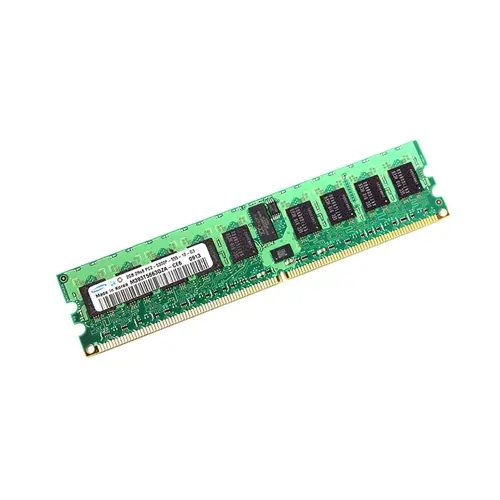
| Model | M393T5663QZA-CE6 |
|---|---|
| Product Type | Memory Module |
| Compliance Standards | EU RoHS,FCC |
| Memory Capacity | 2 GB |
| Memory Technology | DDR2 |
| Product Voltage | 1.8V |
| RAM Speed | 667MHz |
| RAM Standard | DDR2-667/PC2-5300 |
| Error Identifying | ECC |
| Signal Type | Registered |
| Column Access Strobe (CAS) | CL5 |
| Rank | Dual Rank x8 |
| Quantity of Pins | 240-pin |
| RAM Genre | RDIMM |
Designed as a server-grade DDR2-667 Registered ECC module, the Samsung M393T5663QZA-CE6 delivers critical data integrity for legacy virtualization hosts and memory-intensive databases. Its dual-rank x8 organization with CL5 latency and registered signal buffering ensures stable operation under fully populated configurations, making it an ideal choice for sustaining reliable uptime in aging enterprise platforms where error correction is paramount.
1. ECC memory detects and corrects single-bit errors in real time, preventing silent data corruption that could otherwise crash critical financial or healthcare transaction systems.
2. Registered signal logic buffers command and address lines, allowing dense memory populations to remain stable even when every DIMM slot is populated in a large-scale virtualization host.
3. Dual Rank x8 organization enables rank interleaving that saturates the memory bus, delivering the sustained bandwidth essential for running multiple heavy database instances concurrently.
4. The CL5 column access strobe latency provides tightly deterministic read timing, reducing completion jitter for synchronous replication tasks in clustered legacy server environments.
5. A module density of 2 GB fits cost-constrained legacy infrastructures, offering sufficient capacity to sustain essential domain controllers or lightweight edge caching nodes without overprovisioning.
The M393T5663QZA-CE6 is a server‑grade RDIMM engineered to eliminate the silent killers of data‑center workloads. In a virtualized cluster, the integrated ECC continuously hunts and corrects single‑bit upsets — cosmic‑ray flips that would otherwise poison a hypervisor’s memory space and bring down dozens of customer VMs without warning. That means true 24/7 uptime, not just promised availability. The registered buffer rebuilds command signals across fully populated channels, letting you scale to massive memory footprints without signal collapse, a direct enabler for dense VMware hosts that must keep growing. Dual‑rank x8 organization takes this further through rank interleaving: while one rank finishes a fetch, the other is already prepared for the next concurrent request from an in‑memory database like Redis. The result is sustained bandwidth under heavy commit storms, so transaction latencies stay flat. Finally, CL5 latency trims every access cycle, accelerating real‑time analytics so your SAP HANA dashboards render insights before users feel a delay. Here, every specification is a service‑level commitment.
General Virtualization
For moderate consolidation of legacy virtual machines, populate at least four identical M393T5663QZA-CE6 modules to leverage quad-channel interleaving on older server platforms. This 8GB total (4x2GB) configuration balances cost and memory bandwidth, avoiding bottlenecks when running multiple lightweight VMs. Ensure all slots per channel are filled symmetrically to maintain uniform latency and prevent NUMA imbalances.
In-Memory Database
In-memory datasets demand maximum error resilience, making these ECC Registered DIMMs essential for data integrity. Configure the server with fully populated ranks—install two modules per channel to achieve dual-rank interleaving, reducing contention under high transaction rates. While 2GB per stick limits raw capacity, prioritizing rank population over fewer, larger DIMMs helps sustain low-latency access for key-value stores or caching layers.
High-Performance Computing
HPC workloads benefit from the predictable CL5 latency and ECC protection of these DDR2-667 modules in distributed node architectures. Deploy six or eight modules per node in a balanced multi-channel setup to maximize theoretical memory throughput for memory-bandwidth-bound simulations. Instruct firmware to keep the registered buffer voltage at 1.8V and disable power-saving modes to avoid timing jitter during long-running parallel calculations.
Strictly validated for servers: Dell PowerEdge 2950, HP ProLiant DL380 G5, IBM System x3650.
Q: Can I mix this M393T5663QZA-CE6 with other memory modules of different brands or speeds?
A: Mixing modules is strongly discouraged in server environments. Mismatched brands or speeds can cause stability issues and disable ECC functionality. For reliable operation, populate with identical Samsung DDR2-667 Registered ECC DIMMs.
Q: Is this memory compatible with my Intel or AMD server platform?
A: Compatibility depends on your server board's qualified vendor list. This DDR2-667 Registered ECC module fits platforms using Intel 5000/5400 series or older AMD Opteron chipsets requiring 240-pin RDIMMs with 1.8V support.
Q: What is the recommended DIMM population order for optimal performance?
A: Always follow your server board manual. Typically, populate identical DIMMs per channel starting with the slot farthest from the CPU. For dual-rank RDIMMs, maintain balanced configurations across memory channels to maximize interleaving.
Q: Does this module support overclocking or XMP profiles?
A: No, this is an enterprise server memory module. It adheres strictly to JEDEC DDR2-667 standards and does not support overclocking or XMP profiles. Performance is fixed at 667MHz with CL5 timings for guaranteed data integrity.
Q: What warranty and typical failure rate can I expect?
A: This module is backed by a one-year warranty. Actual failure rate is extremely low under proper conditions, comparable to industry-standard server memory, with ECC functionality designed to detect and correct single-bit errors before they cause downtime.