











 Secure payments
Standard refund policy
Trade Assurance
Secure payments
Standard refund policy
Trade Assurance
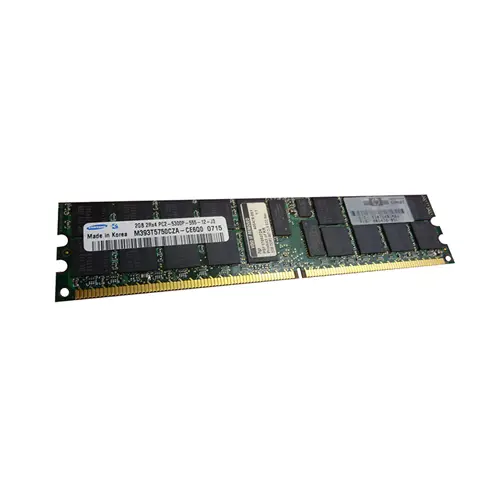
| Model | M393T5750CZA-CE6Q0 |
|---|---|
| Product Type | Memory Module |
| Compliance Standards | EU RoHS,FCC |
| Memory Capacity | 2 GB |
| Memory Technology | DDR2 |
| Product Voltage | 1.8V |
| RAM Speed | 667MHz |
| RAM Standard | DDR2-667/PC2-5300 |
| Error Identifying | ECC |
| Signal Type | Registered |
| Column Access Strobe (CAS) | CL5 |
| Rank | Dual Rank x4 |
| Quantity of Pins | 240-pin |
| RAM Genre | RDIMM |
Designed for legacy server platforms requiring DDR2-667 Registered ECC memory, this Samsung M393T5750CZA-CE6Q0 RDIMM is ideally suited for memory-intensive, mission-critical workloads such as virtualization, in-memory databases, and data integrity-sensitive applications. Its dual-rank x4 configuration with CL5 latency and registered signal architecture delivers stable, reliable operation under full population, while integrated ECC corrects single-bit errors to ensure data integrity in always-on enterprise environments.
1. ECC protection detects and corrects single-bit errors on the fly, preserving data integrity for mission-critical databases and financial transaction servers where even silent corruption is unacceptable.
2. Registered signaling buffers command and address lines, allowing dense memory configurations across many DIMM slots to support heavy virtualization workloads without sacrificing signal stability.
3. Dual Rank x4 organization interleaves internal bank accesses, sustaining channel utilization that keeps multiple virtual machines responsive and throughput steady under consolidated loads.
4. 667 MHz clock speed provides a dependable 5.3 GB/s per channel, matching the bandwidth needs of legacy enterprise servers running latency-sensitive messaging and caching services.
5. CL5 column access strobe shortens read latency, tightening response times for cache-dependent server processes and improving overall transaction throughput in request-heavy environments.
When managing virtualized clusters and in-memory databases, Samsung M393T5750CZA-CE6Q0, a 2GB DDR2-667 RDIMM, delivers four capabilities that directly prevent costly failures. First, ECC memory corrects single-bit errors caused by background radiation, stopping silent data corruption inside financial ledgers or hypervisor states where a flipped bit could crash dozens of virtual machines. Second, the Registered buffer stabilizes address and command signals across high-density configurations, so fully populating all DIMM slots to maximize capacity won't degrade signal integrity as your VM density scales. Third, its Dual Rank x4 design enables rank interleaving: the memory controller accesses one rank while another precharges, effectively boosting sustained bandwidth and lowering read latency for latency-critical workloads like Redis or Memcached. Finally, a consistent 1.8V operating voltage and CL5 latency deliver predictable thermal behavior and response times under 24/7 operation. In your resilient but aging infrastructure, this module translates directly to preserved data fidelity, extended uptime, and the ability to postpone a full platform migration.
Capacity Planning Guide for M393T5750CZA-CE6Q0 (2GB DDR2-667 ECC Registered RDIMM)
General Virtualization
Virtualization demands ample capacity and reliability. Populate all memory channels symmetrically with at least eight 2GB modules (16GB) to host multiple VMs comfortably. Enable memory mirroring for fault tolerance or sparing to enhance uptime, and stick to identical dual-rank x4 DIMMs for consistent performance.
In-Memory Database
Low latency and large capacity are critical. Fully populate the server with up to 16 modules (32GB) to keep datasets resident. Leverage the dual-rank x4 design to enable rank interleaving, which reduces access latency. Configure the memory controller for optimal row-hammer thresholds if supported.
High-Performance Computing (HPC)
Memory bandwidth is paramount. Install modules in balanced sets (e.g., 4 or 8 DIMMs) across all available channels and configure channel interleaving. Use an even number of ranks per channel to avoid bandwidth cliffs; this 2GB RDIMM’s x4 organization supports efficient stream throughput in dual-rank mode.
Rigorously tested for servers: compatible with Dell PowerEdge 1950/2950/2900, HP ProLiant DL380 G5, IBM x3650.
Q: Can I mix this M393T5750CZA-CE6Q0 with other memory modules of different brands or speeds?
A: Mixing RDIMMs from different brands or speeds is strongly discouraged. It may cause signal integrity issues and system instability. For reliable operation, use identical M393T5750CZA-CE6Q0 modules with the same rank and CAS latency.
Q: Is this memory compatible with my system?
A: This DDR2-667 ECC Registered DIMM is designed for legacy server platforms. It typically supports Intel 5000/5400 series or AMD Opteron-based boards requiring 240-pin RDIMMs. Verify your system’s qualified vendor list for exact compatibility.
Q: What is the recommended DIMM population order for optimal performance?
A: On dual-processor servers, populate slots per channel starting with the lowest-numbered DIMM slot to maximize interleaving. Refer to your system's service guide. Typically, install identical modules in sets of two or four for symmetrical memory population.
Q: Does this module support overclocking or XMP profiles?
A: No. This is a server-grade Registered ECC module built to JEDEC standards. It does not support XMP profiles or overclocking. Its firmware is tuned for data integrity and 24/7 stability, not performance tuning beyond rated timings.
Q: What warranty and typical failure rate can I expect?
A: This module carries a one-year warranty. Enterprise RDIMMs like this have very low annualized failure rates, typically well under 0.5%, and are designed for continuous operation in thermally managed data center environments.