











 Secure payments
Standard refund policy
Trade Assurance
Secure payments
Standard refund policy
Trade Assurance
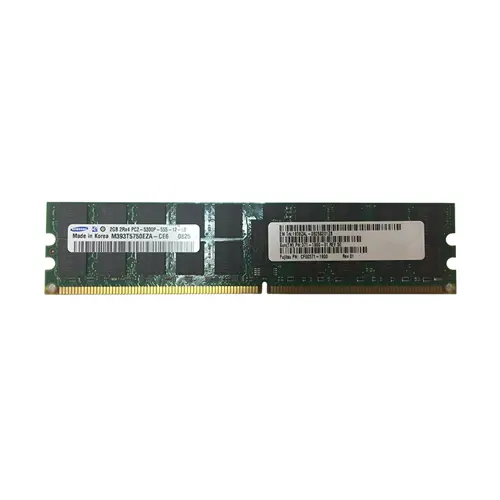
| Model | M393T5750EZA-CE6 |
|---|---|
| Product Type | Memory Module |
| Compliance Standards | EU RoHS,FCC |
| Memory Capacity | 2 GB |
| Memory Technology | DDR2 |
| Product Voltage | 1.8V |
| RAM Speed | 667MHz |
| RAM Standard | DDR2-667/PC2-5300 |
| Error Identifying | ECC |
| Signal Type | Registered |
| Column Access Strobe (CAS) | CL5 |
| Rank | Dual Rank x4 |
| Quantity of Pins | 240-pin |
| RAM Genre | RDIMM |
This 2 GB DDR2-667 registered ECC RDIMM is purpose-built for legacy server platforms running virtualization, in-memory databases, and other mission-critical workloads where data integrity and uptime are non-negotiable. Its dual-rank x4 organization boosts bandwidth through rank interleaving, while the registered signal path and ECC engine maintain rock-solid stability and correct single-bit errors even in fully populated 240-pin channels.
1. ECC protection silently detects and corrects single-bit memory errors, preserving transactional integrity in financial databases and preventing data corruption during long-running analytics jobs.
2. Registered signal buffering stabilizes command and address lines across fully loaded server memory channels, enabling reliable operation with maximum DIMM counts for dense virtualization hosts.
3. The RDIMM form factor delivers robust signal integrity for rack servers, ensuring consistent uptime in multi-tenant environments where memory faults cascade into SLA violations.
4. Dual Rank x4 organization interleaves data accesses across two internal rank groups, sustaining throughput for virtual machine fleets that demand concurrent memory fetches without stalling.
5. DDR2 technology with industry-standard JEDEC compliance guarantees seamless drop-in compatibility with legacy server platforms, extending the service life of critical infrastructure without unexpected integration risks.
The M393T5750EZA-CE6 is a server-grade DDR2 667MHz Registered ECC DIMM purpose-built for legacy enterprise environments. Its ECC, Registered buffering, Dual Rank architecture, and compliance credentials directly address real IT pain points. ECC correction silently fixes single-bit memory errors, preventing silent data corruption that could crash a virtualized cluster or a transactional database—keeping your critical services accurate and always online. Registered buffering stabilizes command signals to support higher memory capacities without signal degradation, so your aging server can scale reliably to host more VMs or run a larger in-memory cache. Dual Rank x4 interleaving boosts effective bandwidth and drives down latency for real-time analytics queries when every millisecond counts. EU RoHS and FCC certification ensure safe, interference-free operation inside densely packed racks. For organizations still running essential applications on mature infrastructure, this module is not just a simple upgrade; it’s your safeguard against costly downtime and data loss, protecting the integrity of your transactional data and extending the life of your hardware investment.
Based on the specifications (DDR2-667, ECC Registered RDIMM, 1.8V), this is clearly a server memory module designed for legacy enterprise systems. Capacity planning must account for its lower density and speed relative to modern workloads.
General Virtualization
With only 2GB per module, you need a high number of identical sticks to populate all memory channels for aggregate capacity. Aim to fully balance channels (e.g., 8 identical modules in an 8-slot server for 16GB total) to maximize interleaving and avoid NUMA bottlenecks. This baseline handles a few light VMs but demands careful reservation to prevent swapping.
In-Memory Database
A 2GB ECC DIMM is severely limiting for in-memory datasets. You must install the maximum supported identical modules—often 8 or 16—to reach 16–32GB total, which only suits small test instances. Strictly validate data fit within physical memory, as any spillover to disk destroys performance. Plan for a migration to higher-capacity systems for production.
High Performance Computing (HPC)
For memory-bandwidth-sensitive HPC, populate all channels with matched, dual-rank x4 Registered DIMMs to sustain peak throughput. The 2GB capacity forces a shallow per-node memory footprint, so you should architect codes to use problem sizes that fit entirely in caches or the limited DRAM, amplifying cluster scale to compensate for node constraints.
Rigorously tested DDR2 RDIMM compatible with Dell PowerEdge SC1435, HP ProLiant DL385 G2, and Sun Fire X4100.
Q: Can I mix this M393T5750EZA-CE6 with other memory modules of different brands or speeds?
A: Mixing with different brands or speeds is not recommended. Registered ECC modules require identical specifications to maintain signal integrity and stability. Mismatched DIMMs may cause system POST failures or silent data corruption.
Q: Is this memory compatible with my system?
A: This RDIMM is compatible with servers based on Intel 5000/5100/5400 series chipsets or AMD Opteron platforms supporting DDR2-667 Registered ECC memory. Verify your server motherboard supports 240-pin registered DDR2 at 667 MHz.
Q: What is the recommended DIMM population order for optimal performance?
A: Follow your server board’s memory population guide. Typically, populate identical DIMMs per channel starting with the farthest slot from the CPU. For dual-rank modules, balanced interleaving across channels maximizes throughput.
Q: Does this module support overclocking or XMP profiles?
A: No. This is a JEDEC-compliant server-grade registered ECC module and does not support overclocking or XMP profiles. It operates strictly at the specified latencies for maximum data integrity and 24/7 reliability.
Q: What warranty and typical failure rate can I expect?
A: This module includes a one-year warranty. As a rigorously tested enterprise RDIMM, it delivers an extremely low annualized failure rate (AFR) under normal server operating conditions, ensuring dependable long-term system uptime.