











 Secure payments
Standard refund policy
Trade Assurance
Secure payments
Standard refund policy
Trade Assurance
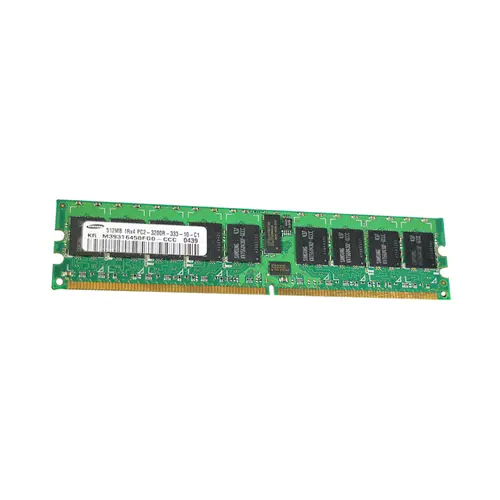
| Model | M393T6450FG0-CCC |
|---|---|
| Product Type | Memory Module |
| Compliance Standards | EU RoHS,FCC |
| Memory Capacity | 512 MB |
| Memory Technology | DDR2 |
| Product Voltage | 1.8V |
| RAM Speed | 400MHz |
| RAM Standard | DDR2-400/PC2-3200 |
| Error Identifying | ECC |
| Signal Type | Registered |
| Column Access Strobe (CAS) | CL3 |
| Rank | Single Rank x4 |
| Quantity of Pins | 240-pin |
| RAM Genre | RDIMM |
This 512 MB DDR2-400 registered ECC RDIMM is purpose-built for legacy server platforms requiring strict data integrity, making it suitable for lightweight virtualization hosts, file servers, or in-memory caching on aging Intel Xeon or AMD Opteron systems. Its single-rank x4 organization and low CAS latency of 3 provide stable, low-latency access under sustained loads, while the registered buffer and full ECC protection ensure signal integrity and end-to-end error correction across all populated DIMM slots.
1. Registered signal buffering decouples command and address loading from the memory bus, allowing dense server deployments to scale up to maximum DIMM slots without compromising command integrity.
2. ECC protection continuously detects and corrects single-bit errors in real time, preserving data accuracy across months-long uptime cycles typical of enterprise financial ledgers.
3. Single Rank x4 organization minimizes per-rank electrical drag, sustaining clean signaling when all channels are populated to support high-density virtualization clusters.
4. Ultra-tight CAS latency accelerates memory word retrieval, shaving critical nanoseconds off database index lookups and transactional commit operations.
5. Mature DDR2 process technology provides exceptionally predictable refresh latency profiles, fitting legacy server environments where deterministic response often outweighs peak bandwidth.
In mission-critical server environments, the M393T6450FG0-CCC DDR2 RDIMM directly safeguards your uptime and data quality in ways that generic memory cannot. Consider a dense virtualization cluster running multiple VMware ESXi hosts: the module’s Registered signal buffer stabilizes the command and address lines even when all 240-pin slots are populated, allowing you to scale VM density without intermittent memory errors that would force a host reboot. Meanwhile, the true ECC engine detects and corrects single-bit flips caused by background radiation—a silent threat that, in an in-memory database like Redis or SAP HANA, could corrupt transactional records or propagate stale pricing data across your entire trading platform. This means ECC is not a checklist item; it is insurance against data poisoning. Backing that integrity, the Single Rank x4 organization with a tight CL3 latency delivers deterministic, low-latency access for read-heavy caching layers where every nanosecond of fetch time influences user-facing response. The 1.8V operating voltage and EU RoHS compliance further ensure long-term thermal stability within 1U rack servers where cooling headroom is scarce. For the IT architect, these four characteristics translate into consolidated workloads that run predictably, databases that stay accurate, and a server farm that demands fewer early-morning emergency pages.
General Virtualization
For virtualization hosts using these 512 MB DDR2-400 Registered ECC DIMMs, maximize installed capacity by populating all available memory slots in a balanced configuration. Aim to match identical modules across each memory channel to maintain symmetric multi-channel access, which helps sustain stable VM density under moderate overcommitment. Given the small module size, plan for at least 8–16 identical sticks per server to reach a usable 4–8 GB pool for lightweight hypervisor workloads.
In-Memory Database
In-memory databases demand low latency and absolute data integrity, making ECC Registered memory essential. Populate all memory banks uniformly with these single-rank x4 RDIMMs to minimize electrical loading and achieve the highest possible capacity within the platform’s limits. Even so, 512 MB per DIMM is constraining; target fully loaded server boards (e.g., 16–32 DIMMs) to aggregate 8–16 GB, strictly dedicating the entire physical memory space to the database working set while avoiding any swap.
High Performance Computing
HPC clusters benefit from reliable, deterministic memory access under sustained computation. Deploy these DDR2-400 RDIMMs in a fully balanced, multi-channel configuration—typically one DIMM per channel to avoid rank-staggering penalties—to deliver consistent bandwidth for memory-bound scientific codes. Because capacity per node remains low with 512 MB modules, cluster scaling through more nodes is necessary, and attention should go to uniform firmware settings and identical DIMM placements across all compute nodes for reproducible performance.
Engineered for servers; rigorously tested with Dell PowerEdge 2900, HP ProLiant DL380 G5, IBM System x3650.
Q: Can I mix this M393T6450FG0-CCC with other memory modules of different brands or speeds?
A: Mixing this RDIMM with different brands or speeds is not recommended for server environments. Mismatched modules can cause instability, POST failures, or data corruption. Always populate identical part numbers for mission‑critical reliability.
Q: Is this memory compatible with my system?
A: This DDR2‑400 Registered ECC RDIMM is designed for older server platforms supporting 240‑pin DDR2 Registered memory. Verify compatibility with your Intel Xeon or AMD Opteron system chipset and ensure ECC support in BIOS.
Q: What is the recommended DIMM population order for optimal performance?
A: Refer to your server board manual. Typically, populate identical RDIMMs per channel starting from the slot farthest from CPU. Balance across memory channels for best throughput and full ECC functionality.
Q: Does this module support overclocking or XMP profiles?
A: No. This is a server‑grade Registered ECC memory, operating at JEDEC standard DDR2‑400 (PC2‑3200) speeds. Overclocking and XMP are not supported, as stability and data integrity are prioritized.
Q: What warranty and typical failure rate can I expect?
A: This product includes a 1‑year warranty. As enterprise‑class memory with ECC, typical Annualized Failure Rate (AFR) is very low, usually well below 1% under proper operating conditions.