











 Secure payments
Standard refund policy
Trade Assurance
Secure payments
Standard refund policy
Trade Assurance
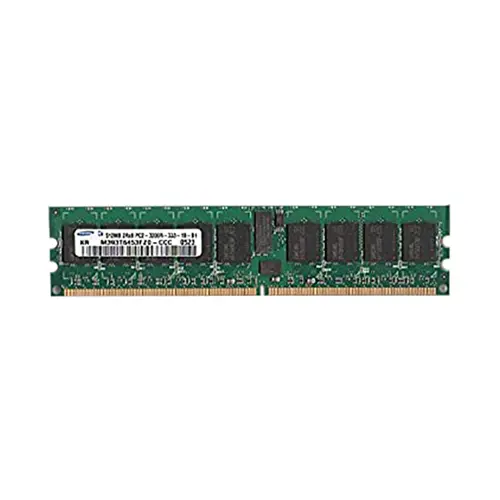
| Model | M393T6453FZ0-CCC |
|---|---|
| Product Type | Memory Module |
| Compliance Standards | EU RoHS,FCC |
| Memory Capacity | 512 MB |
| Memory Technology | DDR2 |
| Product Voltage | 1.8V |
| RAM Speed | 400MHz |
| RAM Standard | DDR2-400/PC2-3200 |
| Error Identifying | ECC |
| Signal Type | Registered |
| Column Access Strobe (CAS) | CL3 |
| Rank | Dual Rank x8 |
| Quantity of Pins | 240-pin |
| RAM Genre | RDIMM |
This DDR2-400 Registered ECC module (M393T6453FZ0-CCC) is a legacy server DIMM purpose-built for stability-sensitive platforms such as aging virtualization hosts and small-scale memory databases where data integrity is non-negotiable. Its Registered signal type reduces electrical loading on the memory controller, while the ECC and dual-rank x8 organization provide a critical layer of error correction and sustained throughput for mission-consistent 24/7 operation.
1. ECC protection proactively identifies and corrects single-bit memory errors, preserving data integrity during prolonged transactional database workloads.
2. The registered buffer isolates electrical loading on command and address lines, enabling dense memory configurations to remain stable under heavy multi-socket processing.
3. Dual Rank x8 interleaving spreads memory accesses across physical banks, maximizing throughput for virtualization hosts consolidating multiple guest instances.
4. The entry-level capacity provides a cost-optimized building block for embedded systems and microservers where balanced resource allocation matters more than raw density.
5. DDR2 technology delivers proven operational reliability and reduced idle power draw, suiting always-on legacy enterprise platforms that prioritize uptime over peak bandwidth.
For servers running legacy mission-critical workloads, the M393T6453FZ0-CCC RDIMM turns four attributes into uptime. ECC corrects single-bit errors on the fly, preventing silent data corruption in virtualized clusters where a flipped bit can corrupt database records or crash VMs during live migration. Registered buffering stabilizes signals, letting you fill all slots with dual-rank DIMMs for in-memory databases like Redis without signal dropouts that trigger parity faults. Dual-rank interleaving then amplifies bandwidth for concurrent queries, ensuring batch analytics or OLTP workloads grind through data without memory-controller stalls. Finally, CL3 latency at 400MHz delivers the predictable response times financial trading systems depend on. For IT teams extending the life of aging servers, this module eliminates the risk of silent data errors and instability, keeping virtual desktop infrastructures and transactional databases running reliably beyond their expected retirement.
General Virtualization
This legacy registered ECC DDR2 module at 512MB is unsuitable for modern virtualization hosts, which demand tens to hundreds of gigabytes per server. For period‑correct hypervisors (e.g., VMware ESX 3.x, Xen), install at least eight identical modules in balanced channels to reach 4GB and minimize memory contention among a handful of lightweight VMs.
In-Memory Database
In‑memory databases require both capacity and error resilience. Deploy the maximum 16 modules (8GB total) in a fully‑populated dual‑rank configuration to exploit ECC reliability, but limit workloads to tiny, read‑heavy datasets such as DNS caching or small Redis instances on retro‑fit hardware.
High-Performance Computing
HPC nodes benefit from registered ECC to sustain long-running parallel jobs. Populate all memory channels symmetrically—typically six to eight modules of this 512MB RDIMM—to achieve perfect rank interleaving and maximum memory bandwidth, confining usage to scaled‑down computational kernels or educational cluster demonstrators.
Rigorously tested DDR2 server memory, compatible with Dell PowerEdge 1850, HP ProLiant DL380 G4, IBM xSeries 346.
Q: Can I mix this M393T6453FZ0-CCC with other memory modules of different brands or speeds?
A: Mixing is strongly discouraged. For reliable server operation, all modules must match in registered ECC DDR2, speed, 1.8V, dual-rank configuration. Mismatched timings or vendors often cause POST failures or data corruption.
Q: Is this memory compatible with my system?
A: This RDIMM is built for server platforms supporting DDR2-400/PC2-3200 Registered ECC at 1.8V, such as legacy Intel Xeon or AMD Opteron servers. Please confirm your motherboard’s QVL for full compatibility before purchase.
Q: What is the recommended DIMM population order for optimal performance?
A: Consult your server board manual. Generally, install identical modules in matched-channel pairs, filling the first slot of each channel to enable balanced interleaving and ensure the highest memory bandwidth and data integrity.
Q: Does this module support overclocking or XMP profiles?
A: No. This is a JEDEC-standard server RDIMM with fixed CL3 timings and no XMP support. Overclocking is not available and would undermine the sustained mission-critical stability required in enterprise environments.
Q: What warranty and typical failure rate can I expect?
A: It includes a one-year warranty. As an enterprise-class registered module, it undergoes rigorous testing and exhibits a very low annualized failure rate under normal operating conditions within specified voltage and temperature ranges.