











 Secure payments
Standard refund policy
Trade Assurance
Secure payments
Standard refund policy
Trade Assurance
| Model | M395T2953GZ4-CE66 |
|---|---|
| Product Type | Memory Module |
| Compliance Standards | EU RoHS,FCC |
| Memory Capacity | 1 GB |
| Memory Technology | DDR2 |
| Product Voltage | 1.8V |
| RAM Speed | 667MHz |
| RAM Standard | DDR2-667/PC2-5300 |
| Error Identifying | ECC |
| Signal Type | Fully Buffered |
| Column Access Strobe (CAS) | CL5 |
| Rank | Dual Rank x8 |
| Quantity of Pins | 240-pin |
| RAM Genre | FB-DIMM |
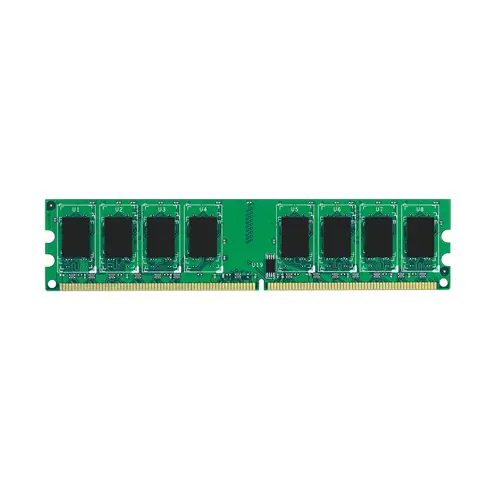
This fully buffered DDR2-667 ECC FB-DIMM is engineered specifically for legacy server platforms, delivering exceptional data integrity in memory-intensive workloads such as virtualization and in-memory databases. Its dual-rank x8 organization and fully buffered signal type enhance electrical stability and capacity scaling, while the integrated ECC reliably corrects single-bit errors to meet demanding uptime requirements.
1. Dual Rank x8 organization interleaves memory banks to reduce access conflicts, sustaining consistent throughput under heavy concurrent query loads in database servers.
2. Fully Buffered architecture isolates memory signals through an advanced buffer, enabling massive capacity scaling without signal degradation for large-memory enterprise workloads.
3. Integrated ECC actively detects and corrects single-bit errors, preventing silent data corruption that could jeopardize long-running mission-critical transactions.
4. The modest entry-level capacity serves as a cost-efficient building block for creating high-density memory pools in scale-out server clusters.
5. DDR2 technology provides proven stability and sufficient bandwidth for legacy enterprise platforms hosting persistent, latency-tolerant applications.
When managing a virtualized server cluster, a single undetected memory error can silently corrupt a hypervisor, cascading failures across dozens of guest machines. The M395T2953GZ4-CE66 is engineered precisely to prevent that nightmare. As a Fully Buffered DDR2 ECC module, its first critical feature is Error Correcting Code, which detects and corrects single-bit data corruption in real time — directly preserving transaction integrity in memory-hungry databases like SAP HANA or SQL Server, where even a bit flip inside an in-memory index can cause query mismatches or data loss. The fully buffered architecture isolates the DRAM chips from the memory bus via an advanced buffer, meaning large deployments with up to eight fully populated DIMMs per channel maintain rock-stable signal quality without the electrical loading that cripples unbuffered designs. This is essential for dense virtualization hosts that require 64GB or more of reliable footprint. The module’s dual-rank x8 organization interlocks two independent sets of DRAM pages on a single stick, enabling the memory controller to issue back-to-back read commands across ranks with lower idle latency — effectively boosting throughput under the random-access workloads typical of multi-tenant cloud computing. Combined with CL5 timing at 667MHz, it delivers deterministic response paths that avoid the jitter and re-transmission penalties seen in slower or lower-quality memory. In practice, that means your cluster nodes experience fewer page faults and reduced context-switching overhead, keeping virtual machines responsive even during database checkpoint storms or end-of-month batch processing. This is not just a memory stick — it is insurance for uptime and data consistency in environments where minutes of instability translate directly into lost revenue.
General Virtualization
This FB-DIMM DDR2-667 module is suited for older server platforms hosting light to moderate virtual machines. For a basic hypervisor host running 6–8 VMs, populate at least 8 identical modules across all channels to maximize bandwidth and ECC protection. Typical starting point is 8 GB (8 x 1 GB), but 16 GB (16 x 1 GB) is recommended if the board supports it to avoid ballooning. Always install in matched pairs or all available slots to maintain fully buffered ECC integrity.
In-Memory Database
In-memory databases demand absolute data reliability and predictable latency, making ECC and buffering critical. Due to the 1 GB capacity limitation, this module is only viable for small caching layers or test environments. Configure the server with the maximum supported quantity—typically 16 or 32 GB total—using identically ranked Dual Rank x8 modules to sustain uniform access times. Heavier production datasets will quickly outgrow this module; plan migration to higher-density DDR3 or DDR4 FB-DIMMs.
High-Performance Computing
For older HPC clusters still using DDR2 platforms, this module can serve as compute-node memory. Deploy four or eight modules per node to enable fully buffered dual-channel or quad-channel operation, yielding up to 4 or 8 GB per node. Capacity is a limiting factor for modern simulations, so restrict usage to lightweight embarrassingly parallel workloads. Ensure consistent module configurations across all nodes to preserve performance symmetry and ECC error-handling behavior.
Rigorously tested server memory; compatible with Dell PowerEdge 2950, HP ProLiant DL380 G5, IBM x3650.
Q: Can I mix this M395T2953GZ4-CE66 with other memory modules of different brands or speeds?
A: Mixing FB-DIMMs of different brands or speeds is not recommended. Inconsistent parameters can cause signal integrity issues and system instability, undermining the ECC reliability required in server environments.
Q: Is this memory compatible with my server system?
A: This DDR2-667 FB-DIMM requires a server platform with a fully buffered DIMM interface, typically Intel 5000/5400 series chipsets. Verify that your motherboard supports ECC and 240-pin FB-DIMMs before purchasing.
Q: What is the recommended DIMM population order for optimal performance?
A: Populate identical FB-DIMMs in matched sets across memory channels according to your server board manual. Typically, fill the farthest slot from the CPU per channel first, ensuring balanced interleaving for maximum throughput.
Q: Does this module support overclocking or XMP profiles?
A: No, this is an enterprise-grade ECC FB-DIMM rated at JEDEC standard DDR2-667 with CL5 timing. It does not support overclocking or XMP, as stability and data integrity are paramount in server operations.
Q: What warranty and typical failure rate can I expect?
A: This module includes a one-year warranty. FB-DIMMs exhibit low failure rates under proper cooling due to integrated AMB temperature management, with annualized failure rates well below 1% in controlled environments.