











 Secure payments
Standard refund policy
Trade Assurance
Secure payments
Standard refund policy
Trade Assurance
| Model | M395T5160CZ4-CE66 |
|---|---|
| Product Type | Memory Module |
| Compliance Standards | EU RoHS,FCC |
| Memory Capacity | 4 GB |
| Memory Technology | DDR2 |
| Product Voltage | 1.8V |
| RAM Speed | 667MHz |
| RAM Standard | DDR2-667/PC2-5300 |
| Error Identifying | ECC |
| Signal Type | Fully Buffered |
| Column Access Strobe (CAS) | CL5 |
| Rank | Dual Rank x4 |
| Quantity of Pins | 240-pin |
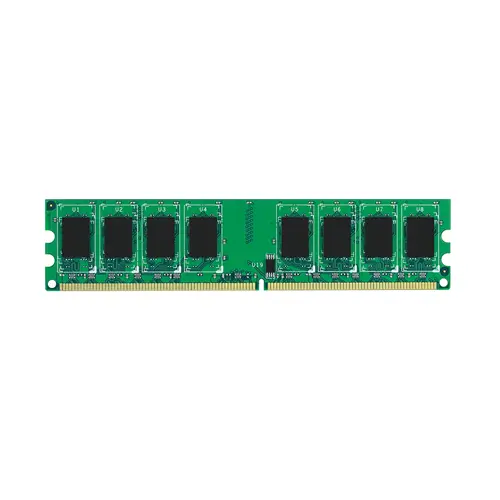
| RAM Genre | FB-DIMM |
This DDR2-667 FB-DIMM with ECC is engineered for legacy server platforms requiring fully buffered memory architecture, making it suitable for virtualization and memory-intensive database workloads where data integrity is critical. The dual-rank x4 organization and fully buffered signal type enhance channel reliability and reduce electrical loading, while ECC safeguards against single-bit errors in high-availability environments.
1. ECC protection silently detects and corrects single-bit errors, preserving data accuracy for financial transactions and long-running virtualization hosts.
2. Fully Buffered DIMM architecture serializes command and data channels, allowing dense memory populations that sustain large in-memory databases under constant query loads.
3. Dual Rank x4 layout interleaves access across multiple internal banks, keeping throughput steady during simultaneous VM migrations and backup snapshots.
4. Entry-level capacity fits purpose-built server roles like lightweight domain controllers or web front-ends, where resource overcommitment is avoided by design.
5. Moderate bus frequency yields deterministic timing margins, lowering soft error risk in always-on legacy platforms that prioritize uptime over peak bandwidth.
Designed specifically for legacy server infrastructures, the Samsung M395T5160CZ4-CE66 FB-DIMM module addresses the critical demands of enterprise computing where downtime is not an option. Its fully buffered architecture stands as the first line of defense in dense memory configurations, using an Advanced Memory Buffer chip to reduce electrical loading on the bus. This means you can populate all 16 or more DIMM slots in a rack server without sacrificing signal integrity, a direct enabler for the massive memory pools required by virtualized clusters running dozens of VMs on a single node.
The integrated ECC engine continuously scans and corrects single-bit errors, a non-negotiable safeguard for in-memory databases like SAP HANA or financial transaction logs. A flipped bit caused by cosmic radiation in a non-ECC environment silently corrupts a calculation; here, that error is caught and fixed in real time, preserving your data's fiscal accuracy and your company’s reputation. Additionally, the dual-rank x4 organization optimizes the command and data transfer pipeline. By interleaving access across two internal ranks on each module, it reduces idle latency between consecutive read operations, which directly accelerates random-access workloads typical of high-concurrency OLTP systems. While its DDR2-667 speed and CL5 timing might appear modest today, for a dedicated legacy appliance or an existing server farm designed for these low-power 1.8V modules, this consistency guarantees a drop-in upgrade that extends the life of your validated platform without introducing thermal or compatibility surprises—keeping your operational overhead minimal while maximizing return on existing assets.
General Virtualization
This FB-DIMM DDR2-667 module, with ECC and fully buffered architecture, suits legacy server platforms running light virtualization workloads. Deploy at least eight identical 4GB modules (32GB total) in a dual-processor system to balance memory bandwidth across channels and provide headroom for multiple virtual machines. Always populate modules in matched sets per memory riser to maintain reliable ECC protection and avoid performance penalties.
In-Memory Database
For in-memory databases on older FB-DIMM servers, maximize capacity by filling all available slots with 4GB modules—typical systems can reach 64GB or more with 16 DIMMs. Prioritize identical dual-rank x4 modules to sustain consistent latency and error correction under heavy cache pressure. Given the 667MHz speed and CL5 latency, limit dataset size to what fits entirely in RAM to avoid swapping, and consider clustering for larger footprints.
High-Performance Computing
In HPC clusters built on DDR2-era nodes, fully buffered memory allows high capacity per node but adds latency; use balanced configurations with modules evenly spread across all memory channels. For compute-bound workloads, install at least 4GB per core (e.g., 32GB on an 8-core node) using 8 identical M395T5160CZ4-CE66 sticks to maintain uniform access patterns and error resilience under sustained loads.
Rigorously tested server FB-DIMM for Dell PowerEdge 2950/1950, HP DL380 G5, IBM x3650.
Q: Can I mix this M395T5160CZ4-CE66 with other memory modules of different brands or speeds?
A: Mixing FB-DIMMs of different brands, speeds, or ranks is not advised. Mismatched modules may cause instability or fail to boot due to strict buffering requirements. Use identical part numbers for guaranteed compatibility.
Q: Is this memory compatible with my system?
A: This DDR2-667 Fully Buffered ECC module targets server platforms based on Intel 5000/5100/5400 chipsets. Confirm your server board supports 1.8V FB-DIMMs and review its qualified vendor list before purchase.
Q: What is the recommended DIMM population order for optimal performance?
A: Populate identical FB-DIMMs per channel, usually filling slots farthest from the CPU first. Follow the server board's manual to enable memory interleaving and avoid performance penalties from unbalanced configurations.
Q: Does this module support overclocking or XMP profiles?
A: No. It strictly adheres to JEDEC DDR2-667 standard timings (CL5) for server reliability. Overclocking or custom XMP profiles are not supported, as they compromise data integrity in mission-critical environments.
Q: What warranty and typical failure rate can I expect?
A: It includes a 1-year warranty. Enterprise-grade FB-DIMMs with ECC demonstrate extremely low failure rates, typically below 0.1% AFR when operated within specified temperature and voltage ranges.