











 Secure payments
Standard refund policy
Trade Assurance
Secure payments
Standard refund policy
Trade Assurance
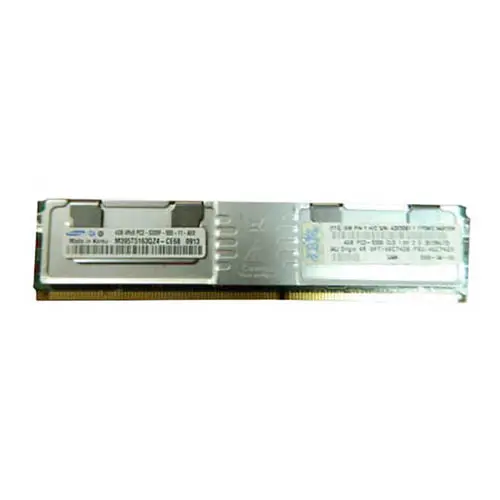
| Model | M395T5163QZ4-CE68 |
|---|---|
| Product Type | Memory Module |
| Compliance Standards | EU RoHS,FCC |
| Memory Capacity | 4 GB |
| Memory Technology | DDR2 |
| Product Voltage | 1.8V |
| RAM Speed | 667MHz |
| RAM Standard | DDR2-667/PC2-5300 |
| Error Identifying | ECC |
| Signal Type | Fully Buffered |
| Column Access Strobe (CAS) | CL5 |
| Rank | Quad Rank x8 |
| Quantity of Pins | 240-pin |
| RAM Genre | FB-DIMM |
The M395T5163QZ4-CE68 is a server-class FB-DIMM engineered with ECC and a Fully Buffered signal architecture, making it ideal for legacy enterprise platforms running memory-intensive workloads such as virtualization and in-memory databases where data integrity is critical. Its Quad Rank x8 configuration enables high-density memory configurations on DDR2-era servers, ensuring stable operation under heavy load with reduced command bus contention.
1. Fully Buffered architecture isolates the memory controller from bus loading, which maintains signal integrity across large memory populations essential for stable database operations.
2. ECC error correction silently detects and fixes single-bit memory faults, preventing data corruption in transactional systems where every record must be provably accurate.
3. Quad Rank x8 organization quadruples the device density per DIMM, allowing older enterprise platforms to achieve maximum memory capacity for heavier virtualization ratios.
4. The 4GB capacity per module supplies enough working memory to consolidate multiple light Linux containers or legacy application stacks without triggering performance-sapping disk swapping.
5. 667MHz operation provides steady 5.3GB/s channel bandwidth, ensuring smooth data streaming to multiple processor cores handling concurrent user requests in a typical mid-tier server.
At the heart of legacy enterprise servers and high‑density computing platforms, the M395T5163QZ4‑CE68 FB‑DIMM is engineered for workloads where uptime and data integrity are non‑negotiable. Its four defining capabilities translate directly into operational resilience. First, the Fully Buffered architecture serializes data requests across the memory channel, allowing your server to host far more DIMMs per channel without signal degradation. In a VMware ESXi virtualization cluster, this means you can saturate the host with memory—consolidating dozens of virtual machines onto a single node without compromising stability. Second, the ECC engine silently detects and corrects single‑bit errors caused by cosmic radiation or electrical noise. For an in‑memory database like Redis or a financial transaction log, that correction prevents silent data corruption that could cascade into costly analytical errors or failed audits. Third, the Quad Rank x8 design packs 4 GB onto a single module using high‑density DRAM packages, maximizing capacity in servers with limited DIMM slots—critical when scaling up legacy database servers that demand every gigabyte for buffer pools. Finally, the 667 MHz speed at CL5 delivers predictable, seasoned bandwidth for multi‑process workloads: your SQL Server checkpoint operations and concurrent OLTP queries run against a stable, validated timing envelope, not speculative overclocking. These aren’t just technical specifications; they are your insurance policy against downtime and data drift in environments that never sleep.
Capacity Planning for DDR2 FB-DIMM Server Memory
The module M395T5163QZ4-CE68 is a 4GB DDR2-667 Fully Buffered ECC DIMM, designed exclusively for legacy server platforms that require FB-DIMM technology. Capacity planning for these systems must balance the limited maximum server memory (often 32–64 GB) with the demands of each workload.
General Virtualization
Populate at least four identical modules (16 GB total) across all memory channels to ensure balanced interleaving and adequate headroom for multiple light VMs. For moderate consolidation, aim for eight modules (32 GB) to avoid ballooning and swapping under memory overcommitment.
In-Memory Database
Maximize capacity by filling every available DIMM slot with these 4 GB quad-rank modules, as in-memory datasets benefit from large, contiguous address spaces. Pair with careful NUMA affinity tuning, and ensure identical modules are installed to maintain ECC integrity and consistent access latencies.
High Performance Computing
Deploy modules in multiples of four (16 GB or 32 GB) to sustain quad-channel bandwidth, critical for memory-bandwidth-bound HPC codes. Leverage ECC to detect and correct transient errors during long-running parallel jobs, and use identical FB-DIMMs to avoid signalling issues on the shared serial interface.
Rigorously tested DDR2 FB-DIMM server memory compatible with Dell PowerEdge 2950, HP DL380 G5, IBM x3650, Fujitsu Primergy RX300 S4.
Q: Can I mix this M395T5163QZ4-CE68 with other memory modules of different brands or speeds?
A: Mixing different brands or speeds is strongly discouraged for FB-DIMM servers. It may cause signal integrity issues and system instability. Always use identical modules to ensure reliable operation and ECC functionality.
Q: Is this memory compatible with my system?
A: This FB-DIMM ECC DDR2-667 module is designed for Intel® Xeon® 5000 series chipset platforms. Verify your server board supports fully buffered 240-pin DIMMs and quad-rank configurations before ordering.
Q: What is the recommended DIMM population order for optimal performance?
A: For fully buffered servers, populate channels in matching pairs, starting with the farthest slots from the CPU. Follow the system’s memory mirroring or sparing guidelines. Improper order degrades performance and may prevent boot.
Q: Does this module support overclocking or XMP profiles?
A: No. This is a server-grade FB-DIMM operating at fixed JEDEC standard timings (DDR2-667, CL5). Overclocking and XMP are not supported; stability and data integrity are prioritized over performance tuning.
Q: What warranty and typical failure rate can I expect?
A: This module includes a 1-year warranty. As an enterprise-class ECC FB-DIMM, it undergoes stringent testing, resulting in a very low AFR (annualized failure rate) under specified voltage and thermal conditions.