











 Secure payments
Standard refund policy
Trade Assurance
Secure payments
Standard refund policy
Trade Assurance
| Model | M395T5750CZD-CD5 |
|---|---|
| Product Type | Memory Module |
| Compliance Standards | EU RoHS,FCC |
| Memory Capacity | 2 GB |
| Memory Technology | DDR2 |
| Product Voltage | 1.8V |
| RAM Speed | 533MHz |
| RAM Standard | DDR2-533/PC2-4200 |
| Error Identifying | ECC |
| Signal Type | Fully Buffered |
| Column Access Strobe (CAS) | CL4 |
| Rank | Dual Rank x4 |
| Quantity of Pins | 240-pin |
| RAM Genre | FB-DIMM |
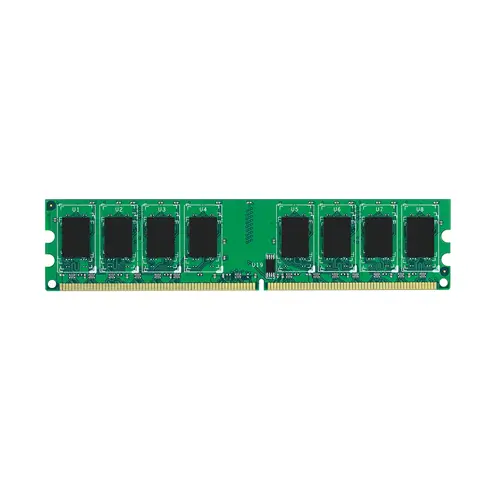
This FB-DIMM module is engineered exclusively for legacy server platforms, where its Fully Buffered architecture and ECC enable robust signal integrity and error correction essential for memory-intensive workloads like virtualization and database hosting. The dual-rank x4 configuration at CL4 latency maximizes capacity access efficiency within older dual-socket systems, ensuring stable data throughput under sustained load.
1. Fully Buffered architecture isolates memory transactions on a high-speed serial interface, dramatically scaling capacity and reliability for mission-critical server environments.
2. ECC protection detects and corrects single-bit errors, ensuring data integrity in financial transactions or database operations where accuracy is non-negotiable.
3. Dual Rank x4 organization interleaves accesses to keep the memory channel fully utilized, boosting throughput for virtualized workloads under heavy consolidation.
4. The module's capacity provides a solid building block for mid-range server memory pools, balancing cost-per-gigabyte with adequate headroom for enterprise applications.
5. Low CAS latency reduces the time to first data for random accesses, accelerating response times for cache-heavy server processes and real-time analytics.
The M395T5750CZD-CD5 is a server-grade FB-DIMM engineered for legacy enterprise platforms where data integrity and uptime are non-negotiable. Its ECC technology continuously scans and corrects single-bit memory errors caused by background radiation, which directly prevents silent data corruption in a virtualized cluster running multiple hypervisors; a flipped bit in a VM’s page table could otherwise crash several production workloads without warning. The Fully Buffered architecture serializes commands via an Advanced Memory Buffer, enabling this module to coexist with numerous identical DIMMs on a single channel without signal degradation. This matters when scaling an in-memory database like SAP HANA or a Redis cluster to hundreds of gigabytes: the buffer maintains clean timing across all ranks, so the memory subsystem stays stable under heavy, concurrent query loads. The module’s dual-rank x4 organization allows the memory controller to interleave accesses across two internal rank sets, overlapping precharge and activation cycles to reduce average latency. In a memory database, that interleaving translates directly into faster key-value lookups and higher transactions per second. At 1.8V and CL4, the module adheres to the strict power and thermal envelope of dense rack servers, minimizing cooling overhead while delivering predictable 533 MHz bandwidth for persistent data services. Choosing this FB-DIMM means protecting transactional integrity and maximizing the usable lifespan of your 24/7 infrastructure.
General Virtualization
Deploy this FB-DIMM in a dual-socket server using a balanced population—install eight identical 2 GB modules across both memory branches to enable full channel interleaving and maximize throughput. With its ECC and fully buffered architecture, the setup reliably hosts a dozen moderate VMs, ensuring error resilience without oversubscribing physical RAM. Leave at least two DIMM slots free per riser to accommodate future scale-out as VM density grows.
In-Memory Database
For latency-sensitive datasets, fill all available channels with these 2 GB dual-rank x4 DIMMs to reach a minimum of 16 GB total capacity, aligning with typical Redis or Memcached footprints. The CL4 timing and buffered design stabilize access under high concurrency, while ECC guards against silent data corruption in critical cache nodes. Pair two identically configured nodes in a redundant cluster to maintain availability during maintenance cycles.
High Performance Computing
Populate every memory channel symmetrically to achieve the widest possible interleaving—this reduces access bottlenecks during large MPI job initialization. A four-socket FB-DIMM platform fully loaded with 32 GB total (sixteen modules) delivers the sustained bandwidth needed for iterative simulation checkpoints. Monitor thermal headroom closely, as fully buffered DIMMs generate extra AMB heat under continuous HPC loads.
Server-grade FB-DIMM, rigorously tested; verified with Dell PowerEdge 2950, HP ProLiant DL380 G5, IBM System x3650.
Q: Can I mix this M395T5750CZD-CD5 with other memory modules of different brands or speeds?
A: Mixing is not recommended. FB-DIMMs require identical AMB configurations and timing. Combining different brands, speeds, or ranks often causes system instability or prevents booting on server platforms.
Q: Is this memory compatible with my server?
A: It is designed for servers with Intel 5000 series or equivalent chipsets supporting DDR2-533 Fully Buffered DIMMs. Verify your board specifically lists FB-DIMM compatibility and a 240-pin socket before purchase.
Q: What is the recommended DIMM population order for optimal performance?
A: Install identical FB-DIMMs in pairs per channel, starting with the farthest slot from the CPU. For this dual-rank module, populate Channel 0 first, then matching branches to maintain balanced memory interleaving.
Q: Does this module support overclocking or XMP profiles?
A: No. As a JEDEC-standard server FB-DIMM, it runs at fixed 533 MHz with CL4 timings. Overclocking or XMP is not supported; it prioritizes signal integrity and ECC reliability over frequency scaling.
Q: What warranty and typical failure rate can I expect?
A: This module includes a one-year warranty. With its ECC and fully buffered architecture, the AFR is significantly below standard unbuffered memory when operated within specified thermal and voltage limits.