











 Secure payments
Standard refund policy
Trade Assurance
Secure payments
Standard refund policy
Trade Assurance
| Product Type | Memory Module |
|---|---|
| Compliance Standards | EU RoHS,FCC |
| Memory Capacity | 512 MB |
| Memory Technology | DDR2 |
| RAM Speed | 667 |
| RAM Standard | DDR2-667/PC2-5300 |
| Error Identifying | Non-ECC |
| Signal Type | Unbuffered |
| Column Access Strobe (CAS) | CL5 |
| Rank | Single Rank x16 |
| Quantity of Pins | 200-pin |
| RAM Genre | SoDIMM |
Targeting legacy notebook platforms requiring reliable DDR2 upgrades, this Samsung 512MB PC2-5300 SoDIMM offers a single-rank x16 configuration that ensures broad chipset compatibility and stable unbuffered operation at CL5 latency. Its low-power DDR2 design and 200-pin form factor make it an ideal drop-in solution for extending the lifespan of aging mobile workstations or industrial embedded systems where energy efficiency and plug-and-play simplicity are critical.
1. SoDIMM form factor allows a tool-free, snap-in upgrade that fits right into a laptop’s narrow memory bay, making hardware refresh accessible to anyone.
2. The 200-pin connector ensures perfect mechanical and signal alignment with legacy notebooks, eliminating compatibility guesswork and returns.
3. DDR2 technology matches older mobile platforms at the hardware level, extending the practical life of a trusted laptop without costly motherboard swaps.
4. A 512MB capacity pool revitalizes basic systems by comfortably hosting a minimalist OS and essential productivity apps, turning a sluggish device into a capable on-the-go tool.
5. CL5 low latency accelerates command-to-response turnaround, delivering snappy application loads and a fluid user experience even during mobile multitasking.
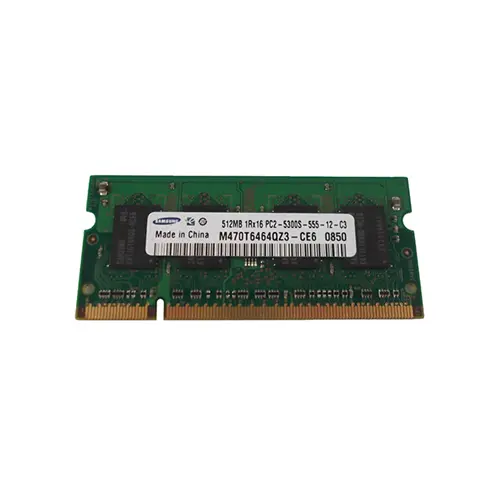
Targeting legacy notebook users, this 512MB DDR2-667 SODIMM (Samsung M470T6464QZ3-CE6) delivers four critical advantages. The Non-ECC unbuffered architecture sips power and generates less heat, directly prolonging battery runtime for field engineers running diagnostic tools on rugged laptops. The compact 200-pin form factor slides effortlessly into ultra-thin chassis, enabling a screwdriver-free upgrade that avoids flexing fragile mainboards. Its Single Rank x16 configuration ensures flawless POST on older chipsets often rejecting denser dual-rank memory, making it ideal for breathing life into a vintage ThinkPad or a point-of-sale terminal. Backed by a CL5 latency at 667MHz, application launches and spreadsheet refreshes feel responsive, even when multitasking in a resource-constrained environment. Together, these attributes turn an aging notebook into a reliable companion for essential mobile productivity, without compromising stability or energy efficiency.
Laptop Upgrade
For aging notebooks with one or two SoDIMM slots, this 512 MB DDR2-667 module serves as a straightforward drop-in replacement or capacity doubler. In a single-slot configuration, use one stick to bring a system from 256 MB or 512 MB to a stable 512 MB baseline for lightweight operating systems. When two slots are available, pairing two identical modules (2 × 512 MB) yields 1 GB of dual-channel unbuffered memory, noticeably improving responsiveness in web browsing and document editing on Windows XP or lightweight Linux setups.
Mobile Workstation
Maximizing capacity with these legacy 200-pin SoDIMMs often involves populating both slots to reach 1 GB total, which was a typical ceiling for DDR2-era professional portables. For memory-intensive tasks like CAD viewing or data analysis on older mobile workstations, a matched pair of 512 MB modules ensures symmetric dual-channel operation and reduces stuttering under load. Users hitting the chipset’s maximum should confirm whether the platform supports 2 GB via 1 GB sticks, as this 512 MB part may be relegated to systems with lower density limits.
Ultrabook Power Saving
Although this module operates at 1.8V standard DDR2 voltage rather than a low-voltage variant, using a single 512 MB stick in an ultraportable can still help reduce overall power draw compared to populating both channels. The Single Rank x16 organization limits the number of active DRAM devices, minimizing refresh overhead and marginally extending battery life during light productivity or media playback. For ultra-thin notebooks where every watt matters, a sole module configuration avoids inter-channel termination power and suits energy-conscious minimal installations.
Rigorously tested, guaranteed compatible with notebooks: Dell Latitude D630, HP Compaq 6710b, Lenovo ThinkPad T61.
Q: Can I mix this M470T6464QZ3-CE6 with other memory modules of different brands or speeds?
A: Mixing is not recommended. Unbuffered 667MHz SO-DIMMs may work together, but latencies and ranks often differ, risking instability. For optimal notebook compatibility, use identical modules.
Q: Is this memory compatible with my system?
A: It is designed for notebooks that support DDR2-667 PC2-5300 200-pin SO-DIMMs. Please verify your laptop chipset (e.g., Intel 945GM/965) explicitly requires Non-ECC, Unbuffered DDR2 at 667MHz.
Q: What is the recommended DIMM population order for optimal performance?
A: Most single-rank SO-DIMMs perform equally in either slot. If only one module is installed, place it in the primary slot (often labeled '0') as indicated by your notebook's service manual.
Q: Does this module support overclocking or XMP profiles?
A: No. This is a legacy DDR2 notebook module running at JEDEC standard CL5. It does not support XMP or overclocking; it operates only at fixed 667MHz with standard timings.
Q: What warranty and typical failure rate can I expect?
A: It carries a 1-year warranty. Failure rates for mature DDR2 technology are very low. All modules are EU RoHS and FCC compliant, ensuring reliable, standard-compliant operation.