











 Secure payments
Standard refund policy
Trade Assurance
Secure payments
Standard refund policy
Trade Assurance
| Product Type | Memory Module |
|---|---|
| Memory Capacity | 16 GB |
| Memory Technology | DDR4 |
| Product Voltage | 1.2 V |
| RAM Speed | 2133 MHz |
| RAM Standard | DDR4-2133/PC4-17000 |
| Error Identifying | ECC |
| Signal Type | Registered |
| Column Access Strobe (CAS) | CL15 |
| Rank | Dual Rank x4 |
| Quantity of Pins | 288-pin |
| RAM Genre | RDIMM |
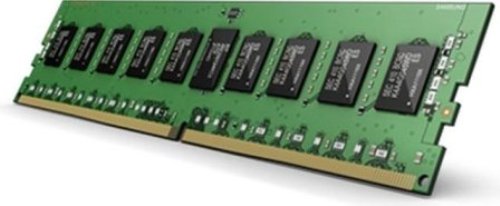
This registered DDR4-2133 RDIMM with ECC is ideally suited for enterprise servers and virtualization platforms running memory-intensive workloads such as in-memory databases and multi-tenant hypervisors where data integrity is paramount. Its dual-rank x4 organization leverages rank interleaving to boost bandwidth efficiency under heavy load, while error-correcting code ensures robust fault tolerance critical for 24/7 operation.
1. ECC protection actively corrects single-bit errors in real time, preserving data integrity for financial transactions and mission-critical databases without service interruption.
2. Registered signal buffering stabilizes clock and command signals across densely populated memory channels, enabling reliable 24/7 operation under extreme server workloads.
3. Dual Rank x4 interleaving keeps DRAM pages open simultaneously across ranks, maximizing effective bandwidth for virtualized environments hosting numerous memory-hungry VMs.
4. Sixteen-gigabyte capacity per module boosts memory density per server node, raising consolidation ratios for containerized applications and large in-memory datasets.
5. 1.2V ultra-low operating voltage cuts overall rack-level power draw and cooling demand, directly improving total cost of ownership in hyperscale data centers.
When you deploy the Samsung M393A2G40DB0-CPB2Q, a 16GB DDR4-2133 Registered ECC RDIMM, you are not simply adding memory—you are engineering resilience into your server infrastructure. Its ECC capability is your silent guardian in a dense virtualization cluster: a single bit flip from cosmic radiation can crash a multi‑tenant hypervisor, but ECC detects and corrects those errors in real time, preserving VMware or KVM workloads without data corruption. The Registered signal buffer stabilizes command and address lines when populating all 24 DIMM slots on a 2U rack node; without it, electrical loading would force you to reduce speed or sacrifice capacity—Registered logic lets you scale to terabytes while maintaining crisp 2133 MT/s signalling across the entire memory channel. Consider an in‑memory database like SAP HANA or Redis: the Dual Rank x4 organization interleaves two internal rank accesses on the same DIMM, effectively overlapping precharge and activation cycles to deliver higher sustained bandwidth under random read pressure. Finally, the 1.2V operating voltage shrinks the thermal envelope in a fully loaded rack, lowering cooling costs and extending component lifespan across your whole deferred‑maintenance fleet. Together, these four characteristics translate directly into fewer nighttime pages, more predictable 99.99th‑percentile latency, and a datacenter that runs dense workloads without compromise.
General Virtualization
For a typical virtualization host running 10–15 moderate VMs, plan for at least 64–128 GB of total memory. Using eight to sixteen of these 16 GB DDR4-2133 RDIMMs populating all memory channels (e.g., 8x16 GB or 16x16 GB) ensures balanced NUMA access and sufficient headroom. Stick to identical dual-rank x4 DIMMs per channel to maintain consistent latency and maximize throughput.
In-Memory Database
In-memory databases like Redis or SAP HANA demand large, low-latency memory pools with data integrity. Populate all DIMM slots per memory controller with these 16 GB ECC Registered DIMMs, aiming for at least 128–256 GB to keep active datasets resident. Configure a balanced DIMM-per-channel layout (e.g., 1 DPC or 2 DPC) while monitoring rank count—dual-rank modules deliver strong bandwidth, but avoid exceeding platform limits to prevent clock speed downgrades.
High-Performance Computing
HPC workloads benefit from high aggregate bandwidth and ECC protection. Deploy at least six or eight of these 2133 MT/s RDIMMs in a balanced multi-channel configuration (e.g., 6x16 GB or 12x16 GB) to saturate memory controllers. Use uniform dual-rank x4 DIMMs for optimal command rate and bandwidth; scale out capacity by adding more identical modules, but validate that total rank loading does not force a lower operating frequency under heavy floating-point or MPI jobs.
Rigorously validated for servers like Dell PowerEdge R730, HPE ProLiant DL380 Gen9, and Lenovo ThinkSystem SR650.
Q: Can I mix this M393A2G40DB0-CPB2Q with other memory modules of different brands or speeds?
A: Mixing is not recommended. Mismatched DIMMs can cause instability, reduced speed, or system boot failures. Use identical modules of the same part number, rank, and speed for validated enterprise server reliability.
Q: Is this memory compatible with my system?
A: This DDR4-2133 ECC Registered RDIMM is compatible with Intel Xeon E5-2600 v3/v4 and Scalable platforms, plus AMD EPYC 7001 series. Verify your server's qualified vendor list for this specific 16GB dual-rank module.
Q: What is the recommended DIMM population order for optimal performance?
A: Follow your server motherboard's population guide. Typically, load identical DIMMs starting with the first white or blue slots per channel, balancing across all memory channels for maximum throughput on multi-CPU configurations.
Q: Does this module support overclocking or XMP profiles?
A: No. This is a JEDEC-compliant server RDIMM operating at standard DDR4-2133 timings. ECC Registered memory does not support XMP or overclocking; it prioritizes data integrity and stability at rated speeds.
Q: What warranty and typical failure rate can I expect?
A: This module includes a one-year warranty. Enterprise-grade Samsung RDIMMs exhibit an annualized failure rate (AFR) below 0.5% under normal conditions, ensuring high reliability for 24/7 data center operations.