











 Secure payments
Standard refund policy
Trade Assurance
Secure payments
Standard refund policy
Trade Assurance
| Model | M393A2K43BB1-CTD6Q |
|---|---|
| Product Type | Memory Module |
| Compliance Standards | CE,WEEE,RoHS |
| Memory Capacity | 16 GB |
| Memory Technology | DDR4 |
| Product Voltage | 1.2V |
| RAM Speed | 2666MHz |
| RAM Standard | DDR4-2666/PC4-21300 |
| Error Identifying | ECC |
| Signal Type | Registered |
| Column Access Strobe (CAS) | CL19 |
| Rank | Dual Rank x8 |
| Quantity of Pins | 288-pin |
| RAM Genre | RDIMM |
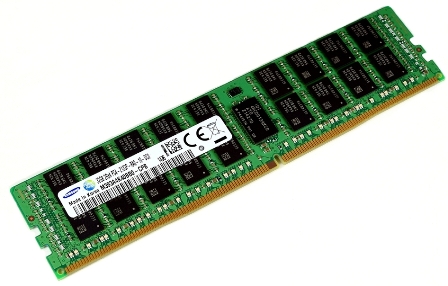
Designed as a server-grade DDR4-2666 Registered DIMM with ECC, the Samsung M393A2K43BB1-CTD6Q ensures data integrity in mission-critical environments such as virtualization clusters and in-memory databases. Its dual-rank x8 organization and registered signal topology provide superior signal stability at high densities, while the CL19 latency balances responsiveness and power efficiency for sustained 24/7 workloads.
1. ECC protection silently corrects single-bit errors, safeguarding data integrity in financial transaction databases where even one flipped bit can cause costly corruption.
2. Registered buffer decouples the memory controller from direct chip loading, allowing densely packed server boards to scale beyond a terabyte of RAM without signal degradation.
3. Dual Rank x8 organization leverages rank interleaving to overlap read/write bursts, maximizing sustained bandwidth for hypervisor hosts running dozens of virtual machines concurrently.
4. 16GB capacity per DIMM delivers the density sweet spot for private cloud nodes, packing enough memory per channel to assign generous RAM slices to each containerized workload.
5. DDR4-2666 operating speed provides a balanced throughput envelope that matches typical dual-socket Xeon memory channels, keeping latency predictable under mixed-enterprise loads.
The M393A2K43BB1-CTD6Q is a registered DDR4-2666 RDIMM engineered for server platforms, where uncompromising data integrity and scalability directly impact business continuity. Its ECC technology actively detects and corrects single-bit memory errors in real time, a non-negotiable defense against silent data corruption in transactional databases like SAP HANA or financial ledger systems—one undetected bit flip here could mean a reconciled balance error, a compliance violation, or costly downtime. The registered signal buffer stabilizes command and address signals across densely populated memory channels, letting you confidently scale capacity to 512GB or more per server without risking signal degradation in large virtualization clusters; this is what keeps hundreds of VMs responsive under fluctuating tenant loads, not just stable on paper. Dual-rank x8 organization interleaves data accesses across two internal ranks, delivering measurably higher bandwidth utilization for in-memory analytics and real-time caching workloads where every last drop of DDR4-2666 throughput translates into faster query responses. At 1.2V, it also lowers your thermal footprint per DIMM in a fully populated 2U rack server, reducing cooling overhead across an entire row of nodes. When you deploy a fleet of hypervisors or an in-memory database cluster, this module turns stated specifications into real-world reliability: you get booked revenue, not corrupted data; you handle peak virtualization density, not intermittent memory faults under load.
General Virtualization
For a balanced virtualized environment, populate six or eight identical 16 GB RDIMMs per CPU socket to enable symmetrical multi-channel access and maximize memory bandwidth. Aim for 96–128 GB per host to comfortably run 15–20 average VMs, leaving headroom for live migration and failover. Always install modules in identical sets to leverage your platform’s full memory interleaving and ECC protection.
In-Memory Database
Low-latency datasets require maximum capacity without sacrificing reliability, so fill all available DIMM slots with these dual-rank 16 GB modules. A dual-socket server fully loaded (e.g., 24 DIMMs) provides 384 GB of RAS-hardened memory, ideal for Redis or SAP HANA working sets. Keep the DIMMs identical to avoid rank-mixing penalties and maintain consistent CL19 latency under heavy write pressure.
High-Performance Computing (HPC)
HPC favors balanced memory-per-core ratios and high sustained bandwidth, typically 4–8 GB per core. Deploy a population of 8 or 16 modules per node to feed all memory channels and support MPI workloads without throttling. Dual-rank x8 DIMMs at 2666 MHz offer a sweet spot between capacity and command rate, and ECC is non-negotiable for runtimes spanning days or weeks.
Rigorously tested server memory, compatible with Dell PowerEdge R760, HPE ProLiant DL380 Gen10, and Lenovo ThinkSystem SR650.
Q: Can I mix this M393A2K43BB1-CTD6Q with other memory modules of different brands or speeds?
A: Mixing RDIMMs of different brands or speeds is not recommended. It can cause instability, ECC errors, or failure to boot. Always use identical modules for validated server reliability.
Q: Is this memory compatible with my system?
A: This DDR4-2666 ECC Registered DIMM is compatible with servers using Intel Xeon Scalable or AMD EPYC platforms. Verify your board supports 288-pin RDIMMs at 1.2V.
Q: What is the recommended DIMM population order for optimal performance?
A: Follow your server board’s manual. Typically, populate identical DIMMs per channel, starting with the first slot (DIMM_A1). Balanced channel population maximizes memory bandwidth and ECC efficiency.
Q: Does this module support overclocking or XMP profiles?
A: No. Enterprise RDIMMs operate strictly at JEDEC standard profiles for stability. Overclocking or XMP is not supported and would violate validated specifications.
Q: What warranty and typical failure rate can I expect?
A: This module includes a 1-year warranty. Built to enterprise-grade standards, it delivers extremely low failure rates under 24/7 operation, ensuring long-term mission-critical reliability.