











 Secure payments
Standard refund policy
Trade Assurance
Secure payments
Standard refund policy
Trade Assurance
| Product Type | Memory Module |
|---|---|
| Memory Capacity | 32 GB |
| Memory Technology | DDR5 |
| Product Voltage | 1.1 V |
| RAM Speed | 4800 MHz |
| RAM Standard | DDR5-4800/PC5-38400 |
| Error Identifying | ECC |
| Signal Type | Registered |
| Column Access Strobe (CAS) | CL4 |
| Rank | Dual Rank x8 |
| Quantity of Pins | 288-pin |
| RAM Genre | RDIMM |
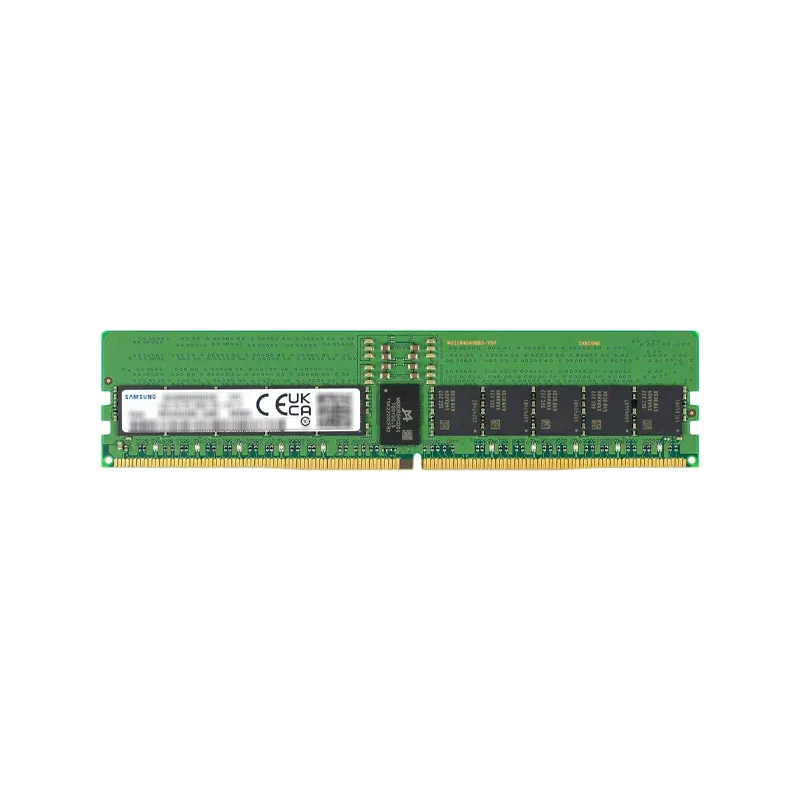
This DDR5-4800 RDIMM is engineered for enterprise servers and memory-intensive workloads such as virtualization and in-memory databases, where its ECC and registered signal type ensure exceptional data integrity and reliable signal stability under heavy load. The dual-rank x8 configuration and CAS 4 low latency deliver high capacity density with minimal access delay, optimizing memory bandwidth and responsiveness for mission-critical operations.
1. Generous module capacity allows data centers to host more virtual machines and in-memory databases per node, maximizing consolidation ratios without compromising responsiveness.
2. DDR5 technology delivers substantially higher memory bandwidth, enabling faster data throughput for analytics and AI workloads that thrive on parallel processing.
3. Integrated ECC corrects single-bit errors in real time, protecting transactional integrity for financial services and mission-critical enterprise applications.
4. Registered signal buffering stabilizes high-density memory configurations, allowing servers to scale up RAM without sacrificing signal integrity under heavy load.
5. Dual Rank x8 interleaving boosts concurrent command execution, ensuring consistent low-latency access across multiple CPU cores during peak virtualization bursts.
The M321R4GA3BB0-CQK is a server-grade DDR5 RDIMM, and its specifications directly address the most critical pain points in data center environments. When you are running a dense virtualization cluster hosting dozens of VMs, the 32GB capacity with Dual Rank x8 architecture becomes essential. Dual rank interleaving allows the memory controller to access data from one rank while the other refreshes, significantly boosting bandwidth and reducing latency under concurrent workloads, which means your hypervisor can spawn more virtual machines without suffering the stuttering caused by memory contention. Meanwhile, the Registered (RDIMM) design with ECC goes far beyond a technical checkbox. In an in-memory database like SAP HANA or a transactional system processing financial records, a single undetected bit flip can corrupt a calculation or even cause a silent outage. The registered clock driver stabilises signal integrity across the high-density modules, while end-to-end ECC corrects single-bit errors and detects multi-bit failures in real time. This translates to uncompromised data reliability and system uptime. Even the 1.1V DDR5 power envelope matters: in a fully populated rack, the accumulated energy savings lower thermal stress and operational costs, allowing your cooling solution to work less aggressively. For any IT architect balancing risk, performance, and TCO, this memory module turns architectural promises like data integrity and linear scalability into tangible, always-on reality.
Server Memory Capacity Planning – DDR5-4800 ECC RDIMM (32GB)
The provided module is a 32GB DDR5-4800 Registered DIMM with ECC, identified by its 288-pin form factor, 1.1V operating voltage, dual-rank x8 organization, and CL40 latency. It is exclusively intended for server-class platforms such as AMD EPYC 7003/9004 or Intel Xeon Scalable systems. Capacity planning must align with the high reliability and multi-channel architecture of these environments.
General Virtualization
Balance memory density with cost per virtual machine. Deploy one DIMM per channel to maximize bandwidth and populate all available memory channels symmetrically. For a typical dual-socket server with eight channels per CPU, install sixteen 32GB modules for a total of 512GB. This supplies enough headroom for 50–80 general-purpose VMs without overprovisioning.
In-Memory Database
Low latency and large working sets are critical. Use the maximum number of supported DIMMs per processor while maintaining balanced ranks across channels. A configuration of 32 x 32GB (1TB per socket) enables entire datasets to reside in RAM, reducing storage I/O. The dual-rank design of the module already provides good rank interleaving; avoid mixing single-rank DIMMs with this module to prevent performance inconsistencies.
High-Performance Computing
Bandwidth is the primary concern. Install exactly one DIMM per channel, using all channels, to sustain peak throughput per core. A common node configuration pairs eight 32GB modules (256GB) per CPU, yielding sufficient capacity for MPI workloads and scratch data. Ensure identical part numbers across all sockets to preserve memory subsystem homogeneity and avoid clock training issues under sustained load.
Rigorously tested, validated for servers: Dell PowerEdge R760, HPE ProLiant DL380 Gen11, Lenovo ThinkSystem SR650 V3, and more.
Q: Can I mix this M321R4GA3BB0-CQK with other memory modules of different brands or speeds?
A: For reliable operation, mixing RDIMMs of different brands or speeds is strongly discouraged in servers. It can introduce signal mismatch and instability. Use identical Samsung modules to ensure full compatibility and data integrity.
Q: Is this memory compatible with my system?
A: This 32GB DDR5-4800 ECC Registered DIMM is built for servers using Intel Xeon Scalable (Sapphire Rapids) or AMD EPYC 9004 platforms. Confirm your board supports DDR5 RDIMMs and 4800MT/s speeds.
Q: What is the recommended DIMM population order for optimal performance?
A: Balance identical DIMMs across all memory channels per CPU. Typically, populate the farthest slot in each channel first, then the adjacent one. Follow your server manual to enable all channels and maintain NUMA symmetry.
Q: Does this module support overclocking or XMP profiles?
A: No. This is a JEDEC-compliant RDIMM operating at DDR5-4800 CL40. It does not support XMP or overclocking, as server memory prioritizes data integrity, stability, and error-free operation over speed tuning.
Q: What warranty and typical failure rate can I expect?
A: The module includes a one-year warranty. Samsung’s server-grade RDIMMs exhibit an extremely low annualized failure rate, typically under 0.1%, when kept within specified thermal and electrical conditions.