











 Secure payments
Standard refund policy
Trade Assurance
Secure payments
Standard refund policy
Trade Assurance
| Product Type | Memory Module |
|---|---|
| Memory Capacity | 32 GB |
| Memory Technology | DDR5 |
| Product Voltage | 1.1 V |
| RAM Speed | 4800 MHz |
| RAM Standard | DDR5-4800/PC5-38400 |
| Error Identifying | ECC |
| Signal Type | Registered |
| Column Access Strobe (CAS) | CL40 |
| Rank | Dual Rank |
| Quantity of Pins | 288-pin |
| RAM Genre | RDIMM |
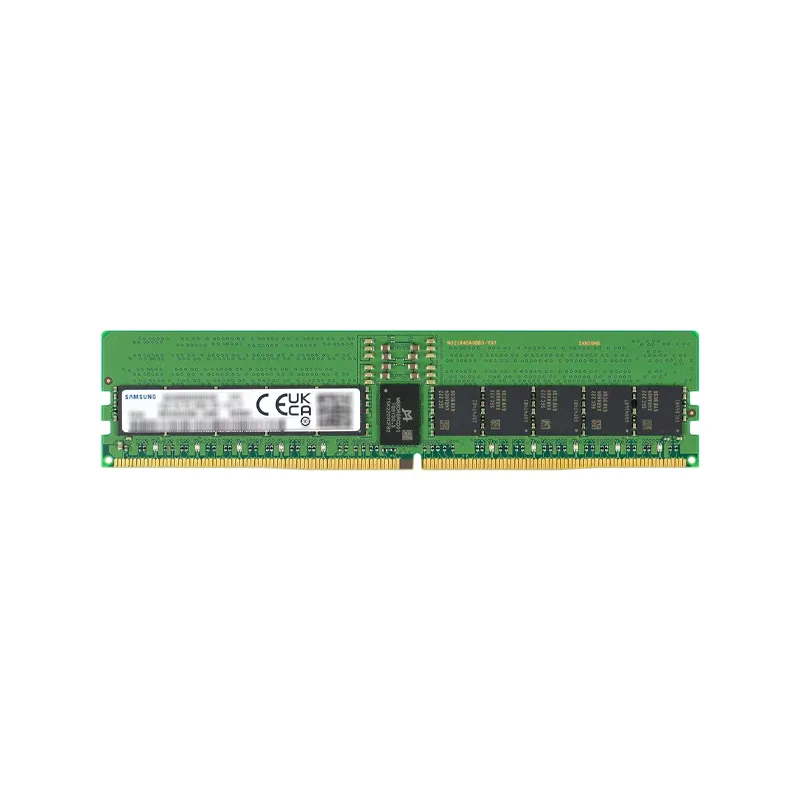
This DDR5-4800 Registered ECC RDIMM is a server-class module engineered for data integrity and scalability in virtualized environments, memory-intensive databases, and enterprise workloads. Its dual-rank design enhances bandwidth efficiency, while ECC and registered signaling deliver the reliability and signal stability required for 24/7 operation in multi-socket platforms.
1. 32GB per module capacity allows virtualization hosts to pack more VMs per server, expanding consolidation ratios without sacrificing memory headroom for each guest.
2. DDR5 technology doubles the internal bank groups and prefetch depth, sustaining much higher memory parallelism needed for in-memory databases and containerized microservices.
3. 4800MT/s transfer rate delivers enough raw bandwidth to keep multiple CPU cores fed simultaneously, reducing data starvation during heavy extract-transform-load jobs.
4. ECC error correction silently fixes single-bit upsets caused by cosmic radiation, essential for preserving long-duration transactional integrity without application interruption.
5. Dual rank organization leverages rank interleaving to overlap access cycles, lifting sustained throughput when large numbers of users query backend data concurrently.
The Samsung M321R4GA3BB0-CQKMG is a server-grade DDR5 RDIMM, purpose-built for mission-critical workloads where downtime is not an option. Its registered design integrates a buffer to stabilize signal integrity, enabling you to populate all memory channels with 32 GB modules without compromising reliability in dense virtualization clusters—meaning you can confidently scale VM density to consolidate hundreds of workloads onto a single node. ECC continuously corrects single-bit errors and detects multi-bit faults, which is non-negotiable for in-memory databases like SAP HANA or Redis; a flipped bit in a financial transaction or patient record could otherwise corrupt results silently. The DDR5-4800 speed, combined with a dual-rank organization, interleaves access across two internal ranks to sustain higher bandwidth and lower latency under heavy concurrent requests. This translates directly into faster query responses in real-time analytics and smoother live migration of virtual machines, keeping your SLA targets intact while the underlying hardware handles constant, fluctuating demand without performance drops.
General Virtualization
Deploy one 32 GB dual-rank RDIMM per memory channel (1DPC) to sustain the full DDR5-4800 speed and avoid clock-rate degradation. This configuration provides low latency and stable bandwidth, ideal for consolidating dozens of virtual machines. A dual-socket server with eight channels per CPU yields 512 GB using sixteen modules—ample for most enterprise workloads. Only move to two modules per channel if capacity demands exceed performance needs, accepting a reduced speed grade.
In-Memory Database
Maximize capacity by populating every DIMM slot, even at two modules per channel (2DPC). Expect the interface to negotiate down to 4400 or 4000 MT/s, but the ability to hold terabytes of hot data in memory outweighs the bandwidth trade-off. With these 32 GB RDIMMs, a fully loaded 16-slot dual-socket platform delivers a 1 TB memory pool for large in-memory datasets.
High Performance Computing
Install a single dual-rank 32 GB module per channel to maintain the peak 4800 MT/s while exploiting rank interleaving for burst transfers. This yields 512 GB on a typical dual-socket HPC node, comfortably supporting simulation, modeling, and EDA workloads. If greater capacity is mandatory, prefer 64 GB or larger DIMMs instead of populating a second module per channel, preserving the highest memory bandwidth.
Server DDR5 RDIMM, rigorously tested, compatible with Dell PowerEdge R760, HPE ProLiant DL380 Gen11, Lenovo ThinkSystem SR650 V3.
Q: Can I mix this M321R4GA3BB0-CQKMG with other memory modules of different brands or speeds?
A: For server environments, mixing this DDR5 RDIMM with different brands or speeds is not recommended. It can cause instability and memory errors, potentially compromising data integrity. Always use identical modules.
Q: Is this memory compatible with my system?
A: This M321R4GA3BB0-CQKMG is a DDR5-4800 Registered ECC module. It's designed for servers with Intel Xeon Scalable Gen 4/5 or AMD EPYC 9004/8004 platforms supporting DDR5 RDIMMs. Verify your motherboard's QVL.
Q: What is the recommended DIMM population order for optimal performance?
A: For dual-socket servers, populate identical DIMMs symmetrically. Follow the server manual: typically fill all channels equally, starting with the slot furthest from the CPU per channel. Balance memory across processors for optimal bandwidth.
Q: Does this module support overclocking or XMP profiles?
A: No. This is an industry-standard server memory module operating at JEDEC-defined DDR5-4800 with CL40. It does not support overclocking or XMP; server RDIMMs prioritize stability and data integrity over frequency tuning.
Q: What warranty and typical failure rate can I expect?
A: This module comes with a 1-year warranty. Server-grade ECC RDIMMs have very low failure rates, typically <0.5% AFR, when operated within specifications. Proper cooling and ESD handling are crucial for longevity.