











 Secure payments
Standard refund policy
Trade Assurance
Secure payments
Standard refund policy
Trade Assurance
| Product Type | Memory Module |
|---|---|
| Memory Capacity | 4 GB |
| Memory Technology | DDR2 |
| Product Voltage | 1.5V |
| RAM Speed | 667MHz |
| RAM Standard | DDR2-667/PC2-5300 |
| Error Identifying | ECC |
| Signal Type | Fully Buffered |
| Column Access Strobe (CAS) | CL5 |
| Rank | Dual Rank x4 |
| Quantity of Pins | 240-pin |
| RAM Genre | FB-DIMM |
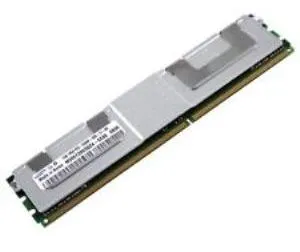
This FB-DIMM module is a server-class memory component engineered for legacy dual-socket servers and workstations demanding robust data integrity under memory-intensive workloads like virtualization, database management, and ECC-critical financial computing. Its Fully Buffered architecture stabilizes high-capacity configurations while the onboard ECC and dual-rank x4 organization safeguard against single-bit errors and maintain balanced throughput, delivering dependable performance for platforms reliant on the Intel 5000 chipset series.
1. Fully Buffered architecture preserves signal integrity across heavily populated memory channels, enabling servers to reliably support large RAM footprints for enterprise virtualization without stability degradation.
2. ECC protection silently corrects single-bit errors in real time, preventing silent data corruption in financial transactions and long-running database operations.
3. Dual Rank x4 organization maximizes bank-level parallelism, sustaining consistent bandwidth under mixed workloads such as concurrent virtual machines and in-memory caches.
4. Generous module capacity increases VM density per physical node, directly improving consolidation ratios and reducing total cost of ownership in data centers.
5. Operating frequency delivers steady throughput aligned with the front-side bus of legacy multi-core Xeon platforms, ensuring predictable response times for latency-sensitive business services.
For your mission-critical server infrastructure, the M395T5160QZ4-YE68 FB-DIMM is far more than a commodity part; it is a strategic enabler of data integrity and scalable performance. As a fully buffered DDR2-667 ECC module, it directly answers the four biggest pain points in virtualized clusters and in-memory databases. Its hardware ECC engine silently detects and corrects single-bit errors, preventing silent data corruption that could crash a hypervisor or poison a financial transaction. The fully buffered architecture then uses an Advanced Memory Buffer to decouple the memory bus, letting you populate multiple DIMMs per channel without signal degradation. This directly supplies the capacity headroom needed to host dozens of solid virtual machines on a single node. Meanwhile, the dual-rank x4 organization exploits rank interleaving to hide precharge delays, shrinking random access latencies and accelerating real-time database index lookups. Finally, operating at just 1.5V, well below the standard 1.8V profile, it dramatically reduces thermal stress inside dense blade enclosures, cutting cooling costs and improving long-term reliability for always-on services where every transaction and every uptime percentage point counts.
General Virtualization
For modest virtualization hosts running older hypervisors, a minimum of eight modules (32 GB total) is recommended to support 8–10 lightweight VMs. Deploy these in matched sets of four to populate both memory branches of the FB-DIMM architecture, ensuring balanced interleaving and tolerable latency. Add a second identical kit to scale to 64 GB if you plan denser consolidation.
In-Memory Database
In-memory workloads demand capacity far above what a few 4 GB FB-DIMMs can provide; you should fully populate all available channels with at least sixteen modules to reach 64 GB, and ideally move to 8 GB DIMMs where the platform permits. Pair them in identical ranks per channel and enable memory scrubbing and ECC-reporting features, as even a single uncorrected error can corrupt an entire dataset.
High-Performance Computing
HPC clusters using DDR2-era nodes are often bound by memory bandwidth, so install four identical dual-rank DIMMs per socket to enable quad-channel access and maximize throughput. Keep all modules at the same CL5 latency and 667 MHz speed, and avoid mixing ranks or capacities, because imbalance will force the memory controller down to the slowest common profile and hurt floating-point performance.
Rigorously tested, compatible with Dell PowerEdge 2950/R900, HP ProLiant DL380 G5, IBM x3650, and similar FB-DIMM servers.
Q: Can I mix this M395T5160QZ4-YE68 with other memory modules of different brands or speeds?
A: Mixing is not advised. Fully Buffered DIMMs require identical specs for stable operation. Mismatched speeds force the lowest common speed and may cause ECC or channel errors on server platforms.
Q: Is this memory compatible with my system?
A: This FB-DIMM targets Intel server platforms with DDR2-667 support, such as those using Intel 5000-series chipsets. Confirm your motherboard supports Fully Buffered ECC DDR2 4GB modules.
Q: What is the recommended DIMM population order for optimal performance?
A: Install matched FB-DIMMs in pairs per memory branch. For dual-rank x4 modules, populate the first slot of each channel first to balance electrical load and thermal distribution as per your server manual.
Q: Does this module support overclocking or XMP profiles?
A: No. As server-grade Fully Buffered ECC memory, it runs at fixed JEDEC DDR2-667 CL5 timings. Overclocking and XMP are not supported; design priority is data integrity and reliability.
Q: What warranty and typical failure rate can I expect?
A: This module includes a 1-year warranty. Enterprise FB-DIMMs typically exhibit an annualized failure rate below 0.5% when operated within specified voltage and cooling conditions.