











 Secure payments
Standard refund policy
Trade Assurance
Secure payments
Standard refund policy
Trade Assurance
| Model | M386B8G70DE0-YH93Q |
|---|---|
| Product Type | Memory Module |
| Compliance Standards | CE,WEEE,RoHS |
| Memory Capacity | 64 GB |
| Memory Technology | DDR3 |
| Product Voltage | 1.35V |
| RAM Speed | 1333MHz |
| RAM Standard | DDR3-1333/PC3-10600 |
| Error Identifying | ECC |
| Signal Type | Registered |
| Column Access Strobe (CAS) | CL9 |
| Rank | Octal Rank x4 |
| Quantity of Pins | 240-pin |
| RAM Genre | RDIMM |
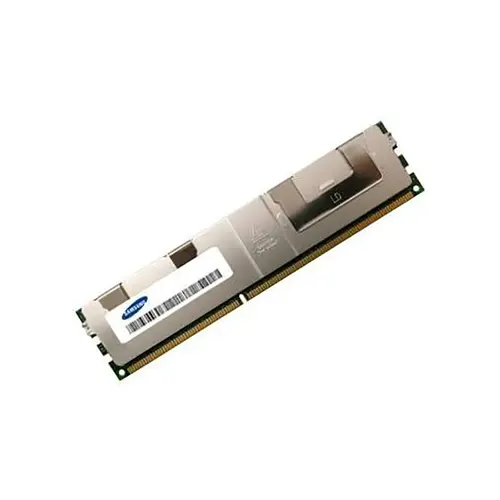
This Samsung 64GB DDR3-1333 Registered ECC RDIMM (M386B8G70DE0-YH93Q) is engineered for legacy enterprise servers and excels in memory-intensive workloads like virtualization and in-memory databases where data integrity is critical. Its octal-rank x4 configuration enables exceptionally dense memory populations, while the registered buffer and ECC actively maintain stable signaling and correct single-bit errors even under full channel loading.
1. High-density module expands in-memory datasets and virtual machine footprints, allowing service providers to consolidate more tenants on each physical host without adding nodes.
2. ECC protection continuously detects and corrects bit-flips in the background, preserving transaction integrity for financial processing or medical records where data accuracy is non-negotiable.
3. Registered buffer isolates the DRAM load from the memory controller, maintaining signal integrity across fully populated channels in multi-socket designs and preventing silent faults under heavy utilization.
4. Octal Rank x4 organization packs extreme capacity into a single DIMM, enabling massive analytics or virtual desktop workloads while keeping the server’s channel count efficient and balanced.
5. Low-voltage operation reduces both primary and cooling power draw in densely packed racks, directly shrinking the datacenter’s energy bill and carbon footprint without sacrificing throughput.
In a virtualized server farm, the M386B8G70DE0-YH93Q’s 64 GB capacity lets you consolidate far more virtual machines per host, directly reducing hardware sprawl and licensing overhead. Its Registered architecture buffers command and address signals, so you can fully populate every DIMM slot on a quad-socket board without signal degradation—this stability is critical when dozens of VMs compete for memory access. At the same time, ECC error correction silently detects and fixes single-bit bit flips that would otherwise crash a hypervisor, corrupt financial transactions, or silently poison a database record. Moving to an in-memory database such as SAP HANA, the module’s octal-rank design leverages aggressive bank interleaving to sustain high bandwidth under heavy random-access workloads, ensuring real-time analytics never stall. The low 1.35 V operating voltage further trims power bills in dense rack deployments, while the registered buffer allows these high-density, multi-rank modules to coexist without sacrificing signal integrity. Every bit of data accuracy and capacity headroom translates directly into fewer outages, faster insights, and a lower total cost of ownership for your data center.
General Virtualization
Populate all memory channels symmetrically to avoid performance bottlenecks. Installing four 64GB registered DIMMs (one per channel) provides 256GB, ideal for moderate VM density, while eight modules (two per channel) scale to 512GB for larger deployments. Balanced population ensures consistent memory access and maximizes hypervisor efficiency.
In-Memory Database
Capacity and reliability are critical for databases like SAP HANA. Deploy eight 64GB RDIMMs across all channels (2DPC) to reach 512GB, leveraging memory interleaving for lower latency. For mission‑critical environments, enable mirroring or lockstep mode if supported, and verify platform compatibility with octal‑rank DIMMs at this density.
High-Performance Computing
Memory bandwidth often limits HPC throughput. Use one 64GB DIMM per channel (1DPC) to maintain the full 1333MT/s speed; eight channels yield 256GB with optimal bandwidth. If larger capacity is necessary, populate two DIMMs per channel but be aware that speed may downclock—check the server’s POR for 2DPC configurations with octal‑rank modules.
Rigorously tested server memory compatible with Dell PowerEdge R720/R620, HP DL380p Gen8, and Lenovo RD630.
Q: Can I mix this M386B8G70DE0-YH93Q with other memory modules of different brands or speeds?
A: Mixing is strongly discouraged for registered server memory. Mismatched brands, speeds, or ranks can cause signal integrity issues and system instability. Always populate with identical Samsung modules to ensure reliable 24/7 operation.
Q: Is this memory compatible with my system?
A: Compatibility requires a server platform supporting DDR3 ECC Registered DIMMs. Verify your board or OEM system accepts 64GB Octal Rank x4 1333MHz RDIMMs. Common supported generations include Intel Xeon E5-2600 v1/v2 and AMD Opteron 6300 series.
Q: What is the recommended DIMM population order for optimal performance?
A: Follow your server motherboard’s specific population guide. Generally, populate identical DIMMs in the first slot of each memory channel (often blue slots) to enable balanced interleaving and maximize memory bandwidth while maintaining ECC integrity.
Q: Does this module support overclocking or XMP profiles?
A: No. This is an enterprise-grade RDIMM designed for stability at JEDEC standard DDR3-1333 CL9. It does not support overclocking or Intel XMP. Its ECC and registered buffer prioritize error-free reliability over tunable performance.
Q: What warranty and typical failure rate can I expect?
A: This module includes a one-year warranty. Enterprise memory inherently has a very low annualized failure rate (AFR), typically under 0.3%, thanks to rigorous binning and stringent testing for 24/7 data-center environments.