











 Secure payments
Standard refund policy
Trade Assurance
Secure payments
Standard refund policy
Trade Assurance
| Product Type | Memory Module |
|---|---|
| Memory Capacity | 64 GB |
| Memory Technology | DDR5 |
| RAM Speed | 6400 MHz |
| RAM Standard | DDR5-6400/PC5-51200 |
| Error Identifying | ECC |
| Signal Type | Registered |
| Column Access Strobe (CAS) | CL52 |
| Rank | Dual Rank x4 |
| Quantity of Pins | 288-pin |
| RAM Genre | RDIMM |
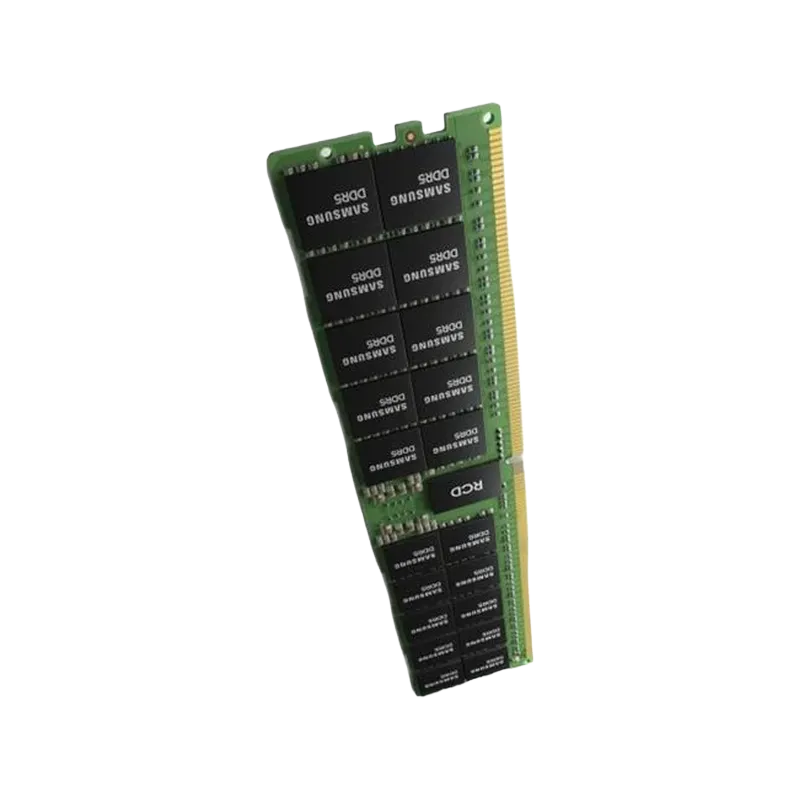
This 64GB DDR5-6400 Registered DIMM with ECC is engineered for enterprise servers and memory-intensive workloads such as virtualization, in-memory databases, and large-scale data analytics, where the dual-rank x4 organization and registered signal type ensure robust signal integrity and maximum capacity per channel under heavy load. Its DDR5-6400 speed combined with ECC error correction delivers high bandwidth and end-to-end data integrity, critical for maintaining reliability in always-on mission-critical environments.
1. ECC protection automatically corrects single-bit memory errors, safeguarding transactional integrity for financial databases and mission-critical enterprise applications.
2. Registered signal type buffers the command and address busses, maintaining rock-solid signal integrity across fully populated server boards with dozens of DIMMs.
3. DDR5 technology delivers higher bank count and doubled burst length, boosting memory bandwidth per core to sustain heavy virtualization and container density.
4. High-speed operation feeds the fastest data throughput to multi-socket CPUs, keeping real-time analytics and in-memory caches responsive under peak loads.
5. Large module capacity allows denser server memory configurations, maximizing the number of virtual machines per node without sacrificing headroom for RAM-hungry workloads.
The M321R8GA0EB2-CCPEC is a registered DDR5 server memory module engineered for mission-critical enterprise workloads. Its 64 GB capacity per stick allows dense memory configurations inside virtualized clusters, meaning more virtual machines can run simultaneously without swapping to slower storage, which directly preserves service-level agreements under heavy consolidation. The 6400 MT/s speed and dual-rank x4 organization elevate bandwidth and interleaving efficiency, enabling in-memory databases like Redis or SAP HANA to sustain millions of transactions per second with visibly lower tail latency — real-time analytics dashboards render faster, and customer-facing applications remain responsive. Underneath that throughput, ECC and the registered buffer tackle two silent killers of server uptime: bit flips and signal degradation. ECC corrects single-bit errors caused by cosmic radiation or power noise, preventing silent data corruption that could cascade into irrecoverable database index damage. Meanwhile, the register on the 288-pin RDIMM isolates the memory controller from capacitive loading across ranks, maintaining clean command signals even when all DIMM slots are populated to multi-terabyte scale. Together, these features translate into uncompromised data integrity and stable, predictable performance for cloud platforms, hypervisors, and high-frequency trading systems where a single error or a millisecond of jitter can cost real revenue.
Server Memory – DDR5-6400 Registered ECC (RDIMM)
This 64 GB DDR5-6400 registered ECC module is built for mission‑critical server platforms. Its high speed and error correction make it ideal for workloads demanding data integrity and large memory footprints. Below are capacity planning recommendations for typical server roles.
General Virtualization
For dense VM consolidation, populate all memory channels symmetrically to maximize bandwidth. A common configuration is eight 64 GB RDIMMs per socket, delivering 512 GB total with balanced interleaving. Using dual‑rank x4 DIMMs at two per channel preserves 1 DPC speed while ECC guards against soft errors in shared multi‑tenant environments.
In‑Memory Database
SAP HANA, Redis, or Memcached require the entire working set in RAM. Fully populate every memory channel with 64 GB RDIMMs, aiming for 1 TB or more per node (e.g., 16 modules on a dual‑socket board). The registered ECC ensures data integrity during sustained high‑throughput reads/writes, and dual‑rank DIMMs improve concurrency under heavy parallel access.
High‑Performance Computing (HPC)
Memory‑bound simulations and modeling thrive on bandwidth. Install at least eight 64 GB RDIMMs per node (512 GB) across all channels to saturate the memory controller. The DDR5‑6400 speed and dual‑rank x4 organization deliver low latency and high aggregate throughput. Configure memory in symmetric NUMA topologies to avoid remote‑node penalties in tightly coupled MPI jobs.
Rigorously tested for enterprise servers: compatible with Dell PowerEdge R760, HPE ProLiant DL380 Gen11, Lenovo ThinkSystem SR650 V3, Supermicro SYS-221H-TNR.
Q: Can I mix this M321R8GA0EB2-CCPEC with other memory modules of different brands or speeds?
A: Mixing is not recommended. Registered ECC modules require identical specs to ensure signal integrity and system stability. Mismatched ranks or timings may cause POST failures or data corruption.
Q: Is this memory compatible with my system?
A: This DDR5-6400 RDIMM is designed for servers using Intel Xeon Scalable or AMD EPYC platforms. Please verify your motherboard or system QVL and ensure support for 64GB Dual Rank x4 modules.
Q: What is the recommended DIMM population order for optimal performance?
A: Populate identical DIMMs per channel in descending capacity order. For dual-processor systems, balance memory across CPU memory controllers. Always follow the server board's specific population guide to maximize throughput.
Q: Does this module support overclocking or XMP profiles?
A: No. This RDIMM adheres to JEDEC standard profiles for mission-critical reliability. Overclocking or XMP is not supported, ensuring stable operation within the server's specified thermal and power envelope.
Q: What warranty and typical failure rate can I expect?
A: This module includes a one-year warranty. It is built to enterprise-grade standards with an expected AFR well below 0.5% under normal server operating conditions, ensuring long-term data center reliability.