











 Secure payments
Standard refund policy
Trade Assurance
Secure payments
Standard refund policy
Trade Assurance
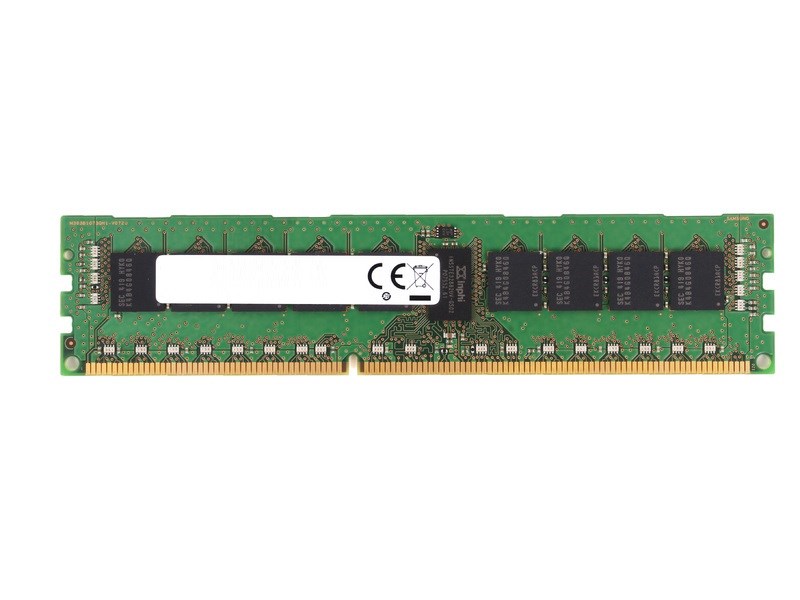
| Model | M393B1G73QH0-YK0Q9 |
|---|---|
| Product Type | Memory Module |
| Compliance Standards | EU RoHS,FCC |
| Memory Capacity | 8 GB |
| Memory Technology | DDR3 |
| Product Voltage | 1.35V |
| RAM Speed | 1600MHz |
| RAM Standard | DDR3-1600/PC3-12800 |
| Error Identifying | ECC |
| Signal Type | Registered |
| Column Access Strobe (CAS) | CL11 |
| Rank | Dual Rank x8 |
| Quantity of Pins | 240-pin |
| RAM Genre | RDIMM |
This Samsung M393B1G73QH0-YK0Q9 is an 8GB DDR3-1600 registered ECC RDIMM designed specifically for server platforms, making it ideal for memory-intensive workloads such as virtualization, in-memory databases, and mission-critical applications that demand uncompromising data integrity. Its 1.35V low-voltage operation reduces power consumption and thermal load, while the dual-rank x8 configuration with registered signal technology enhances signal stability and memory channel utilization in dense multi-DIMM enterprise environments.
1. ECC protection catches and corrects single-bit memory errors in real time, preventing silent data corruption that could crash critical database or virtualization workloads.
2. Registered signal buffering stabilizes the command and address lines, allowing dense server configurations to populate all DIMM slots without compromising signal integrity under sustained load.
3. Dual Rank x8 organization interleaves internal banks to keep the memory channel busy, directly improving the throughput available to multiple virtual machines running concurrently.
4. Operating at just 1.35V cuts power consumption per module, meaning a fully populated rack of these DIMMs significantly lowers cooling overhead and energy costs in a data center.
5. The 1600MHz clock speed delivers a peak bandwidth of 12800 MB/s, ensuring responsive handling of simultaneous memory requests when hosting latency-sensitive enterprise applications.
This Samsung ECC Registered DIMM is engineered for mission-critical server deployments, not the desktop. In a dense virtualization cluster running VMware or Hyper-V, silent memory corruption is the hidden adversary that triggers unexplained guest crashes and data inconsistencies. The module’s ECC function actively detects and corrects single-bit errors—a hard stop against cosmic-ray-induced bit flips—so your hypervisor stack can run extended 24/7 workloads without creeping instability. Meanwhile, the Registered signal design buffers the command and address lines, which directly resolves the signal-integrity nightmare seen when all 24 DIMM slots are populated; you can scale system memory capacity with confidence, knowing boot failures and memory training faults are driven out of the picture.
Operating at a low 1.35 V delivers another decisive advantage: in a farm of servers, that power savings compounds into lower electricity bills and reduced fan speed, making a genuine dent in TCO. The dual-rank x8 organization, paired with 1600 MHz speed, brings memory interleaving into play—critical for an in-memory database like Redis or a financial tick engine where microseconds matter, because it overlaps internal bank accesses to sustain higher bandwidth during burst reads. What all this means for you is a server memory foundation that turns uptime from a gamble into a guarantee while trimming operational overhead.
Server Memory – DDR3L-1600 Registered ECC RDIMM (8GB)
General Virtualization
For entry-level virtualization hosts, populate at least six identical modules across three memory channels to leverage the triple-channel architecture common to this era of servers. A total capacity of 48GB (6 x 8GB) allows efficient hosting of 10–15 light VMs, while sticking to a single rank per channel maintains optimal 1333/1600MHz speeds under moderate loading.
In-Memory Database
Low-latency databases such as Redis or Memcached benefit from large capacity and consistent latency. Deploy a fully balanced configuration with 12 x 8GB RDIMMs (96GB total) to maximize channel interleaving and ensure CL11 predictability. The 1.35V low-power design helps reduce thermal throttling in dense 1U nodes running sustained in-memory analytics.
High-Performance Computing (HPC)
HPC workloads demand maximum memory bandwidth. Install dual-rank x8 modules in a fully populated, balanced setup—typically 12 or 16 DIMMs—to saturate all memory channels. The registered ECC signaling maintains signal integrity at heavy load, while 1600MHz operation combined with dual-rank access patterns delivers the throughput required for fluid dynamics, molecular modeling, or financial simulations.
Rigorously tested for servers, compatible with Dell PowerEdge R720, HP ProLiant DL380p Gen8, and Lenovo System x3650 M4.
Q: Can I mix this M393B1G73QH0-YK0Q9 with other memory modules of different brands or speeds?
A: Mixing different brands or speeds is not recommended for this registered server DIMM. It may cause stability issues. Populate identical modules to maintain ECC and dual-rank integrity for reliable 24/7 operation.
Q: Is this memory compatible with my system?
A: This M393B1G73QH0-YK0Q9 is an 8GB DDR3-1600 Registered ECC RDIMM for servers. It fits platforms using Intel Xeon E5 series or AMD Opteron 6300 series chipsets with C602/C600 or equivalent server boards.
Q: What is the recommended DIMM population order for optimal performance?
A: Populate identical dual-rank RDIMMs starting with slot 0 of each memory channel, typically blue slots first. Follow the server motherboard manual for balanced channel interleaving and maximize memory bandwidth.
Q: Does this module support overclocking or XMP profiles?
A: No, this registered ECC server DIMM adheres strictly to JEDEC DDR3-1600 CL11 specifications. Overclocking or XMP is not supported, as it compromises data integrity and platform stability in enterprise environments.
Q: What warranty and typical failure rate can I expect?
A: This module includes a 1-year warranty. As a premium Samsung RDIMM, it delivers high reliability with an annualized failure rate typically below 0.4%, provided proper cooling and voltage conditions are maintained.