











 Secure payments
Standard refund policy
Trade Assurance
Secure payments
Standard refund policy
Trade Assurance
| Product Type | Memory Module |
|---|---|
| Compliance Standards | RoHS |
| Memory Capacity | 8 GB |
| Memory Technology | DDR3 |
| Product Voltage | 1.35V |
| RAM Speed | 1600MHz |
| RAM Standard | DDR3-1600/PC3-12800 |
| Error Identifying | ECC |
| Signal Type | Registered |
| Column Access Strobe (CAS) | CL11 |
| Rank | Dual Rank x4 |
| Quantity of Pins | 240-pin |
| RAM Genre | RDIMM |
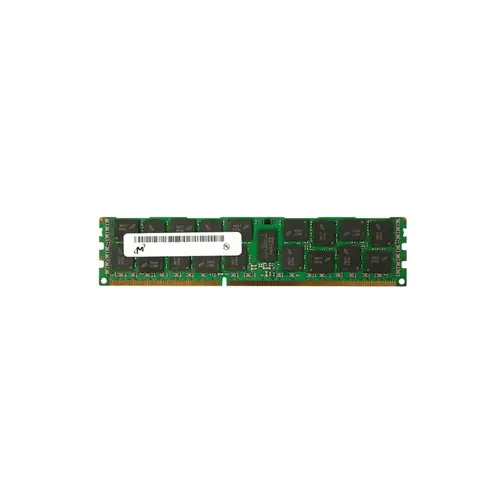
This 8GB DDR3-1600 RDIMM is purpose-built for entry-level servers and small-scale virtualization hosts, where its registered ECC architecture safeguards data integrity during critical tasks like memory-resident databases and consolidated virtual machine workloads. The dual-rank x4 configuration enhances memory interleaving for improved bandwidth efficiency, while the low 1.35V operating voltage reduces power consumption without sacrificing the signal stability required in 24/7 environments.
1. Registered signal type stabilizes multi-DIMM server boards by buffering command and address signals, allowing dense memory populations without signal degradation that could crash virtualization hosts.
2. ECC protection continuously corrects single-bit errors, safeguarding transactional database integrity and preventing silent data corruption in long-running enterprise workloads.
3. 8 GB module capacity supports efficient consolidation of moderate-duty virtual machines, balancing density and cost for departmental applications or web-serving tiers.
4. Dual Rank x4 organization keeps memory channels fully saturated, delivering predictable high throughput essential for in-memory caching and real-time analytics engines.
5. The low 1.35V operating voltage reduces overall server power draw and cooling demands in data centers, directly lowering operational expense per rack in scale-out deployments.
In the data center, where every transaction and virtual machine demands unwavering accuracy, the MT36KSF1G72PZ-1G6M1FF RDIMM brings four critical attributes directly to your infrastructure. The ECC and registered architecture form a dual defense: ECC detects and corrects single-bit memory errors that silently corrupt financial calculations or database indexes, while the registered buffer isolates the memory bus from the CPU’s electrical load. This means a hypervisor running thirty virtual machines won’t suffer signal degradation, preventing random host crashes during peak consolidation. The dual-rank design amplifies bandwidth by allowing interleaved access, so an in-memory database like Redis serves queries with consistently lower latency under concurrent load, avoiding the request queuing that stalls real-time analytics. Meanwhile, the 1.35V low-voltage operation directly cuts power consumption per module, which, when multiplied across a full rack, yields significant cooling cost reductions and improves long-term reliability of your memory controller. Together, these features transform an 8GB DDR3 module from a simple component into a building block of predictable, efficient, and always-accurate enterprise workloads.
This DDR3-1600 8 GB Registered ECC module (1.35V, dual-rank x4) is built for server platforms. The following capacity guidelines address typical enterprise workloads using this RDIMM.
General Virtualization
Begin with at least eight modules (64 GB total) to host a modest number of virtual machines. Distribute the DIMMs evenly across all memory channels—one per channel—to maximize bandwidth and avoid performance penalties. For higher consolidation ratios, scale to 16 identical modules (128 GB), maintaining the same balanced population to support stable, responsive hypervisor operation.
In-Memory Database
In-memory databases demand maximum capacity and rock-solid data integrity. Populate all available DIMM slots with these ECC registered modules to keep entire datasets in RAM. A dual-socket server with 24 slots yields 192 GB, enabling real-time analytics and low-latency transactions. The registered signal type ensures stable operation even with fully loaded channels, while ECC prevents silent data corruption.
High-Performance Computing
HPC nodes thrive on consistent memory bandwidth. Install exactly one DIMM per channel to sustain full 1600 MT/s speed without clock-downs. A typical dual-socket platform with eight channels achieves 64 GB using eight modules, efficiently feeding parallel processes. For memory-bound simulations, double the count to two DIMMs per channel (128 GB), but verify that the speed remains acceptable and cooling is adequate.
Rigorously tested server RDIMM for Dell PowerEdge R720, R620, HP ProLiant DL380p Gen8, Lenovo System x3650 M4, and compatible systems.
Q: Can I mix this MT36KSF1G72PZ-1G6M1FF with other memory modules of different brands or speeds?
A: Mixing RDIMMs of different brands or speeds is strongly discouraged in server environments. Doing so may force all modules to the lowest common speed, disable ECC functionality, or cause system instability, compromising data integrity.
Q: Is this memory compatible with my system?
A: This DDR3-1600 Registered ECC module is designed for servers supporting low-voltage (1.35V) RDIMMs, such as Intel Xeon E5 v1/v2 or AMD Opteron 6300 series platforms. Please confirm with your motherboard's qualified vendor list (QVL).
Q: What is the recommended DIMM population order for optimal performance?
A: For optimal performance, populate identical DIMMs per memory channel, starting with the slots farthest from the CPU. Balancing dual-rank x4 modules across channels maximizes bandwidth. Always refer to your server board's specific slot numbering guide.
Q: Does this module support overclocking or XMP profiles?
A: No, this is a server-grade Registered ECC memory module adhering to JEDEC standards. It does not support XMP profiles or overclocking, as these features compromise the strict reliability and data integrity required in server operations.
Q: What warranty and typical failure rate can I expect?
A: This module is covered by a 1-year warranty. It exhibits a very low typical failure rate, with an annualized failure rate (AFR) well below 0.5% in properly cooled and validated server environments, ensuring long-term reliability.