











 Secure payments
Standard refund policy
Trade Assurance
Secure payments
Standard refund policy
Trade Assurance
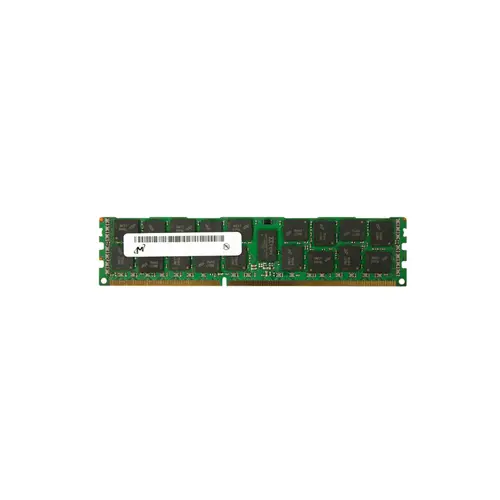
| Product Type | Memory Module |
|---|---|
| Memory Capacity | 4 GB |
| Memory Technology | DDR3 |
| Product Voltage | 1.35 V |
| RAM Speed | 1600 MHz |
| RAM Standard | DDR3-1600/PC3-12800 |
| Error Identifying | ECC |
| Signal Type | Registered |
| Column Access Strobe (CAS) | CL11 |
| Rank | Dual Rank x8 |
| Quantity of Pins | 240-pin |
| RAM Genre | RDIMM |
This Micron 4GB DDR3-1600 RDIMM, operating at a low 1.35V with ECC and registered signal buffering, is ideally suited for entry-level servers and virtualization hosts where data integrity and stable multi-DIMM configurations are critical. Its dual-rank x8 organization improves memory interleaving for consistent throughput in memory-database caches and small-scale virtualized environments, while registered logic ensures reliable signal integrity across multiple modules.
1. ECC protection silently corrects single-bit memory errors in real time, safeguarding transactional data integrity in mission-critical server workloads.
2. Registered signal buffering stabilizes high-capacity memory arrays, allowing dense server configurations to scale without compromising electrical reliability.
3. DDR3-1600 delivers up to 12.8 GB/s of peak bandwidth per channel, efficiently feeding data-hungry virtualization hosts and in-memory databases.
4. Low-voltage 1.35V operation reduces overall datacenter power draw and thermal stress, directly lowering cooling costs in multi-node deployments.
5. Dual rank x8 organization enables rank interleaving that overlaps memory access latencies, sustaining higher throughput under simultaneous VM requests.
The Micron MT18KSF51272PDZ-1G6K1FE is a 4GB DDR3-1600 registered RDIMM built with ECC, dual-rank x8 organization, and a low 1.35V operating voltage. In the server environments it is engineered for, these four characteristics translate directly into infrastructure resilience and performance headroom.
Error-correcting code (ECC) is non-negotiable for data integrity. In a virtualization cluster running multiple VMs on a hypervisor, a single undetected bit flip caused by background radiation can silently corrupt a database transaction or a hypervisor memory page, leading to application crashes or data loss. ECC instantly detects and corrects single-bit errors, turning unpredictable downtime into uninterrupted operations.
Registered signal buffering stabilizes the command and address lines, enabling the motherboard to populate all memory channels with multiple DIMMs without signal degradation. When you expand your VMware host to 192GB or more for high-density consolidation, registered buffering keeps the memory subsystem reliable—even under full load.
The dual-rank design leverages rank interleaving to boost effective bandwidth. While one rank is refreshing or completing a cycle, the memory controller can already begin accessing the next rank, cutting idle latency. This becomes a critical advantage for in-memory databases like Redis, where sub-millisecond latency and high throughput per watt are mandatory.
Finally, the 1.35V low-voltage operation directly reduces power consumption and cooling costs across a fleet of rack servers. In a 24/7 data centre, every watt saved on each DIMM compounds into substantial TCO savings and higher rack density without exceeding thermal envelopes.
General Virtualization
For lightweight virtualization hosts, populate all memory channels with these 4 GB registered ECC modules to sustain memory bandwidth and fault tolerance. A dual‑socket server with 12 DIMM slots per CPU can provide 96 GB using 24 modules, sufficient for small‑scale test/dev clusters or entry‑level hypervisor deployments. Always balance modules across channels and CPU sockets to maintain NUMA symmetry and consistent performance.
In‑Memory Database
In‑memory databases thrive on capacity and low latency; four‑gigabyte modules severely constrain total memory even in densely populated servers. Such a configuration is viable only for tiny datasets or development instances, but it risks performance collapse under growing workloads. For production, replace these modules with higher‑capacity RDIMMs (16 GB or larger) to eliminate capacity bottlenecks and reduce the number of modules needed to reach usable memory footprints.
High Performance Computing
The dual‑rank x8 design and 1,600 MHz speed deliver moderate bandwidth for throughput‑oriented HPC jobs when modules are evenly spread across all memory channels. These 4 GB modules can outfit low‑cost cluster nodes in a scale‑out model, where aggregate memory is achieved by hundreds of nodes rather than a single fat box. For memory‑intensive simulations or fine‑grid modeling, upgrade to larger LRDIMMs to avoid swap overhead and keep datasets resident in RAM.
Rigorously tested, compatible with servers like Dell PowerEdge R720, HP DL380p Gen8, Lenovo ThinkServer RD430.
Q: Can I mix this MT18KSF51272PDZ-1G6K1FE with other memory modules of different brands or speeds?
A: Mixing RDIMMs of different brands or speeds is strongly discouraged in server environments. This can cause signal integrity issues, system instability, and may force all modules to run at the lowest common speed, often requiring increased voltage.
Q: Is this memory compatible with my system?
A: This DDR3-1600 ECC Registered DIMM is designed for server platforms supporting 1.35V RDIMMs, such as Intel Xeon E5-series v1/v2 or select AMD Opteron systems. Verify your board's qualified vendor list for this 4GB dual-rank module.
Q: What is the recommended DIMM population order for optimal performance?
A: For dual-socket servers, balance capacity across memory channels and populate identical modules per channel. Typically, install this dual-rank x8 RDIMM starting with the furthest slot from the CPU, following your server motherboard's specific population guide.
Q: Does this module support overclocking or XMP profiles?
A: No. As an ECC Registered server memory adhering to JEDEC standards, this module does not support overclocking or XMP profiles. It operates exclusively at validated JEDEC timings to ensure maximum data integrity and platform stability.
Q: What warranty and typical failure rate can I expect?
A: This Micron module includes a 1-year warranty. Enterprise-class RDIMMs exhibit very low annualized failure rates under proper thermal and voltage conditions, typically below 0.5% AFR when operated within specified limits.