











 Secure payments
Standard refund policy
Trade Assurance
Secure payments
Standard refund policy
Trade Assurance
| Product Type | Memory Module |
|---|---|
| Memory Capacity | 32 GB |
| Memory Technology | DDR3 |
| Product Voltage | 1.5V |
| RAM Speed | 1600MHz |
| RAM Standard | DDR3-1600/PC3-12800 |
| Error Identifying | ECC |
| Signal Type | Registered |
| Column Access Strobe (CAS) | CL11 |
| Rank | Quad Rank x4 |
| Quantity of Pins | 276-pin |
| RAM Genre | CDIMM |
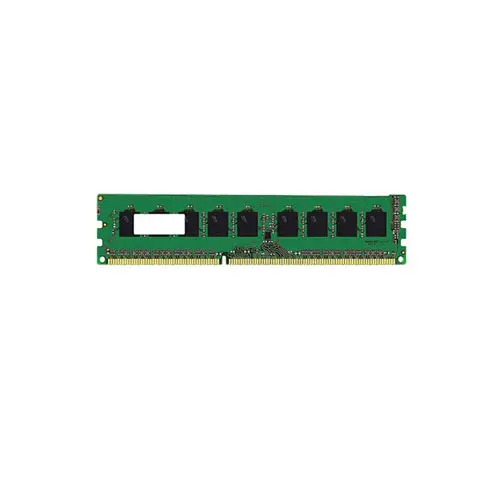
This 32GB DDR3-1600 Registered ECC memory module (CDIMM, Quad Rank x4) is engineered for server platforms requiring high data integrity and robust memory scalability, making it ideal for virtualization, in-memory databases, and mission-critical enterprise workloads. Its registered signal architecture stabilizes multi-DIMM channels under heavy load, while ECC and a quad-rank x4 organization deliver dense 32GB capacity per module with enhanced error correction for uninterrupted 24/7 operations.
1. ECC memory protects against single-bit and multi-bit errors in real time, preventing silent data corruption that could crash critical database transactions or virtualization workloads in a data center.
2. Registered signal type buffers command and address lines, enabling a single server motherboard to support large memory populations without electrical loading issues, which is essential for scaling up memory capacity in virtualization hosts.
3. Quad Rank x4 organization packs four logical ranks on a single module, maximizing memory interleaving and throughput per channel to keep up with multi-core server processors under heavy, concurrent request loads.
4. 32GB capacity per module allows denser VM consolidation and larger in-memory datasets, reducing the need for costly scale-out nodes and improving overall rack-level compute density.
5. 1600MHz speed paired with DDR3 delivers a balanced bandwidth profile for legacy enterprise servers, sustaining stable performance for ERP and database applications that are not yet latency-sensitive to newer DDR generations.
In always-on server environments, the Samsung M351B4G73DB0-YK0 is engineered as a registered ECC DDR3 module, and its four defining characteristics directly address the critical pain points of data integrity, scalability, and sustained throughput. The 32GB quad-rank x4 design is not merely about density; it leverages rank interleaving to boost command efficiency, allowing a virtualization cluster to run dozens of VMs without the memory bus stalling under concurrent access requests. Meanwhile, ECC constantly corrects single-bit errors caused by cosmic radiation or electrical noise, which is non-negotiable for an in-memory database like Redis—one undetected bit flip in a live transaction can silently corrupt financial records or trigger cascading application failures. The registered buffer stabilizes signal loading across the 276-pin CDIMM, enabling you to populate all available slots without sacrificing 1600MHz speed, a must when scaling RAM for large-footprint analytics workloads. Even at CL11, the combination of registered command/address control and quad-rank parallelism translates into predictable, jitter-free performance where a memory instance in a virtualized node must never be the bottleneck during peak query loads.
Server Memory Identified: The provided specifications (DDR3-1600 ECC Registered, Quad Rank x4, 276-pin CDIMM) confirm this is a legacy server-grade module. Capacity planning must account for its 32GB density per module and the platform’s typical population rules for registered memory.
General Virtualization
In virtualized environments, memory is often the primary constraint before CPU. With 32GB Registered DIMMs, populate at least six modules per dual-socket server (192GB total) to comfortably host 20–30 mid-sized VMs. Always configure symmetrical channels (e.g., one DIMM per channel across all memory risers) to maintain balanced memory access and avoid NUMA penalties.
In-Memory Database
For databases like Redis or SAP HANA, large and reliable memory pools are critical. Use the maximum number of identical 32GB Quad Rank modules the platform supports—often 24 DIMMs for 768GB in a four-socket server—to minimize data sharding overhead. Quad Rank x4 architecture provides robust chip-level error correction, but be aware of speed drops at high rank counts; validate that 1600MHz is maintained under full population.
High-Performance Computing
HPC workloads demand high bandwidth and low latency. Install at least one 32GB DIMM per memory channel (typically eight modules per node for 256GB) to fully utilize the CPU’s memory bandwidth. Avoid mixing ranks within a channel; stick with the Quad Rank x4 parts exclusively to preserve consistent CAS 11 timing and prevent memory training failures during cluster scaling.
Rigorously tested, compatible with servers like Dell PowerEdge R720, HP ProLiant DL380p Gen8, and Lenovo ThinkServer RD630.
Q: Can I mix this M351B4G73DB0-YK0 with other memory modules of different brands or speeds?
A: Mixing is not recommended for server-grade Registered ECC memory. Inconsistent ranks, timings, or vendors can cause stability issues. For guaranteed reliability, populate channels with identical part numbers.
Q: Is this memory compatible with my system?
A: This DDR3-1600 Registered ECC CDIMM targets Intel Xeon E5-2600 v1/v2 and AMD Opteron 6300 series platforms. Verify that your server board supports quad rank, 1.5V, 276-pin LRDIMM-style modules and proper ECC RDIMM slots.
Q: What is the recommended DIMM population order for optimal performance?
A: Follow your server’s technical guide. Typically, populate identical quad rank modules starting with the first slot of each memory channel (often blue slots), balancing across all populated CPUs for optimal interleaving.
Q: Does this module support overclocking or XMP profiles?
A: No. This is a JEDEC-compliant Registered ECC server module operating strictly at PC3-12800 (1600MHz). It does not support XMP or overclocking, as server platforms prioritize data integrity and rock-solid stability.
Q: What warranty and typical failure rate can I expect?
A: This product includes a one-year warranty. Engineered with enterprise-grade components and rigorous screening, its AFR (annualized failure rate) is substantially lower than standard desktop memory in qualified server environments.