











 Secure payments
Standard refund policy
Trade Assurance
Secure payments
Standard refund policy
Trade Assurance
| Model | M386B4G70BM0-CK0 |
|---|---|
| Product Type | Memory Module |
| Compliance Standards | EU RoHS,FCC |
| Memory Capacity | 32 GB |
| Memory Technology | DDR3 |
| Product Voltage | 1.5V |
| RAM Speed | 1600MHz |
| RAM Standard | DDR3-1600/PC3-12800 |
| Error Identifying | ECC |
| Signal Type | Registered |
| Column Access Strobe (CAS) | CL11 |
| Rank | Quad Rank x4 |
| Quantity of Pins | 240-pin |
| RAM Genre | RDIMM |
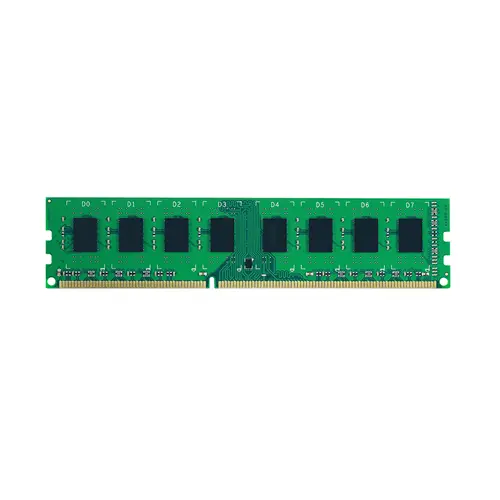
Targeted at enterprise servers and virtualization platforms, this Samsung M386B4G70BM0-CK0 32GB DDR3-1600 Registered ECC RDIMM ensures maximum data integrity for memory-intensive workloads like in-memory databases and large-scale virtual machine deployments. Its registered signal architecture stabilizes heavy Quad Rank x4 configurations across multiple DIMMs, while the CL11 latency and 1.5V operation maintain consistent performance under 24/7 mission-critical conditions.
1. ECC protection detects and corrects single-bit errors in real time, preserving data integrity for financial transactions and mission-critical virtualization workloads.
2. Registered signal buffering stabilizes command and address lines across populated memory channels, enabling large-capacity server deployments without sacrificing reliability.
3. Quad Rank x4 organization doubles the logical bank count per module, sustaining higher simultaneous access rates under heavy in-memory database contention.
4. The thirty-two-gigabyte module density allows a typical dual-socket server to scale memory capacity economically, packing more virtual machines onto each physical host.
5. DDR3-1600 transfer speed delivers balanced throughput for legacy enterprise workloads, efficiently serving numerous concurrent users while remaining thermally sustainable in data-center racks.
The Samsung M386B4G70BM0-CK0 32GB DDR3-1600 Registered ECC DIMM directly confronts the critical pain points of server infrastructure. In virtualization clusters, ECC correction prevents silent data corruption that could crash multiple VMs or quietly flip a transactional entry, keeping your multi-tenant environment trustworthy around the clock. Meanwhile, the registered buffer preserves signal integrity when all 24 memory slots are fully populated with high-density quad-rank modules, enabling seamless scaling to large memory pools without stability hiccups—essential for consolidating heavy workloads. The Quad Rank x4 architecture employs bank interleaving to deliver higher effective bandwidth; when your in-memory database such as Redis faces thousands of simultaneous queries, the reduced access latency translates straight into faster response times and more transactions per second. Finally, the reliable 1600MHz speed at CL11 supplies a steady 12.8 GB/s, perfectly matching popular Xeon E5 platforms, so you extend server lifespan and safeguard data without a costly platform overhaul. This combination keeps your virtualized workloads and real-time analytics performing with minimal downtime.
General Virtualization
For a DDR3 Registered ECC module like the 32GB M386B4G70BM0-CK0, populate at least two identical DIMMs per channel to enable memory interleaving, but avoid mixing quad-rank DIMMs on the same channel beyond one per channel in older servers, as this typically limits speed to 1066MHz or 800MHz. Aim for balanced configurations—such as six or twelve modules in a dual-processor system—to maximize available capacity for VMs while maintaining reliable 1600MHz operation where supported.
In-Memory Database
In-memory databases demand both high capacity and the data integrity that Registered ECC provides. Deploy these 32GB quad-rank RDIMMs in symmetrical configurations across all memory channels (e.g., 512GB using 16 identical modules in a 2-socket server) to minimize latency variations. Given the CL11 latency and quad-rank loading, strictly adhere to the server vendor’s population guide to prevent clock speed downgrades, and consider slightly overprovisioning memory to accommodate dataset growth and maintenance operations.
HPC
For HPC workloads that require error-resilient, large memory footprints, fill each memory channel with a single quad-rank 32GB RDIMM to achieve maximum capacity at the highest possible speed, often 1333MHz or 1600MHz depending on platform. Ensure all installed DIMMs share the same rank, latency, and revision to avoid NUMA imbalances and unexpected throttling. When scaling out, plan node capacity in 384GB or 768GB increments using these modules, aligning per-core memory ratios to the application’s working set for optimal throughput.
Rigorously tested server memory, compatible with Dell PowerEdge R720, HP DL380p Gen8, and Lenovo ThinkServer RD430.
Q: Can I mix this M386B4G70BM0-CK0 with other memory modules of different brands or speeds?
A: Mixing is not recommended for server environments. Combining this registered ECC DIMM with unbuffered or non-ECC modules causes instability. For mixed brands, match identical rank and timing to minimize performance penalties and potential system halts.
Q: Is this memory compatible with my Intel Xeon or AMD EPYC server platform?
A: It is designed for dual-processor platforms using Intel Xeon E5-2600 v1/v2 with C600 chipsets, or select AMD Opteron 6300 series. Confirm your board accepts 32GB quad-rank DDR3-1600 registered ECC DIMMs with 1.5V before purchasing.
Q: What is the recommended DIMM population order for optimal performance?
A: Install this quad-rank RDIMM starting from the slot farthest from each CPU, populating blue or black slots first. For balanced memory interleaving, use identical modules per channel and avoid mixing ranks within the same channel.
Q: Does this module support overclocking or XMP profiles?
A: No. This is a JEDEC-compliant registered server DIMM running at the standard DDR3-1600 (PC3-12800) with fixed CL11 latency. Overclocking and XMP are not supported; stability and data integrity take precedence in enterprise environments.
Q: What warranty and typical failure rate can I expect for this Samsung RDIMM?
A: You receive a 1-year warranty. Samsung enterprise memory exhibits a very low annualized failure rate, typically under 0.2% under 24/7 operation, backed by rigorous component screening and ECC protection to maintain server uptime.