











 Secure payments
Standard refund policy
Trade Assurance
Secure payments
Standard refund policy
Trade Assurance
| Brand | Intel |
|---|---|
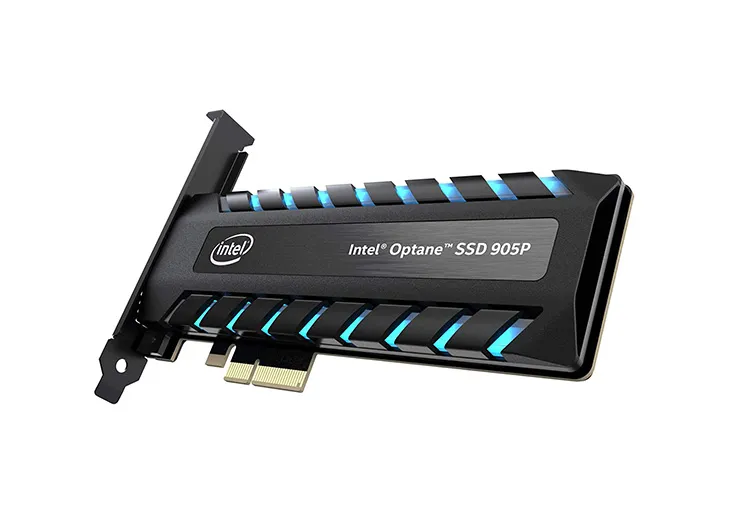
| Model | Optane SSD 905P Series |
| Capacity | 1.5TB |
| Usage Class | Workstation / Enthusiast |
| Host Interface | PCIe Gen 3.0 x4, NVMe |
|---|---|
| Total Interface Bandwidth | 8 Gb/s |
| Form Factor | HHHL |
|---|
| NAND Flash | Intel Optane (3D XPoint) |
|---|---|
| Drive Writes Per Day | 10 |
| Total Bytes Written | 27370 TBW |
| Sequential Read | 2600 MB/s |
|---|---|
| Sequential Write | 2200 MB/s |
| Random Read IOPS | 575000 |
| Random Write IOPS | 550000 |
| Average Latency | 10 μs |
| Mean Time Between Failures | 1.6 Million Hours |
|---|---|
| Uncorrectable Bit Error Rate | 1.0×10⁻¹⁷ |
| Power Loss Protection | Yes |
| MPN | SSDPED1D015GA |
|---|
The SSDPED1D015TAX1 distinguishes the Optane SSD 905P Series by pairing Intel 3D XPoint media with 10 DWPD, 27,370 TBW, and up to 575,000/550,000 IOPS, giving it a clear advantage over same-class NAND SSDs in latency-sensitive databases, write-heavy caching, and high-churn virtualization workloads. Compared with the earlier SSDPED1D015GA, this newer AX1 revision represents a generational step forward in deployable endurance and sustained low-latency consistency, while delivering 2600/2200 MB/s over PCIe Gen 3.0 x4 NVMe in the same 1.5TB footprint.
With an endurance rating of 27,370 TBW and 10 DWPD, the SSDPED1D015TAX1 is built for very write-intensive enterprise use and can comfortably handle repeated full-drive writes every day across its service life. In typical server or system-boot workloads, this level of endurance means the drive is effectively worry-free for long-term deployment and offers substantial headroom well beyond normal daily write demand. Its enterprise-grade reliability is reinforced by power-loss protection (PLP), which helps preserve in-flight data and metadata during an unexpected power interruption, reducing the risk of corruption and downtime. An UBER of 1.0E-17, together with a 1.6 million hour MTBF, indicates a very low probability of uncorrectable bit errors and supports dependable operation in business-critical environments.
1. The PCIe Gen3 x4 NVMe architecture gives this drive a low-overhead, high-parallelism data path that helps enterprise servers clear storage bottlenecks in virtualized, database, and scale-out application environments.
2. Its sequential read performance enables large datasets, logs, and analytics tables to be streamed quickly, reducing wait time for data ingestion, backup restores, and content delivery workflows.
3. The strong random read capability is especially valuable for high-concurrency OLTP, metadata-heavy file systems, and read-intensive cloud services where consistent responsiveness under mixed workloads matters more than peak bandwidth alone.
4. With an endurance class built for very heavy daily rewrites, this SSD is well suited for write-intensive caching, journaling, trading, and logging workloads that would rapidly wear out conventional flash media.
5. By combining Intel Optane media with ultra-low typical latency, the drive delivers near-memory-class responsiveness for latency-sensitive applications such as real-time analytics, index acceleration, and mission-critical database transactions.
Lower capacity reference: 960GB Higher capacity reference: 1.92TB At 1.5TB, SSDPED1D015TAX1 sits in the sweet spot of the family. Compared with the 960GB model, it gives meaningfully more headroom for data growth, overprovisioning, and mixed application workloads without forcing early capacity expansion. Compared with the 1.92TB option, it preserves nearly the same enterprise-class sequential and random performance profile while delivering a more efficient cost-per-deployment balance. This makes 1.5TB especially well suited for mid-scale virtualization clusters, such as hosting boot and active data volumes for roughly 40 to 60 business application instances.
Q: Is SSDPED1D015TAX1 suitable for a write-heavy database server?
A: Yes. SSDPED1D015TAX1 is well suited for write-intensive database workloads, thanks to 10 DWPD endurance, 27,370 TBW, Intel Optane media, and ultra-low 10 µs typical latency.
Q: How many full drive writes per day can it actually endure over its warranty period?
A: This model is rated for 10 full drive writes per day. With 1.5TB capacity, that equals about 15TB of writes daily within its specified warranty endurance limits.
Q: Does it include power loss protection (PLP) and why is that critical?
A: Yes, it includes power loss protection. PLP is critical because it helps preserve in-flight data and metadata during unexpected outages, reducing corruption risk and improving storage reliability.
Q: What RAID level is recommended for this SSD?
A: RAID choice depends on your goal. For database servers, RAID 1 or RAID 10 is commonly recommended to balance redundancy, performance, and fast recovery while leveraging this SSD’s low latency.