











 Secure payments
Standard refund policy
Trade Assurance
Secure payments
Standard refund policy
Trade Assurance
| Brand | Intel |
|---|---|
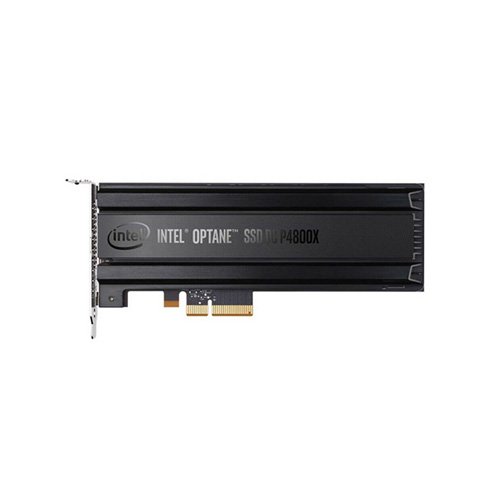
| Model | Optane DC P4800X |
| Capacity | 750 GB |
| Usage Class | Enterprise/Write-Intensive |
| Host Interface | PCIe 3.0 x4, NVMe |
|---|---|
| Total Interface Bandwidth | 32 Gb/s |
| Form Factor | AIC (Half-Height Half-Length) |
|---|
| NAND Flash | 3D XPoint |
|---|---|
| Drive Writes Per Day | 30 |
| Total Bytes Written | 41000 TBW |
| Sequential Read | 2500 MB/s |
|---|---|
| Sequential Write | 2200 MB/s |
| Random Read IOPS | 550000 |
| Random Write IOPS | 550000 |
| Average Latency | 10 μs |
| Mean Time Between Failures | 2 Million Hours |
|---|---|
| Uncorrectable Bit Error Rate | 1.0×10⁻¹⁷ |
| Power Loss Protection | Yes |
| MPN | SSDPED1K750GA |
|---|
The SSDPED1K750GA01 Optane DC P4800X 750GB is the right choice for ultra-low-latency databases, real-time analytics, and write-intensive caching tiers, combining 3D XPoint media with 550K/550K random IOPS and class-leading 30 DWPD endurance for workloads that quickly wear out conventional NAND SSDs. Compared with the previous SSDPED1K750GA, the SSDPED1K750GA01 represents the newer A01 production revision, giving engineers a more current deployment baseline while preserving the same 41,000 TBW durability and 2500/2200 MB/s performance profile that made the P4800X the benchmark for latency-sensitive enterprise storage.
With an endurance rating of 41,000 TBW and 30 DWPD, the SSDPED1K750GA01 is built for extremely write-intensive enterprise workloads and can sustain full-drive writes many times per day throughout its service life. In typical real-world deployment, this level of endurance is far beyond the needs of a system or boot drive, meaning it can operate for many years with substantial margin and provide long-term peace of mind for procurement planning. For enterprise reliability, built-in power loss protection (PLP) helps preserve in-flight data and protects metadata integrity if power is interrupted unexpectedly, reducing the risk of corruption and downtime. Its UBER rating of 1.0E-17, together with a 2 million hour MTBF, indicates very strong data integrity and dependable long-term operation in business-critical environments.
1. The PCIe 3.0 x4 NVMe architecture, paired with strong sequential throughput, accelerates dataset streaming, backup ingestion, and large-volume checkpoint loading in latency-sensitive enterprise servers.
2. Its high random-read capability sustains fast access to massive numbers of small records, making it ideal for OLTP databases, metadata-heavy virtualization, and real-time analytics platforms.
3. The extreme write endurance supports intensive logging, cache-tier, and high-churn transactional workloads day after day, reducing replacement cycles and improving fleet reliability.
4. Built on 3D XPoint media, the drive delivers storage-class memory behavior that bridges the gap between DRAM and NAND, enabling consistently fast service under mixed and unpredictable I/O patterns.
5. Ultra-low typical latency helps cut tail-response times for mission-critical applications, improving QoS in high-frequency trading, in-memory database spillover, and latency-sensitive cloud infrastructure.
Lower capacity reference: 400 GB Higher capacity reference: 1.2 TB At 750 GB, the SSDPED1K750GA01 sits in the sweet spot of the family. Compared with the 400 GB model, it gives meaningfully more headroom for OS images, application growth, logging, and overprovisioning, reducing the risk of early capacity pressure. Compared with the 1.2 TB option, it keeps acquisition cost and fleet-level spend more controlled while delivering essentially the same enterprise-class sequential throughput and random IOPS. This makes 750 GB a strong choice for mid-scale virtualization, such as boot and application datastore tiers for roughly 40 to 60 general-purpose virtual machines.
Q: Is SSDPED1K750GA01 suitable for a write-heavy database server?
A: Yes. SSDPED1K750GA01 is well suited for write-heavy database servers, thanks to its 30 DWPD endurance, 41,000 TB TBW, very low 10 µs latency, and enterprise-grade PCIe 3.0 x4 NVMe performance.
Q: How many full drive writes per day can it actually endure over its warranty period?
A: It is rated for 30 full drive writes per day. For a 750 GB capacity, that equals about 22.5 TB of writes daily, consistent with its very high 41,000 TB total endurance rating.
Q: Does it include power loss protection (PLP) and why is that critical?
A: Yes, it includes power loss protection. PLP is critical because it helps preserve in-flight data and metadata during sudden outages, reducing corruption risk and improving reliability in enterprise environments.
Q: What RAID level is recommended for this SSD?
A: RAID 1 or RAID 10 is typically recommended, depending on capacity and performance goals. For databases and other critical workloads, these levels provide strong redundancy while preserving the SSD’s low-latency performance.