











 Secure payments
Standard refund policy
Trade Assurance
Secure payments
Standard refund policy
Trade Assurance
| Brand | Intel |
|---|---|
| Model | Optane SSD DC P5800X |
| Capacity | 400GB |
| Usage Class | Enterprise Data Center / High Performance Computing |
| Host Interface | PCIe Gen 4.0 x4, NVMe 1.3d |
|---|---|
| Total Interface Bandwidth | 16 Gb/s |
| Form Factor | 2.5 (U.2) 15mm |
|---|
| NAND Flash | Intel Optane (3D XPoint) |
|---|---|
| Drive Writes Per Day | 100 |
| Total Bytes Written | 73000 TBW |
| Sequential Read | 7200 MB/s |
|---|---|
| Sequential Write | 6100 MB/s |
| Random Read IOPS | 1500000 |
| Random Write IOPS | 1500000 |
| Average Latency | 6 μs |
| Mean Time Between Failures | 2.0 Million Hours |
|---|---|
| Uncorrectable Bit Error Rate | 1.0×10⁻¹⁷ |
| Power Loss Protection | Yes |
| MPN | SSDPED1K375GA |
|---|
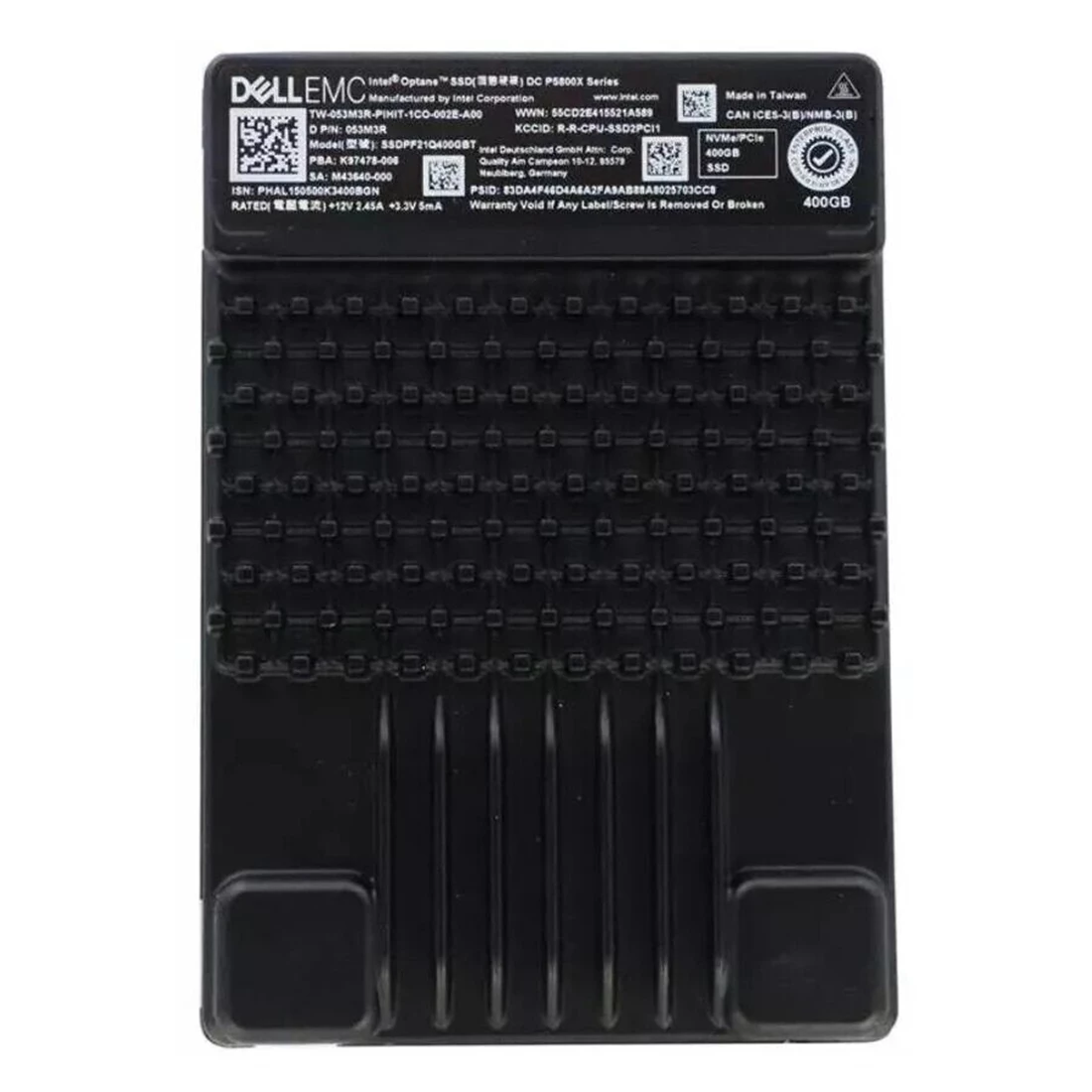
The SSDPF21Q400GBT Optane SSD DC P5800X delivers a clear generational leap over SSDPED1K375GA, moving to PCIe Gen 4.0 and boosting sequential performance to 7200/6100 MB/s with up to 1.5M/1.5M IOPS—roughly 3× the throughput and far higher low-latency transaction handling than the prior Optane generation. With 100 DWPD and 73,000 TBW, it also provides more than 3× the write endurance of its predecessor, making it a strong fit for write-intensive database logging, high-frequency trading, and tier-0 storage cache workloads where latency consistency and endurance are critical.
With an endurance rating of 73,000 TBW and 100 DWPD, the SSDPF21Q400GBT is built for extremely write-intensive enterprise workloads and can sustain full-drive rewrites many times per day throughout its service life. In practical terms, this level of endurance is far beyond typical OS, application, logging, and cache usage, giving buyers strong confidence that it can operate for many years in demanding server roles without wear concerns. For enterprise reliability, the drive includes Power Loss Protection (PLP), which helps preserve in-flight data and protects metadata integrity during unexpected power interruptions, reducing the risk of corruption and unplanned recovery events. Its UBER of 1.0E-17, combined with a 2 million-hour MTBF, reflects a very low likelihood of uncorrectable bit errors and supports the high data integrity and operational stability expected in business-critical environments.
1. The PCIe Gen4 x4 interface with NVMe enables this drive to keep modern dual-socket servers and storage nodes fed with data, reducing application wait time in throughput-heavy analytics and virtualization environments.
2. Its class-leading sequential read performance accelerates large-block workloads such as database snapshots, checkpoint recovery, and high-speed dataset ingestion for AI and HPC pipelines.
3. The ultra-high random read capability is built for latency-sensitive platforms like OLTP databases, real-time indexing, and dense virtual desktop farms, where massive parallel access must stay consistently responsive.
4. With an endurance profile suited for extremely write-intensive duty cycles, this SSD is ideal for logging, caching, journaling, and metadata tiers that would quickly wear out conventional flash drives.
5. Built on Intel Optane media and delivering microsecond-class response times, it provides near-memory-like storage behavior that sharply improves tail latency for trading systems, in-memory databases, and other mission-critical workloads.
Lower-capacity reference: 200GB Higher-capacity reference: 800GB In this series, the 400GB model sits at the practical sweet spot. Compared with the 200GB version, it offers much better headroom for OS images, logs, metadata, and application growth, reducing the risk of early capacity pressure. Compared with the 800GB option, it delivers a more attractive cost-per-node while keeping essentially the same enterprise-class sequential throughput and random IOPS behavior. That makes 400GB a balanced choice for mid-scale deployments, such as shared boot, caching, or database log storage across roughly 20 to 40 application or virtualized server instances.
Q: Is SSDPF21Q400GBT suitable for a write-heavy database server?
A: Yes. SSDPF21Q400GBT is well suited for write-heavy database workloads, thanks to its 100 DWPD endurance, 73,000 TBW rating, ultra-low 6 µs latency, and Intel Optane 3D XPoint media.
Q: How many full drive writes per day can it actually endure over its warranty period?
A: This model is rated for 100 DWPD, meaning it can sustain 100 full 400GB drive writes per day throughout its warranty period, which aligns with its extremely high endurance specification.
Q: Does it include power loss protection (PLP) and why is that critical?
A: Yes, it includes power loss protection. PLP is critical because it helps preserve in-flight data and metadata during unexpected outages, reducing corruption risk and improving enterprise storage reliability.
Q: What RAID level is recommended for this SSD?
A: The recommended RAID level depends on your goal. For database and enterprise use, RAID 1 or RAID 10 is typically preferred, balancing performance, redundancy, and fast recovery with high-endurance SSDs.