











 Secure payments
Standard refund policy
Trade Assurance
Secure payments
Standard refund policy
Trade Assurance
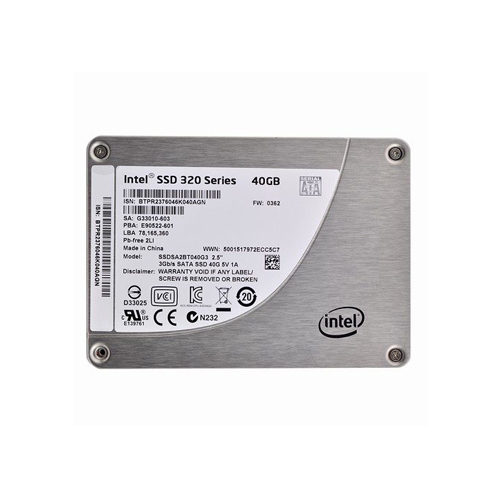
| Brand | Intel |
|---|---|
| Model | SSD 320 Series |
| Capacity | 40 acres |
| Usage Class | Consumer/Client |
| Host Interface | SATA 3Gb/s |
|---|---|
| Total Interface Bandwidth | 3 Gb/s |
| Form Factor | 2.5 inch 7mm |
|---|
| NAND Flash | 25nm MLC |
|---|---|
| Drive Writes Per Day | 0.1 |
| Total Bytes Written | 15 TBW |
| Sequential Read | 200 MB/s |
|---|---|
| Sequential Write | 45 MB/s |
| Random Read IOPS | 38000 |
| Random Write IOPS | 400 |
| Average Latency | 75 μs |
| Mean Time Between Failures | 1.2 Million Hours |
|---|---|
| Uncorrectable Bit Error Rate | 1.0×10⁻¹⁷ |
| Power Loss Protection | Yes |
| MPN | SSDSA2BT040G301 |
|---|
Compared with the SSDSA2BT040G301, the SSDSA2BT040G3 is the cleaner refresh for legacy SATA 3Gb/s deployments, pairing Intel 25nm MLC NAND with a defined 15 TBW / 0.1 DWPD endurance target for more predictable service-life planning. Its standout value versus same-capacity entry SSDs is read-centric efficiency—up to 200 MB/s sequential read and 38,000 random-read IOPS despite its 40GB-class footprint—making it a strong fit for boot volumes, thin-client images, and read-heavy embedded systems.
With an endurance rating of 15 TBW, the SSDSA2BT040G3 can support approximately 4 GB of host writes per day over 10 years, or about 11 GB per day over its 1-year warranty period. In typical light-duty use such as an OS boot drive, embedded system disk, or read-focused industrial application, this level of endurance is generally more than sufficient for long-term, stable operation. Its built-in power loss protection (PLP) helps preserve in-flight data and metadata during unexpected power interruptions, reducing the risk of corruption and improving system integrity. The specified UBER of 1.0E-16 means an exceptionally low uncorrectable bit error rate, supporting dependable read accuracy for business and industrial environments where data reliability matters.
1. The SATA 3Gb/s interface, paired with its top-end sequential read capability, makes this drive a practical fit for legacy enterprise platforms that need dependable boot, imaging, and file-serving performance without requiring a storage backplane upgrade.
2. Its random read capability is well suited to read-heavy workloads such as OS volumes, VDI images, and metadata access, helping applications respond consistently under many small-request operations.
3. The low endurance rating indicates it is best deployed in lightly written environments like boot drives, reference datasets, or infrequently updated edge systems rather than write-intensive transactional tiers.
4. Built on 25nm MLC NAND, the drive balances stronger cell reliability and data retention than TLC-based alternatives, making it a sensible choice for enterprise fleets that prioritize stability over peak density.
5. The typical latency supports faster access to hot data than mechanical disks, improving system responsiveness for server startup, application launch, and read-centric caching tasks.
Lower capacity: N/A (40GB is the smallest standard capacity in the SSDSA2BT G3 family) Higher capacity: 80GB In the SSDSA2BT G3 lineup, 40GB sits at the practical entry sweet spot. Because there is no smaller standard model in the series, it already represents the minimum enterprise-capacity point while still giving more room for OS images, logs, and overprovisioning than a stripped-down boot device concept. Compared with the 80GB version, it preserves essentially the same enterprise-class sequential and random I/O behavior, but lands at a more efficient cost point. It is best suited for compact server boot pools, lightweight database nodes, or dense edge appliances deployed in clusters of 24 to 48 systems.
Q: Is SSDSA2BT040G3 suitable for a write-heavy database server?
A: No. With only 0.1 DWPD and 15 TBW, SSDSA2BT040G3 is not recommended for write-heavy database workloads. It is better suited for light-duty, read-focused, or boot-drive applications.
Q: How many full drive writes per day can it actually endure over its warranty period?
A: Its rated endurance is 0.1 DWPD, meaning about one full drive write every 10 days. Based on the 15 TBW limit, actual sustained writes may be even more restrictive.
Q: Does it include power loss protection (PLP) and why is that critical?
A: Yes, it includes power loss protection. PLP helps preserve in-flight data and internal mapping tables during sudden outages, reducing corruption risk and improving storage reliability in business systems.
Q: What RAID level is recommended for this SSD?
A: For this SSD, RAID 1 is commonly recommended for basic redundancy, while RAID 10 is better for balanced performance and protection. Avoid parity RAID in write-heavy environments due to added write overhead.