











 Secure payments
Standard refund policy
Trade Assurance
Secure payments
Standard refund policy
Trade Assurance
| Brand | Intel |
|---|---|
| Model | DC S3500 |
| Capacity | 80 GB |
| Usage Class | Enterprise/Read-Intensive |
| Host Interface | SATA 6Gb/s |
|---|---|
| Total Interface Bandwidth | 6 Gb/s |
| Form Factor | 2.5 inch 7mm |
|---|
| NAND Flash | 20nm MLC |
|---|---|
| Drive Writes Per Day | 0.3 |
| Total Bytes Written | 45 TBW |
| Sequential Read | 340 MB/s |
|---|---|
| Sequential Write | 100 MB/s |
| Random Read IOPS | 68000 |
| Random Write IOPS | 7500 |
| Average Latency | 50 μs |
| Mean Time Between Failures | 2 Million Hours |
|---|---|
| Uncorrectable Bit Error Rate | 1.0×10⁻¹⁷ |
| Power Loss Protection | Yes |
| MPN | SSDSC2BB080G401 |
|---|
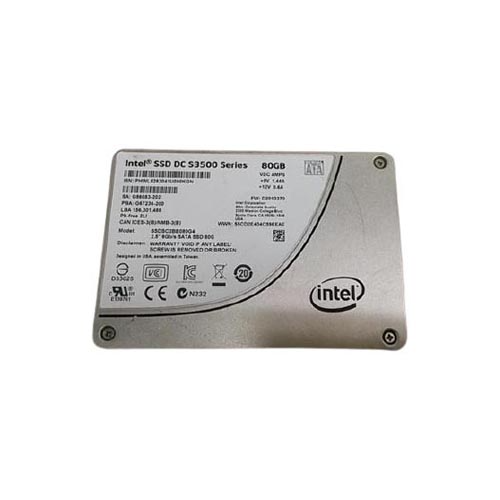
Compared with the earlier SSDSC2BB080G401, the SSDSC2BB080G4 represents a later DC S3500 revision that retains the platform’s proven 20nm MLC reliability while delivering the same 45 TB endurance and 68,000/7,500 IOPS profile in a stable 80 GB data-center SATA SKU. Its unique value in the entry enterprise tier is precise fit for boot, hypervisor, logging, and metadata workloads, where 340/100 MB/s performance and 0.3 DWPD are better aligned than higher-cost mainstream SSDs that overprovision capacity without improving these read-centric use cases.
With an endurance rating of 45 TBW and 0.3 DWPD, the SSDSC2BB080G4 is well suited for typical boot, OS, and read-focused business workloads, where daily write volume is usually modest. In practical terms, for use as a system drive or in light-duty enterprise applications, this level of endurance supports many years of stable operation under normal usage conditions. The SSDSC2BB080G4 also includes power-loss protection (PLP), which helps preserve in-flight data and maintain drive integrity if power is interrupted unexpectedly. Its ultra-low uncorrectable bit error rate of 1.0E-17, together with a 2 million hour MTBF, reflects strong enterprise-class data reliability and dependable long-term performance.
1. The SATA interface enables drop-in deployment across mainstream enterprise servers and storage arrays, making it a low-risk upgrade for expanding capacity without changing backplane infrastructure.
2. Its sustained read bandwidth is well suited for boot volumes, media-serving tiers, and read-focused application delivery where predictable data streaming matters more than peak PCIe-class speed.
3. Strong random read capability helps accelerate virtual desktop access, metadata lookups, and database query bursts, improving responsiveness under highly fragmented enterprise workloads.
4. The endurance profile fits read-centric production roles such as OS images, reference datasets, and content distribution, where drive life remains stable without the cost of heavier write-optimized media.
5. MLC NAND paired with very low typical latency provides a balanced mix of flash reliability and fast response time, supporting consistent QoS for latency-sensitive enterprise applications.
Model context: Intel SSD DC S3500 series, 2.5-inch SATA enterprise SSD. Reference capacities in the same series: Lower capacity: None in the standard lineup; 80 GB is the entry-capacity model. Higher capacity: 120 GB Typical performance positioning: 80 GB: up to about 500 MB/s read, about 90 MB/s write, up to about 75K random read IOPS, about 11K random write IOPS 120 GB: up to about 500 MB/s read, about 140 MB/s write, up to about 75K random read IOPS, about 14K random write IOPS Capacity positioning analysis: In the Intel DC S3500 family, the 80 GB model is the practical sweet spot for compact enterprise deployments. It offers meaningfully more usable headroom than smaller boot-oriented SSD classes, leaving extra space for OS images, logs, patches, and swap growth. Compared with the 120 GB version, it keeps acquisition cost tighter while still delivering essentially the same enterprise read performance profile for many boot and light mixed-workload roles. It is best suited for small virtualization clusters, such as hosting boot volumes for roughly 20 to 30 infrastructure or edge servers.
Q: Is SSDSC2BB080G4 suitable for a write-heavy database server?
A: Not ideally. With 0.3 DWPD and 45 TBW, SSDSC2BB080G4 is better suited for read-intensive or mixed workloads rather than sustained write-heavy database environments.
Q: How many full drive writes per day can it actually endure over its warranty period?
A: This model is rated at 0.3 DWPD, meaning about 30% of its 80 GB capacity can be written daily over the warranty period, equivalent to roughly 24 GB per day.
Q: Does it include power loss protection (PLP) and why is that critical?
A: Yes, it includes power loss protection. PLP helps preserve in-flight data and metadata during unexpected outages, reducing corruption risk and improving reliability in enterprise or transactional systems.
Q: What RAID level is recommended for this SSD?
A: RAID 1 or RAID 10 is generally recommended, depending on capacity and performance needs. These levels provide redundancy and solid performance, making them suitable for business-critical SSD deployments.