











 Secure payments
Standard refund policy
Trade Assurance
Secure payments
Standard refund policy
Trade Assurance
| Brand | Intel |
|---|---|
| Model | DC S3510 |
| Capacity | 240 GB |
| Usage Class | Enterprise/Read-Intensive |
| Host Interface | SATA 6Gb/s |
|---|---|
| Total Interface Bandwidth | 6 Gb/s |
| Form Factor | 2.5 inch 7mm |
|---|
| NAND Flash | 16nm MLC |
|---|---|
| Drive Writes Per Day | 0.3 |
| Total Bytes Written | 140 TBW |
| Sequential Read | 500 MB/s |
|---|---|
| Sequential Write | 260 MB/s |
| Random Read IOPS | 68000 |
| Random Write IOPS | 10200 |
| Average Latency | 55 μs |
| Mean Time Between Failures | 2 Million Hours |
|---|---|
| Uncorrectable Bit Error Rate | 1.0×10⁻¹⁷ |
| Power Loss Protection | Yes |
| MPN | SSDSC2BB240G601 |
|---|
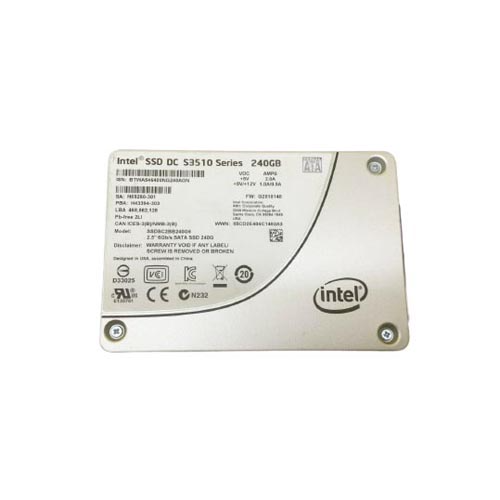
The Intel DC S3510 240GB (SSDSC2BB240G6) is a strong fit for read-centric datacenter workloads such as web hosting, boot volumes, and content-serving nodes, combining 16nm MLC NAND with 500/260 MB/s throughput, up to 68,000/10,200 IOPS, and 140 TBW in a power-efficient SATA 6Gb/s form factor. Compared with the earlier SSDSC2BB240G601 revision, SSDSC2BB240G6 provides a later platform build that improves deployment continuity and lifecycle standardization while preserving the S3510 family’s proven balance of endurance, latency consistency, and low-cost SATA scalability.
With an endurance rating of 140 TBW and 0.3 DWPD, the SSDSC2BB240G6 can reliably handle typical OS, office, and light application workloads for many years without concern. For example, in a system-drive scenario with moderate daily writes, this level of endurance is generally sufficient for up to around 10 years of normal use, giving buyers strong confidence in long-term service life. For enterprise reliability, the drive includes Power Loss Protection (PLP), which helps preserve in-flight data and reduce the risk of corruption if power is suddenly interrupted. Its UBER of 1.0E-17 means the probability of an uncorrectable bit error is extremely low, supporting dependable data integrity in business and data-center environments.
1. The SATA 6Gb/s interface enables straightforward integration into existing enterprise servers and storage arrays, delivering dependable performance without requiring a PCIe platform upgrade.
2. With 500 MB/s sequential read throughput, the drive speeds up OS boot, image loading, backup recovery, and other read-heavy bulk data operations.
3. Its 68,000 IOPS random read capability helps virtualized environments, indexing workloads, and metadata-intensive databases stay responsive under scattered access patterns.
4. A typical latency of 55 µs supports faster application response and more predictable QoS, which is especially valuable for transactional systems and cache-layer reads.
5. Using 16nm MLC NAND and a 0.3 DWPD endurance rating, the drive offers enterprise-grade write stability and retention characteristics that fit read-centric workloads with moderate daily write pressure.
Lower-capacity reference: 160 GB Higher-capacity reference: 300 GB In the Intel DC S3500 family, the 240 GB model sits at a practical sweet spot. Compared with the 160 GB version, it offers noticeably better headroom for OS growth, logs, patching, and temporary data, reducing the risk of early capacity pressure. Compared with the 300 GB model, it preserves nearly the same enterprise-class SATA performance profile while keeping acquisition cost and fleet budget under tighter control. This makes 240 GB especially well suited for medium-scale deployments, such as standardized boot drives for around 50 to 80 application or database nodes.
Q: Is SSDSC2BB240G6 suitable for a write-heavy database server?
A: SSDSC2BB240G6 is generally not ideal for write-heavy database workloads. With 0.3 DWPD and 140 TBW, it is better suited for read-intensive, mixed-use, or light-write enterprise applications.
Q: How many full drive writes per day can it actually endure over its warranty period?
A: This model is rated for 0.3 drive writes per day, meaning it can sustain about 30% of its 240 GB capacity in writes daily over the warranty period.
Q: Does it include power loss protection (PLP) and why is that critical?
A: Yes, it includes power loss protection. PLP helps preserve in-flight data and metadata during unexpected outages, which is critical for maintaining data integrity and reducing corruption risk.
Q: What RAID level is recommended for this SSD?
A: RAID 1 or RAID 10 is typically recommended for this SSD in business environments, as these levels provide strong redundancy, good read performance, and better protection against drive failure.