
 Secure payments
Standard refund policy
Trade Assurance
Secure payments
Standard refund policy
Trade Assurance
| Product Collection | Xeon Gold |
|---|---|
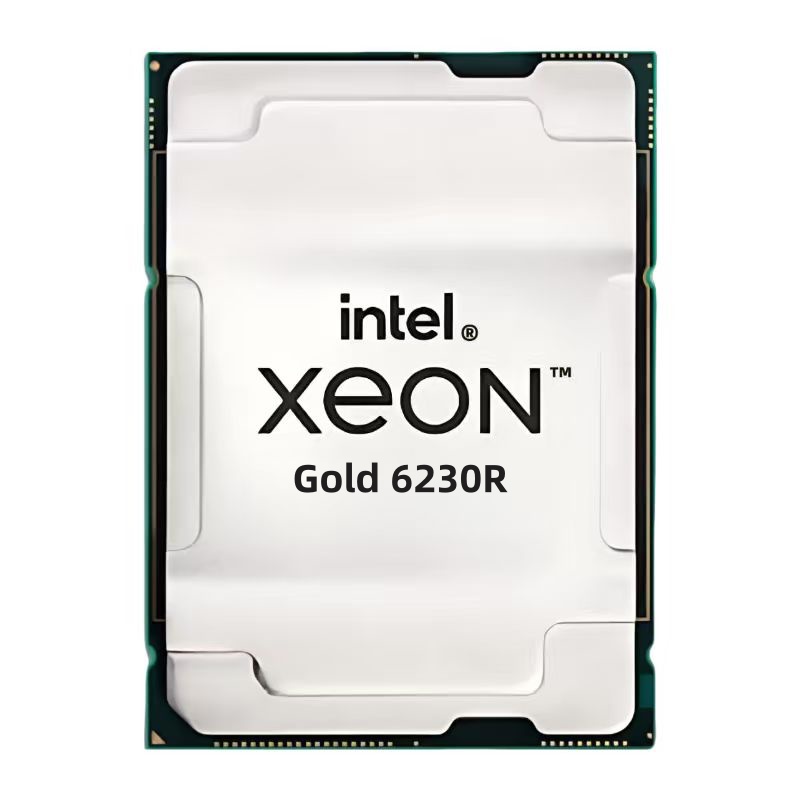
| Processor Number | Xeon Gold 6230R |
| Total Cores | 26 |
| Total Threads | 52 |
| Processor Base Frequency | 2.10 GHz |
| Max Turbo Frequency | 4.00 GHz |
| Max Turbo Frequency (1-core) | 4.00 GHz |
| Max Turbo Frequency (all-core) | 3.10 GHz |
| Cache | 35.75 MB |
| UPI Speed | 10.4 GT/s |
| Number of UPI Links | 3 |
| Max Memory Size | 1 TB |
| Memory Types | DDR4-2933 |
| Memory Channels | 6 |
| Max Memory Bandwidth | 140.8 GB/s |
| PCI Express Revision | 3.0 |
| PCI Express Lanes | 48 |
| Thermal Design Power | 150 W |
| Socket | FCLGA3647 |
| Hyper-Threading Technology | Yes |
| Virtualization Technology | Yes |
| Turbo Boost Technology | 2.0 |
| Instruction Set | 64-bit |
| AVX-512 | Yes |
| Trusted Execution Technology | Yes |
| Lithography | 14 nm |
| Launch Date | Q1 2020 |
| Max CPU Configuration | 2 |
| Tcase | 77°C |
| Architecture | Cascade Lake |
| Memory Speed | DDR4-2933 |
| Instruction Set Extensions | SSE4.2, AVX2, AVX-512 |
| Intel Optane Persistent Memory Support | Yes |
| Intel Deep Learning Boost | Yes |
| Performance Feature | High Multithreading Performance |
Engineer's Note: The Intel Xeon Gold 6230R pairs 26 cores / 52 threads with a 2.10 GHz base clock that boosts to 4.00 GHz on demand and 35.75 MB of on-die cache, making it a drop-in candidate for virtualization hosts running dozens of VMs. Its FCLGA3647 socket means it slots into existing platforms without board redesign. Positioned as the workhorse tier of the Scalable family, balancing per-core speed and core density, it is built for sustained multi-user workloads.
1. Scalability to 2-socket systems: in multi-socket servers the processors share memory over a coherent interconnect, letting a single OS instance use all cores and all RAM — the classic architecture for large relational databases and consolidation hosts.
2. 26 cores / 52 threads: hardware multi-threading lets each physical core run two instruction streams, so concurrent workloads — virtualization hosts running dozens of VMs — share the die without context-switch overhead. When you size licenses or plan VM placement, thread count is the number the scheduler actually sees.
3. 2.10 GHz base / 4.00 GHz turbo: the frequency governor drops light threads onto boosted cores, so single-threaded paths (license checks, stored procedures, log processing) finish fast while background jobs keep the remaining cores saturated. The result is responsive interactive performance without sacrificing aggregate throughput.
4. FCLGA3647 platform compatibility: matching sockets across your fleet simplifies spares management — one processor SKU covers many chassis generations, and upgrades become a socket swap rather than a board replacement. That matters at 3 a.m. when a node needs to be back in service before morning.
5. Memory platform on the Intel Xeon Gold 6230R: support for DDR4-2933, up to 1 TB of RAM, 140.8 GB/s of peak bandwidth. This is the headroom in-memory databases and dense VM farms need — capacity for growth, bandwidth for the data streams in between.
If your roadmap includes virtualization hosts running dozens of VMs, the Intel Xeon Gold 6230R turns architectural decisions into predictable outcomes. Its 26-core layout sizes the node for expected concurrency, the 4.00 GHz turbo headroom keeps interactive paths responsive, and 1 TB of addressable memory gives the platform room to grow. Every unit passes functional testing before shipment, and our bulk-pricing desk keeps multi-socket refresh projects inside budget.
Q: Is the Intel Xeon Gold 6230R compatible with my server?
A: The Intel Xeon Gold 6230R uses the FCLGA3647 socket. Check your motherboard's qualified processor list — any chassis with that socket and matching BIOS support will run it. Our team can confirm compatibility if you share your server model.
Q: What workloads suit 26-core processors best?
A: With 26 cores / 52 threads, this processor is sized for multi-threaded server workloads: virtualization hosts, database servers, and application consolidation. Single-threaded-light environments (file servers, internal tools) will leave headroom unused.
Q: Can I mix this processor with different models in the same server?
A: In multi-socket servers, matched processors (same model, same stepping) are strongly recommended. Mixed models can cause boot failures or instability because memory controllers and QPI/UPI links negotiate to the lowest common configuration.
Q: Does this CPU include a cooler?
A: Server processors are typically installed with chassis-specific heat sinks, so none is included. Match the heat sink to your server model for correct airflow direction — our team can advise on the right part.
Q: Do you offer bulk pricing for fleet upgrades?
A: Yes. Multi-socket refresh projects and fleet orders get consolidated pricing — request a quote through the form on this page with your target quantity, and our team responds with an offer typically within one business day.