
 Secure payments
Standard refund policy
Trade Assurance
Secure payments
Standard refund policy
Trade Assurance
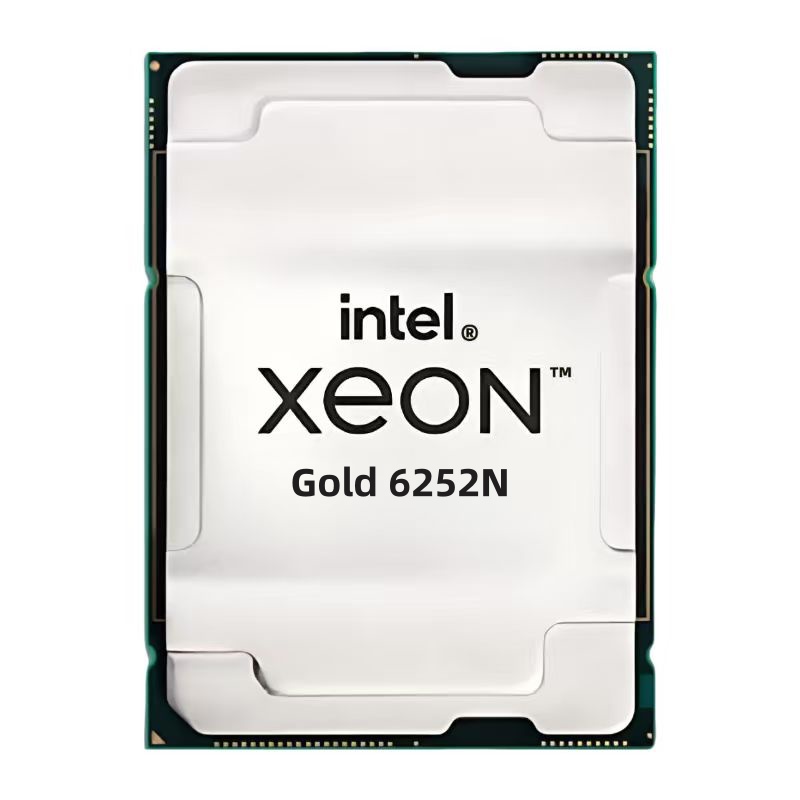
| Product Collection | Xeon Gold 6252N |
|---|---|
| Total Cores | 24 |
| Total Threads | 48 |
| Max Turbo Frequency | 3.60 GHz |
| Processor Base Frequency | 2.30 GHz |
| Cache | 35.75 MB |
| Bus Speed | 10.4 GT/s UPI |
| Max Memory Size | 1 TB |
| Memory Types | DDR4-2933 |
| Max # of Memory Channels | 6 |
| Max Memory Bandwidth | 140.8 GB/s |
| Thermal Design Power (TDP) | 150 W |
| Socket | FCLGA3647 |
| Chipset Support | Intel C62x Series |
| Instruction Set Extensions | Intel SSE4.2, AVX, AVX2, AVX-512 |
| Max CPU Configuration | 2 |
| Operating System Support | Windows Server, Linux, VMware |
| Virtualization Technology | Intel VT-x, Intel VT-d, Intel EPT |
| Status | Launched |
| Launch Date | Q2'19 |
| Instruction Set | 64-bit |
| Lithography | 14 nm |
| Max Thermal Design Power | 150 W |
| Min Thermal Design Power | 150 W |
| Scalability | 2S |
| NFV Optimization Technology | Intel Resource Director Technology (RDT), Intel Speed Select Technology |
| Recommended Use | Telecommunications, Network Function Virtualization (vCPE, SD-WAN), Edge Computing |
Engineer's Note: The Intel Xeon Gold 6252N pairs 24 cores / 48 threads with a 2.30 GHz base clock that boosts to 3.60 GHz on demand and 35.75 MB of on-die cache, making it a drop-in candidate for latency-sensitive business applications. Its FCLGA3647 socket means it slots into existing platforms without board redesign. Positioned as the workhorse tier of the Scalable family, balancing per-core speed and core density, it is built for sustained multi-user workloads.
1. 35.75 MB of shared cache: a large last-level cache keeps hot working sets on-die, cutting memory round-trips for databases and compilers. Fewer main-memory accesses translate directly into lower average latency and better tail performance under load — often the difference you feel before any benchmark confirms it.
2. 24 cores / 48 threads: hardware multi-threading lets each physical core run two instruction streams, so concurrent workloads — latency-sensitive business applications — share the die without context-switch overhead. When you size licenses or plan VM placement, thread count is the number the scheduler actually sees.
3. Scalability to 2-socket systems: in multi-socket servers the processors share memory over a coherent interconnect (10.4 GT/s UPI), letting a single OS instance use all cores and all RAM — the classic architecture for large relational databases and consolidation hosts.
4. Memory platform on the Intel Xeon Gold 6252N: support for DDR4-2933, up to 1 TB of RAM, 6 memory channels, 140.8 GB/s of peak bandwidth. This is the headroom in-memory databases and dense VM farms need — capacity for growth, bandwidth for the data streams in between.
5. FCLGA3647 platform compatibility: matching sockets across your fleet simplifies spares management — one processor SKU covers many chassis generations, and upgrades become a socket swap rather than a board replacement. That matters at 3 a.m. when a node needs to be back in service before morning.
When you spec out latency-sensitive business applications, the Intel Xeon Gold 6252N turns architectural decisions into predictable outcomes. Its 24-core layout sizes the node for expected concurrency, the 3.60 GHz turbo headroom keeps interactive paths responsive, and 1 TB of addressable memory gives the platform room to grow. Every unit passes functional testing before shipment, and our bulk-pricing desk keeps multi-socket refresh projects inside budget.
Q: What memory does it require?
A: The platform supports DDR4-2933. Use ECC registered memory (RDIMM/LRDIMM) — desktop UDIMMs are not compatible with Xeon sockets. Faster modules will downclock to the processor's rated speed.
Q: What is the thermal design power?
A: The TDP is listed in the specifications table. It stays within standard server cooling envelopes for the platform generation.
Q: Is it new or refurbished? What warranty applies?
A: We offer both new and tested refurbished units — the condition is shown on each listing. All processors include a one-year warranty and pass functional testing (boot, memory controller, all cores) before dispatch.
Q: Can I mix this processor with different models in the same server?
A: In multi-socket servers, matched processors (same model, same stepping) are strongly recommended. Mixed models can cause boot failures or instability because memory controllers and QPI/UPI links negotiate to the lowest common configuration.
Q: Does this CPU include a cooler?
A: Server processors are typically installed with chassis-specific heat sinks, so none is included. Match the heat sink to your server model for correct airflow direction — our team can advise on the right part.