
 Secure payments
Standard refund policy
Trade Assurance
Secure payments
Standard refund policy
Trade Assurance
| Basic Information | Product Collection |
|---|---|
| 9221 | Basic Information |
| Cascade Lake | Basic Information |
| 32 | Performance |
| 64 | Performance |
| 2.1 GHz | Performance |
| 3.7 GHz | Performance |
| 71.5 MB | Performance |
| BGA5903 | FCLGA3647 | Architecture & Process |
| 14 nm | Architecture & Process |
| 2 | Architecture & Process |
| 1 TB | Memory |
| DDR4-2933 | Memory |
| 6 | Memory |
| 140.8 GB/s | Memory |
| 3.0 | Expansion |
| 48 | Expansion |
| 64-bit | Advanced Technologies |
| 2.0 | Advanced Technologies |
| Yes | Advanced Technologies |
| Yes | Advanced Technologies |
| Yes | Advanced Technologies |
| 250 W | Power |
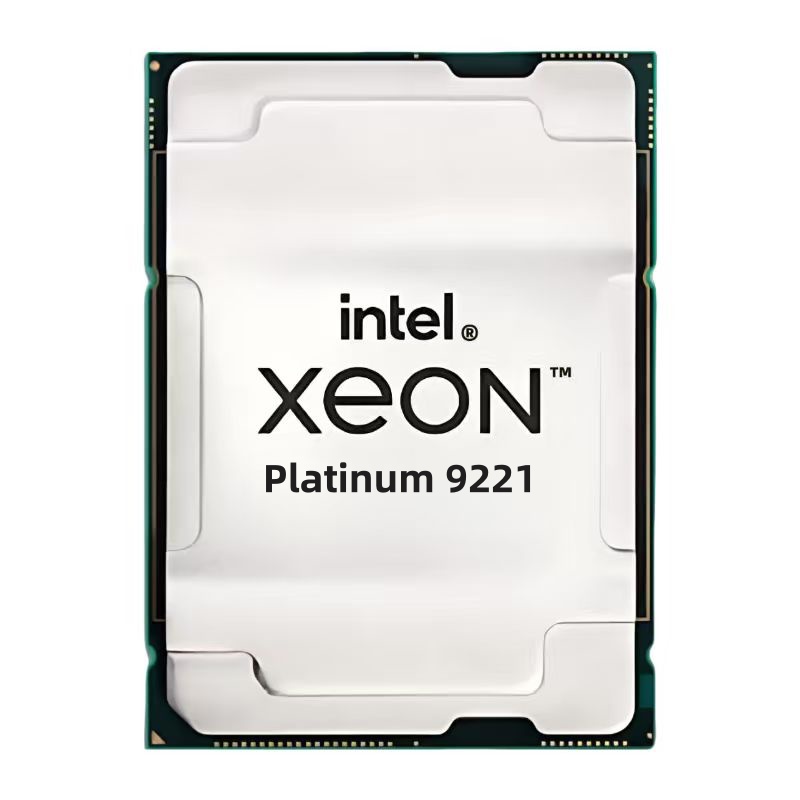
Engineer's Note: The Intel Xeon Platinum 9221 pairs 32 cores / 64 threads with a 2.1 GHz base clock that boosts to 3.7 GHz on demand and 71.5 MB of on-die cache, making it a drop-in candidate for consolidated multi-tenant platforms. The 250 W thermal envelope keeps it inside standard server cooling budgets. Its BGA5903 | FCLGA3647 socket means it slots into existing platforms without board redesign. Positioned as the top tier of Intel's Scalable lineup, built for maximum throughput and platform reliability, it is built for sustained multi-user workloads.
1. 32 cores / 64 threads: hardware multi-threading lets each physical core run two instruction streams, so concurrent workloads — consolidated multi-tenant platforms — share the die without context-switch overhead. When you size licenses or plan VM placement, thread count is the number the scheduler actually sees.
2. 48 PCIe lanes (PCIe 3.0): the lane budget drives expansion. NVMe SSDs, 25/100GbE NICs, and GPU accelerators each consume 8–16 lanes, and this processor keeps enough lanes free to build a storage-dense or GPU-accelerated node without a PCIe switch — saving cost and a hop of latency.
3. Scalability to 2-socket systems: in multi-socket servers the processors share memory over a coherent interconnect, letting a single OS instance use all cores and all RAM — the classic architecture for large relational databases and consolidation hosts.
4. 250 W TDP: the thermal envelope is sized for sustained all-core loads in multi-socket chassis, so the processor holds its rated clocks through long batch windows instead of throttling halfway through. It also keeps per-socket cooling and power costs predictable when you scale out — datacenter capacity planning runs on numbers like these.
5. 71.5 MB of shared cache: a large last-level cache keeps hot working sets on-die, cutting memory round-trips for databases and compilers. Fewer main-memory accesses translate directly into lower average latency and better tail performance under load — often the difference you feel before any benchmark confirms it.
If your roadmap includes consolidated multi-tenant platforms, the Intel Xeon Platinum 9221 turns architectural decisions into predictable outcomes. Its 32-core layout sizes the node for expected concurrency, the 3.7 GHz turbo headroom keeps interactive paths responsive, and 1 TB of addressable memory gives the platform room to grow. Every unit passes functional testing before shipment, and our bulk-pricing desk keeps multi-socket refresh projects inside budget.
Q: Do you offer bulk pricing for fleet upgrades?
A: Yes. Multi-socket refresh projects and fleet orders get consolidated pricing — request a quote through the form on this page with your target quantity, and our team responds with an offer typically within one business day.
Q: Is it new or refurbished? What warranty applies?
A: We offer both new and tested refurbished units — the condition is shown on each listing. All processors include a one-year warranty and pass functional testing (boot, memory controller, all cores) before dispatch.
Q: What workloads suit 32-core processors best?
A: With 32 cores / 64 threads, this processor is sized for multi-threaded server workloads: virtualization hosts, database servers, and application consolidation. Single-threaded-light environments (file servers, internal tools) will leave headroom unused.
Q: Will 250 W TDP fit my server's cooling budget?
A: 250 W is within the standard envelope for its socket generation, so existing chassis cooling handles it under sustained all-core load. Confirm your server's supported TDP range if you are upgrading from a lower-tier part.
Q: Can I mix this processor with different models in the same server?
A: In multi-socket servers, matched processors (same model, same stepping) are strongly recommended. Mixed models can cause boot failures or instability because memory controllers and QPI/UPI links negotiate to the lowest common configuration.