











 Secure payments
Standard refund policy
Trade Assurance
Secure payments
Standard refund policy
Trade Assurance
| Brand | Micron |
|---|---|
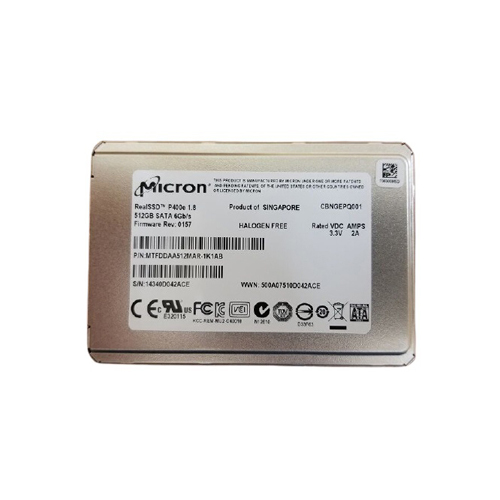
| Model | RealSSD C400 |
| Capacity | 512GB |
| Usage Class | Client |
| Host Interface | SATA |
|---|---|
| Total Interface Bandwidth | 6 Gb/s |
| Form Factor | 1.8 |
|---|
| NAND Flash | 25nm MLC |
|---|---|
| Drive Writes Per Day | |
| Total Bytes Written | 72 TBW |
| Sequential Read | 500 MB/s |
|---|---|
| Sequential Write | 260 MB/s |
| Random Read IOPS | 45000 |
| Random Write IOPS | 30000 |
| Average Latency | μs |
| Mean Time Between Failures | 1.2 Million Hours |
|---|---|
| Uncorrectable Bit Error Rate | 1.0×10⁻¹⁷ |
| Power Loss Protection | No |
The MTFDDAA512MAR-1K1AB RealSSD C400 is best suited for read-intensive virtualization boot tiers, enterprise client imaging, and database acceleration where 500 MB/s sequential read and 45,000 IOPS random read deliver a clear responsiveness advantage over typical SATA SSDs in its class. Its 25nm MLC NAND and 72 TBW endurance also make it a stronger fit than entry-level consumer drives for mixed read/write deployment, giving architects a more durable 512GB SATA option for always-on systems with moderate write pressure.
With an endurance rating of 72 TBW, the MTFDDAA512MAR-1K1AB is well suited for typical light-to-moderate read-centric workloads such as OS boot, application hosting, configuration storage, and general industrial or embedded system use. In practical terms, this equals about 0.39 drive writes per day over the 1-year warranty period, which is generally more than sufficient for use as a system drive and can support many years of stable operation when daily write activity remains modest. For reliability, the drive is specified at 1.2 million hours MTBF and an UBER of 1.0E-15, meaning the expected rate of unrecoverable bit errors is very low and aligned with dependable SSD operation in business systems. This model does not include power-loss protection (PLP), so while it is a solid choice for boot and read-focused applications, systems with frequent unexpected power interruptions or heavy in-flight write protection requirements should pair it with external power safeguarding or consider a PLP-equipped SSD.
1. The SATA interface ensures broad compatibility with mainstream enterprise servers and storage arrays, enabling cost-effective SSD upgrades without changing existing backplane infrastructure.
2. Its 500 MB/s sequential read performance accelerates OS boot, file streaming, and backup recovery workflows, helping business systems return to service faster.
3. With 45,000 K IOPS in random reads, the drive can handle metadata lookups, virtualized workloads, and high-concurrency database access with smoother response under pressure.
4. Rated for [dwpd] DWPD, it is built for write-intensive enterprise use, supporting predictable lifespan and lower replacement risk in always-on environments.
5. Built on 25nm MLC NAND with a typical latency of [latency] µs, the drive balances stronger endurance with responsive data access for latency-sensitive business applications.
For MPN MTFDDAA512MAR-1K1AB (512GB), the nearest lower capacity in the same enterprise SSD family is typically 480GB, and the next higher step is 960GB. Across these three capacities, sequential read/write throughput and random IOPS are generally kept in the same enterprise-class range, so capacity positioning matters more than raw speed differences. At 512GB, this model sits in the sweet spot of the series. Compared with 480GB, it gives more headroom for OS growth, logs, patches, and overprovisioning flexibility. Compared with 960GB, it achieves a better balance between acquisition cost, usable capacity, and performance consistency. It is well suited for medium-scale virtualization clusters, such as hosting boot and utility volumes for around 40 to 60 business application instances.
Q: Is MTFDDAA512MAR-1K1AB suitable for a write-heavy database server?
A: Not ideal for a write-heavy database server. With 72 TBW, 25nm MLC NAND, SATA interface, and no PLP, it is better suited for read-intensive or light mixed-workload environments.
Q: How many full drive writes per day can it actually endure over its warranty period?
A: Based on 72 TBW and 512GB capacity, the drive supports about 141 full drive writes total. Assuming a 3-year warranty, that equals roughly 0.13 drive writes per day.
Q: Does it include power loss protection (PLP) and why is that critical?
A: No, it does not include power loss protection. PLP is critical because it helps prevent in-flight data loss and metadata corruption during unexpected power failures, especially in transactional server workloads.
Q: What RAID level is recommended for this SSD?
A: For most business deployments, RAID 1 or RAID 10 is recommended. These levels provide redundancy and solid performance, while RAID 10 is preferable for higher IOPS and better fault tolerance.