

 Secure payments
Standard refund policy
Trade Assurance
Secure payments
Standard refund policy
Trade Assurance
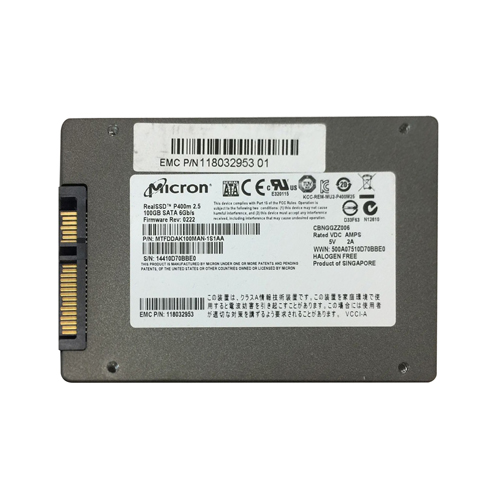
| Brand | Micron |
|---|---|
| Model | P400m |
| Capacity | 100GB |
| Usage Class | Enterprise |
| Host Interface | SATA 6Gb/s |
|---|---|
| Total Interface Bandwidth | 6 Gb/s |
| Form Factor | 2.5" 7mm |
|---|
| NAND Flash | 2D MLC |
|---|---|
| Drive Writes Per Day | 10 |
| Total Bytes Written | 1750 TBW |
| Sequential Read | 380 MB/s |
|---|---|
| Sequential Write | 200 MB/s |
| Random Read IOPS | 52000 |
| Random Write IOPS | 21000 |
| Average Latency | 570 μs |
| Mean Time Between Failures | 2 Million Hours |
|---|---|
| Uncorrectable Bit Error Rate | 1.0×10⁻¹⁷ |
| Power Loss Protection | Yes |
The Micron P400m 100GB (MTFDDAK100MAN-1S1AA) is best suited for write-intensive boot, logging, and metadata tiers in enterprise servers, where its 10 DWPD endurance, 1,750TB TBW, and 2D MLC NAND deliver significantly stronger sustained reliability than typical read-optimized SATA SSDs. With 52,000/21,000 random IOPS and 380/200 MB/s performance on a SATA 6Gb/s interface, it offers a balanced low-latency profile for cache journals, hypervisor boot volumes, and small-capacity transactional workloads that need enterprise endurance rather than maximum capacity.
With an endurance rating of 1,750 TBW and 10 DWPD, the MTFDDAK100MAN-1S1AA is built for sustained write-intensive operation and can comfortably handle typical enterprise system-disk, boot, logging, or edge workloads over its intended service life. In practical terms, for normal OS and application usage, this level of endurance means buyers can expect many years of worry-free operation without write wear being a limiting factor. On the reliability side, built-in Power Loss Protection (PLP) helps preserve in-flight data and metadata during unexpected power interruptions, reducing the risk of corruption and unplanned recovery events. Its enterprise-grade UBER of 1.0E-16, together with a 2 million hour MTBF, indicates a very low rate of unrecoverable read errors and strong long-term operational dependability for business-critical environments.
1. The SATA 6Gb/s interface provides broad compatibility with legacy enterprise backplanes and servers, making it a low-risk upgrade path for storage refresh projects.
2. With sequential reads up to 380 MB/s, this drive accelerates large-file access such as system image loading, log replay, and backup restore operations in read-focused environments.
3. Delivering 52,000 random-read IOPS, it helps databases and virtualization clusters respond faster under highly fragmented, transaction-heavy workloads.
4. Rated for 10 DWPD and built on 2D MLC NAND, it is engineered for sustained write-intensive use cases where predictable endurance and long service life matter more than peak capacity efficiency.
5. A typical latency of 570 µs supports more consistent application response times, which is critical for enterprise workloads that depend on predictable QoS rather than occasional burst speed.
Lower capacity reference: 50GB Higher capacity reference: 200GB In this series, the 100GB model sits at the practical sweet spot. Compared with the 50GB version, it provides much better headroom for OS images, logs, metadata, and short-term workload growth, reducing the risk of early capacity pressure. Compared with the 200GB model, it preserves essentially the same enterprise-class read/write and random IOPS profile while offering a more attractive cost point and better budget efficiency. This makes 100GB especially well suited for small to mid-sized virtualization clusters, such as hosting boot and utility volumes for around 40 to 60 infrastructure-focused virtual machines.
Q: Is MTFDDAK100MAN-1S1AA suitable for a write-heavy database server?
A: Yes. With 10 DWPD endurance, 1750 TBW, and durable 2D MLC NAND, MTFDDAK100MAN-1S1AA is well suited for write-intensive database workloads requiring strong reliability and consistent enterprise SSD performance.
Q: How many full drive writes per day can it actually endure over its warranty period?
A: This model is rated for 10 DWPD, meaning it can sustain about 10 full 100GB drive writes per day throughout its warranty period under the specified enterprise operating conditions.
Q: Does it include power loss protection (PLP) and why is that critical?
A: Yes, it includes power loss protection. PLP helps preserve in-flight data and metadata during unexpected outages, reducing corruption risk and improving data integrity in mission-critical server environments.
Q: What RAID level is recommended for this SSD?
A: The recommended RAID level depends on your priority. RAID 1 suits redundancy, RAID 10 balances performance and protection, and RAID 5/6 may fit capacity-focused deployments with acceptable write overhead.