











 Secure payments
Standard refund policy
Trade Assurance
Secure payments
Standard refund policy
Trade Assurance
| Brand | Micron |
|---|---|
| Model | RealSSD C400 |
| Capacity | 128GB |
| Usage Class | Client |
| Host Interface | SATA 6Gb/s |
|---|---|
| Total Interface Bandwidth | 6 Gb/s |
| Form Factor | 2.5" 7mm |
|---|
| NAND Flash | 25nm MLC |
|---|---|
| Drive Writes Per Day | |
| Total Bytes Written | 72 TBW |
| Sequential Read | 500 MB/s |
|---|---|
| Sequential Write | 175 MB/s |
| Random Read IOPS | 45000 |
| Random Write IOPS | 35000 |
| Average Latency | 55 μs |
| Mean Time Between Failures | 1.2 Million Hours |
|---|---|
| Uncorrectable Bit Error Rate | 1.0×10⁻¹⁷ |
| Power Loss Protection | No |
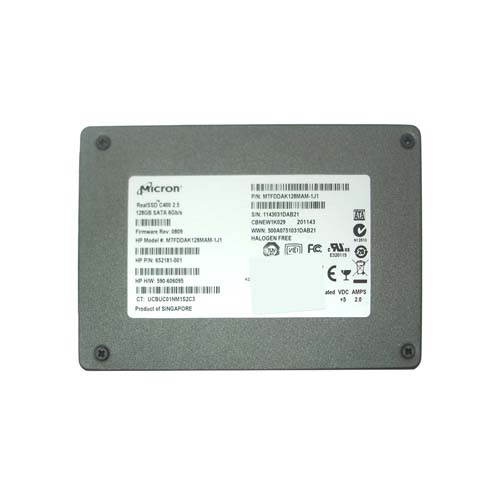
The Micron RealSSD C400 128GB (MTFDDAK128MAM-1J1) is a strong fit for boot, read-caching, and latency-sensitive client or embedded workloads that need SATA 6Gb/s throughput, delivering up to 500 MB/s read, 175 MB/s write, and 45K/35K random read/write IOPS from durable 25nm MLC NAND. Compared with typical same-class entry SATA SSDs, its combination of 72 TBW endurance and high random performance makes it especially well suited for OS images, application launch acceleration, and mixed read-heavy edge systems where responsiveness matters more than raw capacity.
With an endurance rating of 72 TBW, the MTFDDAK128MAM-1J1 can sustain about 72,000 GB of total host writes, which is more than sufficient for typical boot-drive, OS, and application workloads in embedded, industrial, or light enterprise systems. In practical terms, if the drive is mainly used as a system disk with modest daily write activity, this level of endurance can comfortably support many years of reliable service, well beyond the write demand of most read-heavy deployments. From a reliability perspective, the 1.2 million-hour MTBF and 1.0E-15 UBER indicate a solid, dependable platform, with the UBER specification reflecting a very low rate of unrecoverable bit errors during data reads. This model does not include power-loss protection (PLP), so it is best suited for environments with stable power or upstream backup power measures, but for normal controlled system operation it remains a reliable choice for procurement.
1. The SATA interface pairs with the drive’s top-end sequential bandwidth to accelerate boot volumes, firmware distribution, and bulk data retrieval in legacy enterprise platforms without requiring a PCIe upgrade.
2. Its strong random-read capability helps databases, virtual desktop pools, and metadata-heavy applications return small blocks quickly under multi-user pressure.
3. The rated endurance is built for write-intensive enterprise duty cycles, giving IT teams predictable lifespan and lower replacement risk in always-on environments.
4. The mature MLC NAND architecture prioritizes data integrity, sustained performance, and long-term reliability over cheaper consumer-focused flash designs.
5. The low typical latency improves application responsiveness by reducing storage wait time, which is especially valuable for transactional workloads and latency-sensitive caching tiers.
For MPN MTFDDAK128MAM-1J1, the nearest lower capacity in the same family is typically 64GB, while the next higher option is 256GB. Across this enterprise SSD series, sequential read/write performance and random IOPS are generally in the same class, with only minor variation by capacity. The 128GB model is the sweet spot in the lineup. Compared with 64GB, it offers far better headroom for OS growth, logs, patches, and application overhead. Compared with 256GB, it keeps acquisition cost tighter while delivering essentially the same enterprise-class responsiveness. It is well suited for small VDI pools, branch servers, or roughly 40 to 60 lightweight virtual machine boot volumes.
Q: Is MTFDDAK128MAM-1J1 suitable for a write-heavy database server?
A: Not ideal for a write-heavy database server. With 72 TBW, 25nm MLC NAND, no PLP, and roughly 0.31 DWPD, it is better suited for read-intensive or mixed-light enterprise workloads.
Q: How many full drive writes per day can it actually endure over its warranty period?
A: Based on 72 TBW and 128GB capacity, the drive supports about 562 total full drive writes. Assuming a 5-year warranty, that equals approximately 0.31 full drive writes per day.
Q: Does it include power loss protection (PLP) and why is that critical?
A: No, this model does not include power loss protection. PLP is critical in enterprise environments because it helps prevent in-flight data loss and metadata corruption during unexpected power interruptions.
Q: What RAID level is recommended for this SSD?
A: RAID 1 or RAID 10 is generally recommended, depending on capacity and performance needs. These levels provide redundancy and better fault tolerance, which is especially important since this drive lacks PLP.