











 Secure payments
Standard refund policy
Trade Assurance
Secure payments
Standard refund policy
Trade Assurance
| Brand | Micron |
|---|---|
| Model | M600 |
| Capacity | 128GB |
| Usage Class | Client |
| Host Interface | SATA 6Gb/s |
|---|---|
| Total Interface Bandwidth | 6 Gb/s |
| Form Factor | 2.5" 7mm |
|---|
| NAND Flash | 16nm MLC |
|---|---|
| Drive Writes Per Day | 0.7 |
| Total Bytes Written | 100 TBW |
| Sequential Read | 560 MB/s |
|---|---|
| Sequential Write | 400 MB/s |
| Random Read IOPS | 90000 |
| Random Write IOPS | 88000 |
| Average Latency | μs |
| Mean Time Between Failures | 1.5 Million Hours |
|---|---|
| Uncorrectable Bit Error Rate | 1.0×10⁻¹⁷ |
| Power Loss Protection | Yes |
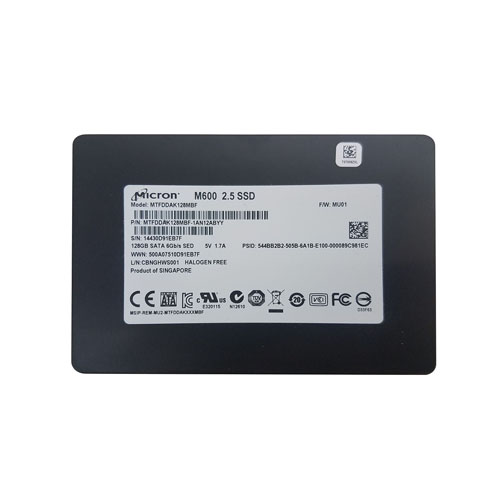
The Micron M600 128GB (MTFDDAK128MBF) is best suited for read-intensive edge caching, embedded boot, and application-acceleration workloads that need enterprise-style consistency from a SATA 6Gb/s drive, pairing 16nm MLC NAND with 0.7 DWPD / 100 TBW endurance in a compact capacity point. Versus typical same-class TLC SATA SSDs, it offers stronger write endurance and more stable mixed-workload behavior while still delivering up to 560/400 MB/s sequential performance and 90,000/88,000 IOPS for fast system responsiveness.
With an endurance rating of 100 TBW and 0.7 DWPD, the MTFDDAK128MBF is well suited for typical boot, OS, and light-to-moderate application workloads, providing ample write capability for everyday enterprise use. In practical terms, for a 128GB system drive handling normal operating system updates, logs, and office or embedded workloads, this endurance level supports long-term deployment and can comfortably serve as a reliable system disk for many years, including up to around 10 years in typical low-write scenarios. For enterprise reliability, the drive includes power-loss protection (PLP), which helps preserve in-flight data and reduces the risk of corruption if power is interrupted unexpectedly. It also features an UBER of 1.0E-15 and an MTBF of 1.5 million hours, indicating a very low uncorrectable bit error rate and strong long-term operational reliability for business-critical environments.
1. The SATA 6Gb/s interface ensures broad compatibility with mainstream enterprise servers and storage arrays, making upgrades straightforward without changing the existing backplane or controller architecture.
2. Its sequential read performance accelerates large-block data access, helping databases, VM image repositories, and backup workloads shorten boot, restore, and file-streaming time.
3. Strong random read capability supports high-concurrency transactional environments, enabling faster response for OLTP databases, virtualization clusters, and read-heavy cloud applications.
4. The endurance profile is well suited to mixed-use enterprise workloads, giving IT teams a practical balance between usable lifespan, replacement planning, and storage cost control.
5. Built with 16nm MLC NAND, the drive offers more predictable sustained performance and stronger write durability than typical TLC-based alternatives in business-critical deployments.
For MPN MTFDDAK128MBF, the closest lower capacity in the same enterprise SSD family is typically 64GB, while the next higher capacity is 256GB. In this series, sequential read/write performance and random IOPS are generally in the same enterprise-class range across these capacities, so the main difference is usable space and cost efficiency. The 128GB version sits at the sweet spot of the lineup. Compared with 64GB, it offers much better headroom for OS images, logs, swap, and application growth, reducing early capacity pressure. Compared with 256GB, it keeps acquisition cost and $/workload more controlled while still delivering similar enterprise SSD performance. This makes it well suited for small to mid-sized clusters, such as boot and utility storage for about 30–50 virtualization hosts or a compact VDI and management platform.
Q: Is MTFDDAK128MBF suitable for a write-heavy database server?
A: MTFDDAK128MBF is better suited to read-intensive or mixed workloads than a write-heavy database server. Its 16nm MLC NAND and PLP help reliability, but 128GB capacity and 100TBW limit sustained heavy writes.
Q: How many full drive writes per day can it actually endure over its warranty period?
A: Based on the 100TBW rating, the drive supports about 781 full drive writes in total for its 128GB capacity. If spread across a 5-year period, that equals roughly 0.43 full writes per day.
Q: Does it include power loss protection (PLP) and why is that critical?
A: Yes, it includes power loss protection. PLP is critical because it helps preserve in-flight data and metadata during sudden power failure, reducing corruption risk and improving storage reliability in server environments.
Q: What RAID level is recommended for this SSD?
A: For business-critical or database applications, RAID 10 is generally recommended for this SSD, as it offers strong redundancy and performance. RAID 1 is also suitable for smaller deployments prioritizing data protection.