











 Secure payments
Standard refund policy
Trade Assurance
Secure payments
Standard refund policy
Trade Assurance
| Brand | Micron |
|---|---|
| Model | 5300 PRO |
| Capacity | 240GB |
| Usage Class | Enterprise |
| Host Interface | SATA |
|---|---|
| Total Interface Bandwidth | 6 Gb/s |
| Form Factor | 2.5-inch |
|---|
| NAND Flash | 96-layer 3D TLC |
|---|---|
| Drive Writes Per Day | 1 |
| Total Bytes Written | 438 TBW |
| Sequential Read | 540 MB/s |
|---|---|
| Sequential Write | 220 MB/s |
| Random Read IOPS | 85000 |
| Random Write IOPS | 24000 |
| Average Latency | 50 μs |
| Mean Time Between Failures | 3 Million Hours |
|---|---|
| Uncorrectable Bit Error Rate | 1.0×10⁻¹⁷ |
| Power Loss Protection | Yes |
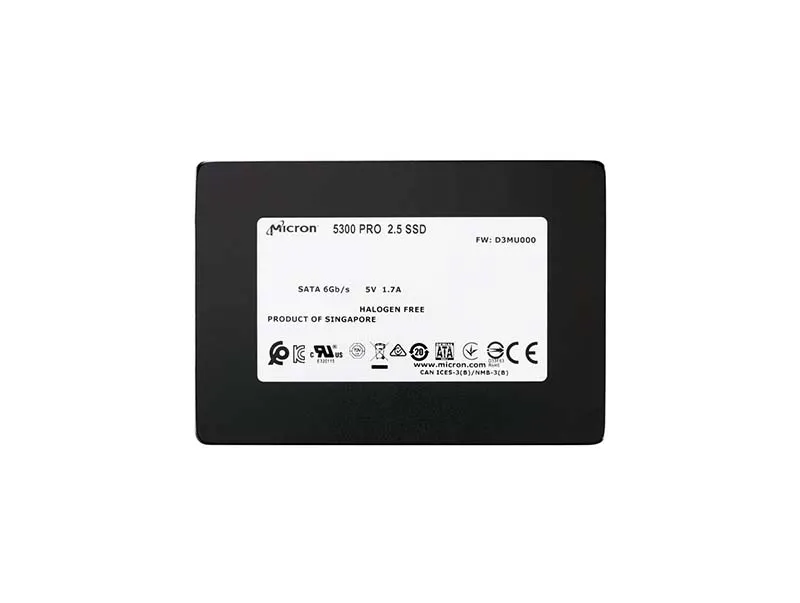
Compared with MTFDDAK240TCB-1AR1ZABYY, the Micron 5300 PRO 240GB advances to 96-layer 3D TLC and delivers up to 540/220 MB/s with 85,000/24,000 IOPS, giving this generation stronger responsiveness for read-centric enterprise SATA deployments. With 1 DWPD and 438 TBW, MTFDDAK240TDS-1AW1ZABYY is a more endurance-focused choice for boot, logging, and light database workloads where predictable SATA performance and longer usable life matter more than raw capacity.
With an endurance rating of 438 TBW, this 240GB SSD can sustain 438 terabytes of total host writes before reaching its rated wear limit, which is more than sufficient for typical OS boot, application, and general business workloads. For example, at 100GB of writes per day, 438 TBW corresponds to about 12 years of use, so in common system-drive scenarios it provides a very comfortable endurance margin. Its enterprise-oriented reliability features further reduce operational risk: power-loss protection (PLP) helps preserve in-flight data and metadata during an unexpected power interruption, minimizing the chance of corruption or incomplete writes. In addition, the 1.0E-17 UBER indicates an extremely low uncorrectable bit error rate, and combined with a 3-million-hour MTBF, it supports dependable long-term deployment in business and data-sensitive environments.
1. The SATA interface makes this drive an easy drop-in upgrade for legacy enterprise servers and storage arrays, enabling dependable performance gains without changing existing backplanes or controller infrastructure.
2. Its top-end sequential read speed helps accelerate boot storms, backup restores, and large file access, making it well suited for read-centric enterprise workloads.
3. Strong random read capability supports fast response under mixed VM, database, and metadata-heavy activity, improving user experience in highly concurrent environments.
4. A 1 DWPD endurance rating provides predictable write durability for always-on business applications that need steady daily data turnover without moving to a higher-cost write-optimized SSD tier.
5. Built with 96-layer 3D TLC NAND and backed by low typical latency, the drive balances cost efficiency, flash density, and responsive access times for mainstream enterprise deployments.
lower_capacity: 120GB higher_capacity: 480GB The 240GB model sits at the sweet spot in this SSD family. Compared with the 120GB version, it provides much better headroom for OS images, logs, metadata, and application growth, reducing the risk of early capacity pressure in enterprise environments. Compared with the 480GB option, it preserves nearly the same class of sequential throughput and random IOPS while offering a more attractive cost profile and lower overprovisioning burden per node. This makes it especially well suited for small to mid-sized virtualization clusters, edge servers, or compact database and boot-storage tiers.
Q: Is MTFDDAK240TDS-1AW1ZABYY suitable for a write-heavy database server?
A: Yes, it can support write-intensive database workloads thanks to its 1 DWPD endurance, 438 TBW rating, 96-layer 3D TLC NAND, and PLP. For extremely heavy writes, higher-endurance models may be preferable.
Q: How many full drive writes per day can it actually endure over its warranty period?
A: This model is rated for 1 DWPD, meaning it can sustain one full 240GB drive write per day throughout its warranty period, consistent with its total endurance rating of 438 TBW.
Q: Does it include power loss protection (PLP) and why is that critical?
A: Yes, it includes power loss protection. PLP helps preserve in-flight data and metadata during unexpected power interruptions, reducing corruption risk and improving reliability in enterprise and database environments.
Q: What RAID level is recommended for this SSD?
A: RAID 1, RAID 10, or RAID 5/6 may be selected depending on performance, redundancy, and capacity needs. For database workloads, RAID 10 is commonly recommended for balanced speed and fault tolerance.