











 Secure payments
Standard refund policy
Trade Assurance
Secure payments
Standard refund policy
Trade Assurance
| Brand | Micron |
|---|---|
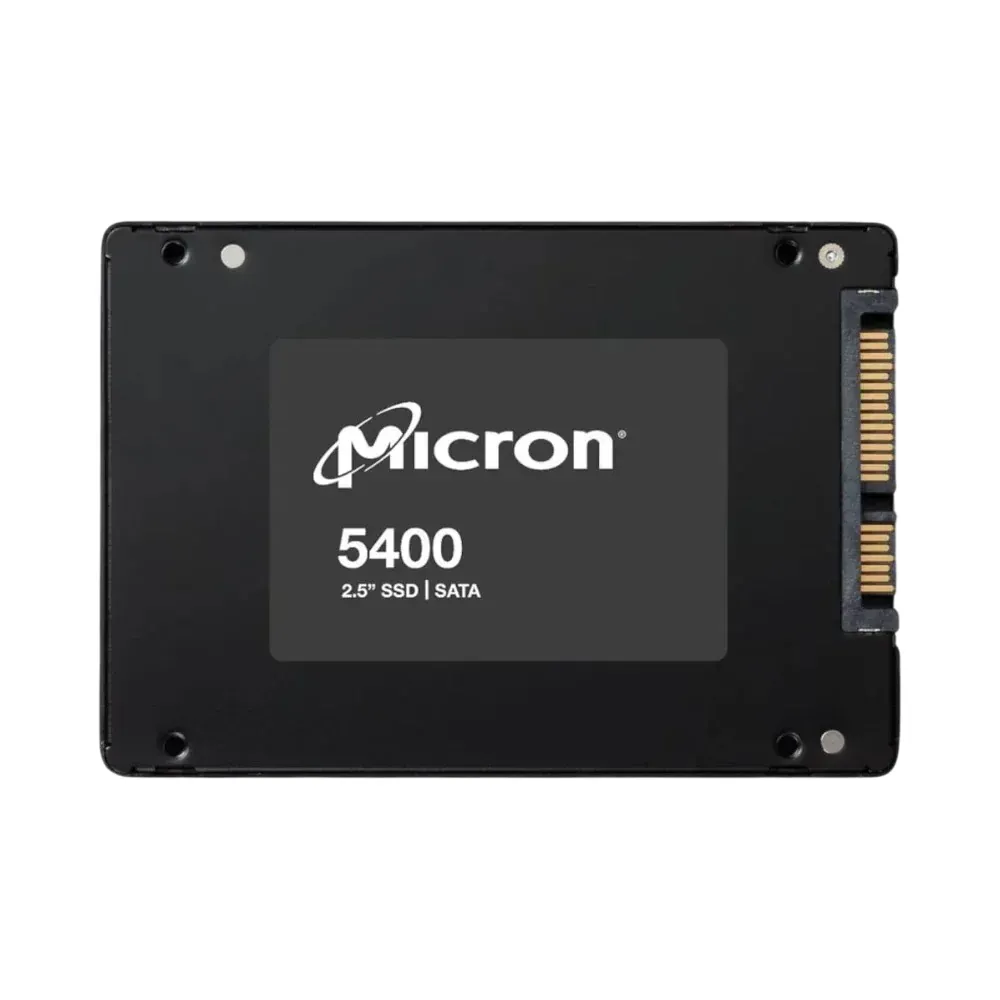
| Model | 5400 MAX |
| Capacity | 3840GB |
| Usage Class | Enterprise |
| Host Interface | SATA III |
|---|---|
| Total Interface Bandwidth | 6 Gb/s |
| Form Factor | 2.5" |
|---|
| NAND Flash | 3D TLC |
|---|---|
| Drive Writes Per Day | 3.4 |
| Total Bytes Written | 23827 TBW |
| Sequential Read | 540 MB/s |
|---|---|
| Sequential Write | 520 MB/s |
| Random Read IOPS | 95000 |
| Random Write IOPS | 34000 |
| Average Latency | 170 μs |
| Mean Time Between Failures | 3 Million Hours |
|---|---|
| Uncorrectable Bit Error Rate | 1.0×10⁻¹⁷ |
| Power Loss Protection | Yes |
The Micron 5400 MAX 3.84TB is purpose-built for write-intensive virtualization, OLTP database, and log-heavy mixed-workload servers that need enterprise SATA compatibility without sacrificing endurance, delivering 3.4 DWPD and 23,827 TBW on durable 3D TLC NAND. Compared with typical read-centric SATA SSDs in the same class, it pairs top-tier 540/520 MB/s throughput with 95K/34K random IOPS to provide substantially higher sustained write headroom and a longer usable service life in always-on datacenter deployments.
With an endurance rating of 23,827 TBW and 3.4 DWPD, the MTFDDAK3T8TGB-1BC16TAYY is built to sustain very heavy daily write activity over its service life, making it well suited for write-intensive enterprise workloads. In typical deployment scenarios, this level of endurance means it can serve reliably for many years as a system, cache, or mixed-use data drive without endurance becoming a practical concern. For enterprise reliability, the drive includes Power Loss Protection (PLP), which helps preserve in-flight data and protects metadata integrity during unexpected power interruptions. Its UBER of 1.0E-17 indicates an extremely low probability of unrecoverable bit errors, supporting high data integrity and dependable operation in business-critical environments.
1. The SATA III interface, paired with 540 MB/s sequential read performance, provides a drop-in upgrade for mainstream enterprise servers and storage arrays, accelerating bulk data access without requiring a PCIe infrastructure refresh.
2. With 95,000 K IOPS random read capability, the drive can sustain highly responsive performance for virtualization, OLTP databases, and metadata-heavy workloads where small-block access dominates.
3. A typical latency of 170 µs helps reduce storage wait time, improving application responsiveness and delivering more predictable QoS in multi-tenant enterprise environments.
4. Rated for 3.4 DWPD, this SSD is built for write-intensive enterprise use cases such as logging, caching, and mixed transactional workloads, supporting heavy daily overwrite cycles with confidence.
5. Its 3D TLC NAND architecture balances capacity, performance, and endurance, making it a cost-efficient choice for data centers that need enterprise reliability at scale.
For MPN MTFDDAK3T8TGB-1BC16TAYY, the nearest lower capacity in the same series is 1.92TB, and the nearest higher capacity is 7.68TB. In this lineup, 3.84TB is the sweet-spot capacity: it offers materially more headroom than 1.92TB for growth, cache expansion, and denser consolidation, while keeping essentially the same enterprise-class sequential throughput and random IOPS profile. Compared with 7.68TB, it delivers a more balanced cost-per-drive, lower budget exposure, and easier scaling flexibility. It is especially well suited for mid-size virtualization clusters, such as hosting OS and application volumes for about 40–60 mixed-workload virtual machines.
Q: Is MTFDDAK3T8TGB-1BC16TAYY suitable for a write-heavy database server?
A: Yes. With 3.4 DWPD, 23,827 TBW, 3D TLC NAND, and 170 µs typical latency, this 3.84TB SATA SSD is well suited for write-intensive database and enterprise server workloads.
Q: How many full drive writes per day can it actually endure over its warranty period?
A: It is rated for 3.4 full drive writes per day. For a 3.84TB drive, that equals about 13.1TB of writes daily across the official warranty period under normal conditions.
Q: Does it include power loss protection (PLP) and why is that critical?
A: Yes, it includes power loss protection. PLP helps preserve in-flight data and metadata during sudden outages, reducing corruption risk and improving reliability for databases, virtualization, and transactional applications.
Q: What RAID level is recommended for this SSD?
A: For most enterprise deployments, RAID 10 is recommended because it balances performance, redundancy, and rebuild safety. RAID 1 suits smaller systems, while RAID 5/6 fits capacity-focused environments.